Wednesday, July 18, 2012

RAPTOR IN A LAB COAT!!!!

Yeah, it's been a while.

When I logged into the Junction - for the first time since April - to write this post, I scanned through the last few things I wrote. Unrealized promises of Moebius tributes, Chronicle reviews, all sorts of things I was never going to follow through with. Looks like somebody isn't very motivated! So it's nice when something riles me up enough to actually commit to writing about it. Like the Lizard.

You see, the Lizard - monstrous alter-ego of Dr. Curt Connors - is my favorite Spidey villain, probably because growing up Jurassic Park was my favorite movie. That scene where the two kids are locked in the kitchen, being stalked by those fucking velociraptors... that's the stuff night-lights were made for. And what's the Lizard but a goddamn super-raptor in a lab coat? The appeal is undeniable.

But you wouldn't know that if, like most people, your only exposure to the character was The Amazing Spider-Man. In regards to the movie itself, there's not a whole lot to write about: it's inferior to the Raimi version, but I still enjoyed it. Most folks seem to feel the same way. Poor Doc Connors (does anything ever go right for him?) was hit worst by the film's script, reducing one of the most complex figures in the mythos to a goofy mad scientist. And as for its version of the Lizard himself... well odds are you're already familiar with the discourse. The less said about the design, the bet--FOR GOD'S SAKE IT BELONGS IN THE MUSICA--

Sorry, these things just slip out. Ahem.

Normally I reserve these posts for Spidey villains struggling for greater resonance - guys like Mysterio, Electro, Sandman, Carnage, the Green Goblin. I didn't see any reason to tackle the Doc Ocks and Venoms and Lizards, the baddies who routinely reach their full potential. There's no reason to delve any deeper, I thought; they can't possibly be done wrong unless that's the intention from the start.

Oh, how I was wrong. So, so wrong. Now let's set the record straight for one of Spider-Man's greatest foes.

Exhibit A: velociraptor in a lab coat
Perhaps the most glaring change to Connors' story in The Amazing Spider-Man is that he's not a family man. In the comics he's been a kind, loving husband and father since his debut in '63... or was until Martha and young Billy were both killed off in recent years. They'll be back sooner or later - these are comic books we're talking about, after all. But it's baffling to me that The Amazing Spider-Man, with all its emphasis on "The Untold Story" of Peter's absent parents, would opt not to include the thematic mirror of Connors' happy, healthy nuclear family. The mere presence of a doting wife and son adds so much depth to Connors; in the same way that Peter chooses to hurt the ones he loves by being Spider-Man - and that it pains him to make that choice - so too does Connors consider both his own and his family's well-being as he stares into that loaded syringe. At least Peter has the satisfaction of being a superhero, which in itself somewhat mitigates the tragedies it causes his personal life. Connors risks it all on that formula and loses, leaving his entire world devastated.

Then, of course, there's his personal connection to Peter Parker, which is what really cinches it for me. Curt is not just a close friend of Peter's but a mentor to him as well. Not an idol by any stretch - that kind of thing always complicates relationships - but certainly someone Peter respects and looks up to, just as Curt is proud of and often amazed by Peter. In many ways Curt is the perfect father figure for Peter, the one Peter's been yearning for ever since Uncle Ben died; at the very least he's a better option than the creepy guy with the bowl cut and tentacle arms or that weirdo with horizontal cornrows.

So compared to most of the wall-crawler's enemies, the emotional investment is much higher in fights between Spider-Man and the Lizard: the stakes are always acutely personal. For Peter to see all that warmth and intelligence, the Curt Connors he jokes with, he admires, to witness that all erode away into animalistic madness must hit home in a painful way. It's Alzheimer's - the loss of mental capacity and everything else that makes you you - as the Dragon, complete with scales and fangs and snout and tail. Curt's body goes the way of his mind in these horrible transformations, warping and contorting into this evil hissing serpent, this primal thing... this motherfucking raptor in a lab coat trying to chomp your head off. I can't imagine what it would be like to experience that happening to someone I cared about; Peter has to every time he fights the Lizard (just as Harry does, to an extent, every time his pop goes bonkers). I've been told there was a scene cut from The Amazing Spider-Man where Peter confronts the Lizard, desperately pleading to the rampaging monster as tears stream down his face: "STOP, DR. CONNORS! THIS ISN'T YOU! THIS ISN'T YOU!" As essential as that moment is in any Lizard story, I'm glad they scrapped it. The movie doesn't do enough justice to their relationship for that to have rung true.

There's such a fantastic thing going on between our web-slinger and the Lizard, a conflict that gets at a big part of what Spider-Man is all about. Barring all that icky Oedipal stuff, one of the foundational questions in Spidey's mythology is: "How do you confront those you're supposed to look up to? How do you resolve the influences - and absences - of your elders? How do you reconcile the circumstances of your upbringing so you can finally be you? And how do you do all that without hurting the people you love?" It's Growing Up, 101: Now with Great Responsibility!
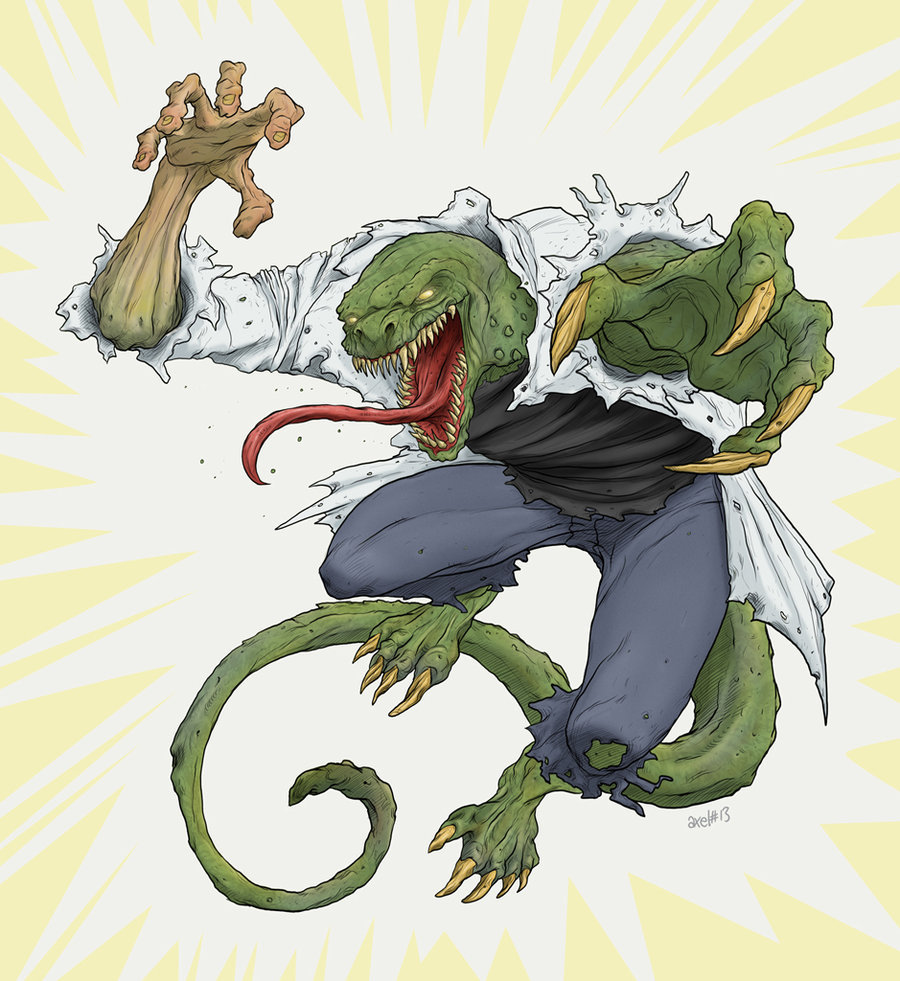
Exhibit B: velociraptor in a lab coat
 But let's take a couple steps back now and refocus on Connors the person. His relationship with his family and with Peter articulates a fundamental personality trait: he is just the nicest guy. Perhaps he's even a better man than Peter (it's funny how the new movie got his snark down but largely missed his heart, while the Raimi movies were the other way around. That perfect cocktail of Peter Parker still eludes the big screen). Beyond being the most likeable guy on campus, remember that Connors lost his arm while he was an army medic on the front lines; people don't get much more selfless than that. In the original 60s comics, that conflict happened in World War II, the only "good war" (see America, Captain). And as far as things to dedicate your life to go, regenerative biology is a pretty upstanding cause.

Which makes the misfortune that befalls him - damning him and his loved ones to a life of ruin - all the more tragic. You can't fault the poor bastard for wanting his arm back, that's not exactly selfish of him. I can see Connors waking up screaming night after night, drenched in sweat, having relived every traumatic experience from the war. The shrapnel-disfigured bodies writhing all around him. The moans of the men and women he couldn't save. The blast that ripped his arm away by the grisly tendons. "If I can get it back, maybe the nightmares will stop," he thinks.

Yeah, if you think Peter lives an unlucky life - and believe me, he does, he really does - look no further than Curt Connors. What's happened to him, it's just... it's just not fair, y'know? It's not fucking fair!

This stuff shouldn't happen to someone as good as Curt Connors. I mean Christ, how come Peter gets a six pack and pecs from being bitten by radioactive spider while Curt's accident, no more absurd or out-there, turns him into a velociraptor in a lab coat? Or worse, a goddamn goomba?

And that's the whole point, isn't it? The unfairness of an indifferent world, and how people respond to it, is a cornerstone of Spider-Man's mythology. It doesn't matter if you can't make rent or if your aunt is in the hospital (again) or if your girlfriend snapped her fucking neck falling off a bridge, life will just keep heaping on the shit. Spider-Man is ultimately inspiring because somehow he deals with it all, he chooses to persevere in the face of seemingly insurmountable odds. But of all the characters in the mythos, it's Connors who draws the shortest stick. The Lizard is an uncaring world's cruel ace in the hole - how can Curt possibly endure when half the time he's not even in control? He can't choose to persevere like Spidey does because he doesn't have choice anymore. He forfeited that privilege.

Exhibit C: velociraptor in a lab coat
Which brings us to the big difference between Curt and Peter: one of them made a choice, one of them didn't. One learned to live with the hand chance dealt him while the other tried to cheat out of it. Connors must have known he was playing with fire when he brewed that first batch of formula. Which is not to say he deserved what happened - he didn't - but simply that he weighed his options and, in a moment of weakness, made a conscious decision to take the risk. He should have known better; one of the most prevalent morals in science fiction, and one that deeply informs the Spider-Man mythology, is that you can't play God. Or else.

It's one thing to build a career on the controversial end of the biology - stem cell research, molecular cloning, all that stuff. But for a person to experiment on himself, to defy the laws of nature in such a reckless, arrogantly disrespectful way, that requires a mentality that forgoes scientific ethics. All it takes is one single, fleeting moment where rational thought gives way to overwhelming emotion... clearly we were never meant to have the power Connors sought. The tragedy is that, unlike most of the power-mongers littering web-head's rogues gallery, Connors was and still is a man of great responsibility. He just slipped, just once.

That's all it takes.

Okay! So we've got Curt Connors down, now what about that velociraptor in a lab coat? The... well, lizard part of the Lizard. First thing that comes to my mind is the enormous aesthetic appeal of his (its?) design: he's a goddamn super-raptor in a lab coat, that's cool as shit no matter how you play it. Unless you're on the design team of The Amazing Spider-Man.

So what's this thing all about? Historically, the Lizard's goal has been to overthrow human civilization and replace it with a society of reptiles, with himself as their leader. Or something. I understand where the idea is coming from, and it's a good one - the natural world striking back against its scientifically-minded, technologically-dependent exploiters - but let's be real here, lizard planet is fucking hokey. The movie's take, along the same lines, wasn't particularly compelling either. But there's something much more satisfying at work here, just underneath the surface. There's oil in them hills!

Exhibit D: something no one will ever dress up as ever
A couple years ago there was an over-arching series in the Spidey comics called "The Gauntlet," which sought to reinvent some of the classic rogues in ways that speak to what they're all about. The Lizard story, "Shed," featured a new spin on one of his trademark powers - telepathic control over reptiles - that set the villain firmly in the right direction. The ability was reworked so that it affects the primitive, instinct-driven structures in the brain, inciting creatures to act on their most primal urges. The Lizard can completely hijack the minds of lesser organisms like reptiles; in us complex human folk, the Lizard's power brings out our wild side, forcing us to succumb to our ids just like Connors does. (The comic says it affects the amygdala, which controls emotional reactions, unconscious responses to fear such as flight-or-fight, sexual arousal and hormone secretion; it should really be the basal ganglia, responsible for instinctual behaviors involved in aggression, dominance, territoriality, and ritual displays. It's even called the "reptilian complex." But, like, whatever.)

That's the Lizard I want to see, the one beyond all that dumb world of reptilessss stuff. To me, he's always been a glaring symbol of destructive, uncontrolled irrationality - the very image of a raptor in a lab coat defies reason in a way few other character visuals match. The Lizard is a primal totem of pure id; like the Vulture, he represents the degeneration of reason as mind and body give way to the grotesque whims of nature. Except now he can do that to you, too! If you think the Lizard is a handful in a brawl, imagine confronting him inside your head: his tongue lashing against your brain, beckoning you to give in to your basest instincts, hissing ancient chants as the last shreds of human intellect fade away. The Lizard isn't mindless - in fact he's extremely cunning - but he might as well be. You can't negotiate with rabies... especially if you're just another animal.

In my mind, he's one of the only comic book villains to give the Joker a run for his money as avatar of chaos. Mankind has always associated chaos with nature (how many stories have weird things happening in forests?) and serpents in particular; it's no different with the Lizard. The fact that he's routinely pitted against a technological wunderkind makes that dynamic all the more delicious. There's so much archetypal power behind the Lizard and his visual design - like those raptors menacing Lex and Tim in Jurassic Park, it speaks to something primordial. Something chthonic.

The stuff night-lights were made for.


Did I mention he's a fucking velociraptor in a lab coat?


Tuesday, April 3, 2012

King of Komics, Part II: A Whole New (Fourth) World

Hey guys, remember back in, like, the beginning of December when I said I was gonna do a series of posts about how Jack Kirby pretty much single-handedly shaped how we view the DC and Marvel Universes? Remember how I wrote the Marvel portion of that series, and then another Marvel portion of that series, and then said I would write the DC portion soon afterward? Remember how it's now April and I still haven't gotten around to that? Well all that changes now!

So as I've theorized previously, the thematic purpose supervillains serve in comics is to contextualize the superhero -- by mirroring, opposing or inverting what qualities or ideas the hero personifies, villains shed light on what exactly their rival is supposed to represent. So when a single villain becomes a collective threat every individual superhero unites against - one that crosses-over each individual hero's mythology within the larger continuity - this "final boss" contextualizes the mythology of that entire comic book universe. At Marvel, that villain is Lee/Kirby's planet-eater Galactus; his brand of antagonism makes apparent the greater thematic symbolism of the MU. In the DCU, that role is occupied by another Kirby creation, a very different beast.


(Click for a larger image)

DIE! DIE! DIE FOR DARKSEID!

Darkseid (as in "Dark Side", subtle I know) first appeared in Superman's Pal, Jimmy Olsen #134, cover-dated November 1970 -- four years after Galactus' debut. The evil overlord was one of Kirby's first creations for DC after he left Marvel under less-than-amiable terms, and served as the main antagonist of Kirby's Fourth World saga, a colossal and groundbreaking meta-series which has since become a cornerstones of the collective DC mythos. Time and time again Darkseid has attempted to enslave the universe, only to be defeated by a last-minute Hail Mary from a union of the world's greatest heroes. Of course there have been plenty of other villains that sentence could apply to, but there's always been something special, something greater about the Lord of Apokolips (yes, he rules a planet named Apokolips), largely do to the intrinsic characteristics Kirby imbued him with. Whether menacing the New Gods, the Legion of Super-Heroes or the Justice League, Darkseid has long been the DCU's number one baddie. He is perhaps the greatest archetypal character in all comics (except Superman - why else do they always find themselves fighting one another?), and is certainly the greatest archetypal villain. Don't get me wrong, Doctor Doom is beyond awesome, but even his megalomaniac posturing can't match the grandiosity Darkseid brings to the table. It's a matter of scale. And metonymy.

Darkseid is not just unambiguously, unrelentingly evil on a grand scale, he is evil itself - not in the trite way of the Saturday morning cartoon vice figure but, as described in Final Crisis, the Platonic ideal of evil given flesh and blood and brought into the physical world. It helps that Darkseid brilliantly avoids the trap vice figures often fall into: the "evil" they represent being undefined, an empty buzzword blindly hinting at some general violation of Judeo-Christian morality or opposition against Platonic good. In Kirby's original Fourth World saga, Darkseid is specifically characterized as the personification of fascism - the absence of choice, the elimination of free will by way of domination, control, enslavement...whatever noun resonates best for you. God I am the worst at this writing thing. Anyway he, as Tim O'Neil states, "isn't a tragically flawed Doctor Doom or an abstract force of nature like Galactus: rather, he is a living embodiment of a very human tendency towards obedience and power." What makes Darkseid so affecting is how this apotheosis is characterized; not only do we see in him a primal, unrelenting authoritarian drive, but also an undeniable clarity of mind in his quest to achieve that total power. Marc Singer writes of the villain:

"...Darkseid is a more mature, more psychologically stable, and therefore far more threatening figure:  imagine a Hitler who's both physically intimidating and not the slightest bit insane. Darkseid is what Hitler wanted to be, the visions he sold to himself in his sleep made real... It's an old chestnut that the greatest villains--Magneto, Doom, Luthor... don't think they're villains, even see themselves as the heroes of their own stories. Darkseid is all the more chilling for knowing exactly what he is and what he's doing, and not feeling the slightest remorse."


Following in Kirby's footsteps, Paul Levitz was the first to associate the cosmic dictator with the qualities of darkness, paving the way for his (however blatantly) implied status as the God of Evil to become an official title. Darkness, after all, is the absence of light - humanity's preeminent metaphor for enlightenment and all things spiritual, sacred and divine. Grant Morrison, one of the few true Kirby disciples, placed this trait within the cosmic-oriented framework characteristic of Jack Kirby's work: Darkseid as the void, the empty black singularity from which not even light can escape. The darkness that pervades the entire universe, exists deep within us all (again, 'cept Superman) and will inevitably control us. The dreaded finality of existence - symbolized by Darkseid's Omega-themed armaments - which utterly transcends interpretation or definition. The single best description of Darkseid comes from his own mouth in JLA: Rock of Ages --


Kirby wasn't the first to understand that superheroes and villains function best as symbols, but he was the first to fully take advantage of it. Under his pen their monthly brawls became titanic philosophical debates between opposing ideas, with magic rings and repulsor rays in place of rhetoric. As the God of Evil, Darkseid benefits from this metonymy being literal, the embodiment being explicit in the text itself. Where Galactus is the cosmic indifference of the universe - humanity's predilection toward complacency and social apathy - in Darkseid we have a grandly iconic rendering of totalitarian wickedness, one of truly mythic proportions. The conflict against him is the ol' battle of "good" versus "evil" on a Biblical scale --who would want it any other way?

And that's the big difference between DC and Marvel, isn't it? It's often said that Marvel heroes have historically been the more fully-realized in terms of character. They're people with distinct, relatable personalities, everymen burdened with "real-life" problems and baggage. They live in New York, not in fictional cities like Gotham or Metropolis. No matter how cosmic, mystic or esoterically cross-dimensional the stories get, they always seem - or at least strive - to take place in "the real world" because we can so closely identify with the characters. The idea was revolutionary when Marvel first introduced it in the 60s, and much of the company's success to this day should be attributed to this innovation.

DC Comics has grown to take another approach in its publications, one that understanding Darkseid and his role within them enables us to define. Whereas Marvel brings their superheroes down-to-earth, DC raises them up. Their comics approach heroes and villains primarily as archetypes, representations of something greater, more heightened than the everyman. They are symbols, and their own symbols take on great iconographic importance within the stories themselves. Of course we're supposed to identify with the characters, but beyond that we're supposed to be inspired by them and aspire to be like them. As always, writers will often subvert the standard - a la the post-Killing Joke Batman of the 90s - but these interpretations are effective precisely because the standard is so ingrained in fundamental mythos of the DCU.

DC's editorial seems acutely aware that their characters are icons in a way that most Marvel characters aren't, and their comics much more consciously attempt to replicate the structure and qualities of myths. So it makes sense that the thematic fabric holding the DCU together is the archetypal conflict between good and evil, which finds its origins in classical mythology and, later, the foundational Judeo-Christian literature. In other words, where Marvel is all about morality against amorality, DC stories deal with morality against immorality. It's Beowulf vs. the Dragon with these guys. Advancement against destruction. Compassion against malice. Democracy against fascism. Freedom against slavery.

What's so funny about truth, justice and the American way?

Especially if it saves you from this guy?


Saturday, March 10, 2012

Moebius has passed.

One of my biggest faults as a writer is my predilection for hyperbole. This is especially true when I write about the comics medium: the inherent BAM! POW! conventions of its most prominent genre all but beckon me to exaggerate.

That being said, I am in no way in overstating things when I write that today one of the most influential visionaries in the history of sequential art, and perhaps the greatest cartoonist of all time, has left us.

Jean Giraud is dead at 73. The foremost among a number of legends to pass away in the span of a scant few months, Moebius' passing will undoubtedly turn the comics world on its head - not since Eisner's death in 2005 has such a titanic figure died. Prooker, who is far more knowledgeable than I in all thing Moebius, will soon begin working on a larger retrospective - truly an enormous undertaking. I wish I could articulate my ideas of the artist and his brilliant body of work, but for now my efforts are fruitless. Moebius' illustrations leave me in a sublime awe, and now I find his passing has left me in the same state. Rest in peace, Jean Giraud.

1938-2012


Sunday, February 5, 2012

THAT TIME OF YEAR! (part 2)

Alright errbody, with the SAG Awards behind us and the Oscars looming, it's time for me to unveil my picks for the 10 best movies of 2011. They've changed a lot from the top 10 list I made a couple weeks ago, which can be attributed to the maelstrom of films I saw between then and now. God bless student discounts.

1. Drive


I don't want to fawn over Drive more than I already have - I practically wrote a goddamn research paper on it here last October - so I'll just say of course the Academy overlooked this film. It was far too innovative, too visionary, too ambitious and gory and polarizing and dynamic a movie for such a bureaucratic, squeamishly pandering organization to acknowledge. The Eberts and Travers' and yous and I's, of course, we know better. And if we're anything like the Driver, we should be content: simply knowing the truth and keeping on will be enough to cement Drive's standing among the greatest films.
 ...and a reeeaaaaaal heeero, reeeaaaaal huuuman being...

2. The Artist


What can I say about The Artist that hasn't been said - or seen - already? Every aspect of its production, from its direction to its cinematography to the impeccable acting of its players (even Uggie the dog!) fully utilizes and embraces the tenets of silent cinema, taking what could have been a flimsy gimmick and turning into something truly spellbinding. The heartwarming, inconspicuously profound wonder is a near perfect love letter to the black-and-white and silent films of yesteryear. Hell, it's a near perfect black-and-white and silent film. Double hell, it's a near perfect film, period. There's a reason it's widely predicted to sweep the Oscars. So what the triple hell are you waiting for, go see this movie now!

3. Take Shelter


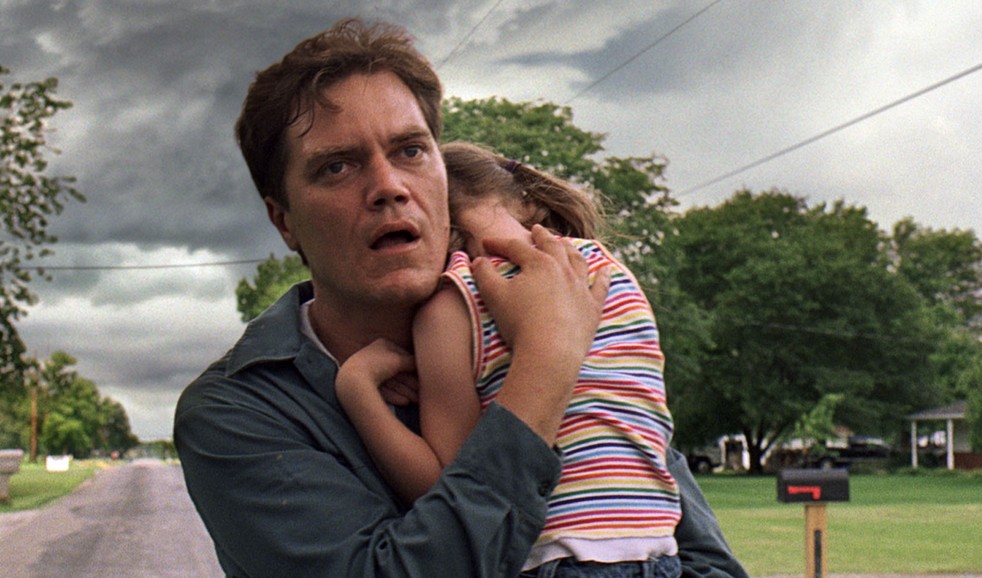
Perhaps the most upsetting thing about 2011's film season is that Take Shelter, the Critics' Week Grand Prix winner at Cannes last May, failed to get the attention it so deserved. Despite receiving near-universal - and enthusiastic! - critical acclaim, a limited release killed its chances of gaining wider recognition. It's a damn shame, too, because Take Shelter is a heart-wrenching triumph of cinematic suspense. Much of its success lies in the brilliant vision of writer-director Jeff Nichols, and the technical precision with which he realizes it. What really drives the film, however, are the two powerhouse performances from Jessica Chastain and especially Michael Shannon (more deserving of the Oscar than any of the nominees), who together create an unforgettable, utterly flooring drama.

4. Midnight in Paris


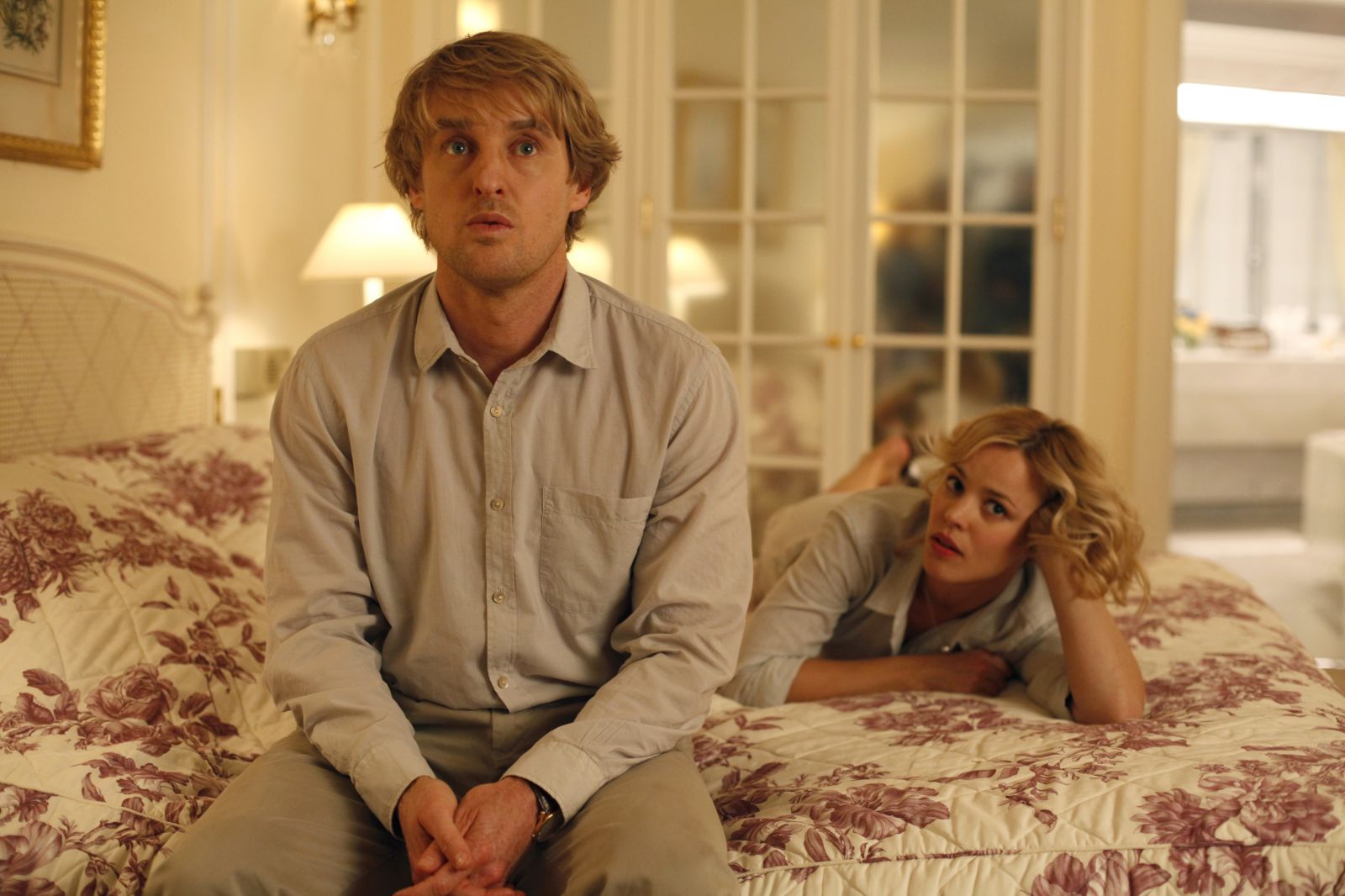
Would it be blasphemy to call Midnight in Paris the best Woody Allen film since Manhattan, or even Annie Hall? Wearing it's fantastical, unabashedly sentimental heart on its sleeve, the movie revels in an enthusiastic abundance of charm, sweetness, wit and intelligence. More than a wet dream for American lit majors, a romance with Francophilia or a love letter to the Roaring Twenties, Midnight in Paris is a thoroughly satisfying meditation on the nature of art itself. It's a manifesto for here, for in the moment, and it thinks forward with a genuine optimism refreshingly uncharacteristic of Allen's work. Owen Wilson channels the neurotic film legend perfectly as Gil Pender, and the rest of the cast - among them figures as diverse as Hemingway (an amazing Corey Stoll) and Dalí - never disappoint.

5. Hugo


I wonder what the executives at Paramount were thinking when Martin Scorsese pitched directing a 3D family film. Did they expect him to make as delightful and exotic - and meta, of all things - a movie as Hugo turned out to be? Like its chief rival at this year's Oscars, Hugo is at once an affecting, heartwarming story, a tribute to the silent era and a testament to the importance of cinema in general. Scorsese imbues his unique genius into both the form and content of the film, creating a self-aware viewing experience we rarely see at the movies; "magical" is the best way I've heard it described. Boasting a remarkable cast and featuring exceptional use of today's film technology (CGI and 3D that actually serve a purpose!), Hugo is a treat that merits multiple viewings.

6. Moneyball


Simply put, Moneyball is a masterful piece of film-making: well-written, made with superb technical craftsmanship, and loaded with heartfelt acting (perhaps Brad Pitt's greatest showing ever). It's a pretty uninspiring inspirational story in the grand scheme of things - the A's lose the first game of postseason and the Red Sox win it all two years later, even without our protagonist as their GM - but it's not a movie about the big picture. Quite the contrary, it's a film where two freethinking visionaries refuse to surrender to - and indeed, defeat - an archaic system, one dominated by outdated, all-or-nothing dogmas such as that of the "big picture." Moneyball is all about the small victories: how they're often the most important ones, how they're often the biggest game-changers of all.

7. Shame


Like the emotion itself, Shame is a melancholy, chilling, bleak, brutal - at times even unbearable - film, with an awe-inspiring Michael Fassbender at its core. It is a truly beautiful movie about a world of unrelenting ugliness. Fassbender's performance is nothing short of brilliant: raw, riveting, wholly immersed. It's the most fully-realized character I've seen onscreen since that mad oilman declared he would drink our milkshakes back in '07. Fassbender's career has just started to rise (hurr durr), and for my money he's the single most talented film actor to come along in years. And of course there's the phenomenal Carey Mulligan, herself a rising star, who's tragic, haunting rendition of New York, New York will send shivers down your spine. It - and the entire film - will affect you to your very marrow.

8. The Adventures of Tintin


What makes Tintin such a resounding success - even more so than how it faithfully captures the essence of Hergé's timeless, beloved comics series - is that in it, for the first time ever, we find Stephen Spielberg truly and completely unconfined by the restraints of reality. Putting on those 3-D glasses as the movie starts takes you down the rabbit hole in a way Avatar could only scratch the surface of. The Adventures of Tintin is a syringe filled with the pure, distilled imagination of the most creative minds in blockbuster film-making (Spielberg! Jackson! Moffat! Wright! Cornish!) and it's begging you to shoot up. Either you can resist it or dive in head first and enjoy one hell of a ride - one that would even make the Vulture relive his inner child.
Also Andy Serkis is Captain Haddock. So yeah.

9. Tinker Tailor Soldier Spy


Boasting easily the best ensemble cast of 2011 (The Help, eat your heart out), TTSS is an astounding adaptation of John le Carré's sweeping spy thriller. Each actor brings a powerhouse performance to his role; no one part overshadows the others. Oldman's subdued George Smiley is mesmerizing, conveying a world of thoughts, of plans and counter-plans and suspicions and suppressed emotions in the glint of a weary eye. It sets the tone for the muted world of Tinker Tailor: an engine of suspense ready to blow, a twisting spiral of paranoia that drives anything it can latch onto - audience included - into the abyss. Director Tomas Alfredson has stripped away all romanticism from the world of intrigue and espionage, leaving a bleak reality where the answers are hidden from us in plain sight.

10. The Tree of Life


Terrence Malick's experimental magnum opus should rightly be polarizing. To say The Tree of Life is difficult to grasp is like saying a 747 is fast. Perhaps it resorts to the occasional existential platitude or empty l'art pour l'art trapping. Perhaps it feels too damn long. But these faults are unavoidable in a film that addresses the puzzle of human nature head-on, that attempts to portray the entirety of all existence through the lens of a single family. This truly one-of-a-kind film never stops striving; the sheer ambition of Malick's creative vision, presented with the utmost technical and artistic mastery, secures The Tree of Life's place among cinema's finest. Even when this film fails, it succeeds. Like with 2001: A Space Odyssey, I think time will treat The Tree of Life favorably. Appropriate, isn't it?


Four outstanding films that made my first top 10 list sadly had to get the boot: Martha Marcy May Marlene, Melancholia, Super 8, and Rise of the Planet of the Apes. Other noteworthy movies from this year include 50/50, Attack the Block, Bridesmaids, Coriolanus, The Descendants (wildly overrated though it may be), Margin Call, Mission Impossible: Ghost Protocol, The Muppets, and Win Win.

Tuesday, January 17, 2012

Monday, January 16, 2012

BUSYBUSYBUSYBUSY

For the next 2-3 weeks I'm going to be super super busy, so updates will be sparse. But when I come back it'll be with a bang! Got a lot of stuff planned - part two (three? two-and-a-half?) of my Kirby retrospective, analyses of the Lizard and Bane, a review of Chronicle by my good friend Dom, and a secret project we're both working on. Stay tuned guys!

Sunday, January 8, 2012

THAT TIME OF THE YEAR! (part 1)

Just got back from The Artist with prooker; inevitably it got us thinking about our top 10 films of 2011. Before I dive in I should probably mention that I haven't seen most of the Oscar bait movies this season (yet), including Moneyball, War Horse, The Descendants, The Ides of March, Midnight in Paris, My Week with Marilyn, Shame, The Skin I Live In, Certified Copy, Beginners, A Separation, Margin Call, A Dangerous Method, Tinker Tailor Soldier Spy, or The Help. I'm working on the latter three - I'll probably see A Dangerous Method and TTSS with prooker, and even though I have no interest in seeing The Help whatsoever I got a free DVD of it.

Also I really wanna see Attack the Block. Just sayin...

And without further ado, here are my picks:

1. Drive
2. The Artist
3. Take Shelter
4. Hugo
5. The Adventures of Tintin
6. The Tree of Life
7. Martha Marcy May Marlene
8. Melancholia
9. Super 8
10. Rise of the Planet of the Apes


I bet this list will be very different once I've seen the films I mentioned in the beginning; at the very least I'm sure the bottom five will have changed significantly. Nothing's dethroning Drive, though. Nothing.

UPDATE 1/23: In the past two weeks I've seen The Help (dreadful), The Descendants (actually decent), Moneyball (great), Attack the Block (swag as hell) and Tinker Tailor Soldier Spy (spectacular). I'm seeing Shame this weekend and will likely get around to Midnight in Paris too via iTunes; after that I'm probably going to have to call it quits. I'll write up my completed top 10 list then, with brief explanations for each pick. Since I was underwhelmed by The Descendants, the likeliest best picture winner after The Artist and maybe Hugo - is it really Oscar-worthy or has this just been a mediocre year, a la 2008? - I'm assuming the less-favored of the big contenders (Ides, War Horse, Beginners et. al) will inspire the same reaction. Still upset that I didn't get around to Marilyn, The Skin I Live In and A Dangerous Method, though. :(

Saturday, December 24, 2011

The Adventures of Tintin in One Sentence

Most fun I've had at the movies in a long, long time.


And only 107 minutes! All these trudging three hour epics in theaters these days could learn a thing or two from it...lookin' at you, Girl with the Dragon Tattoo.

Saturday, December 17, 2011

A bad month in comics history.

Exactly one week after Jerry Robinson's untimely death, his good friend and fellow comics legend Joe Simon has passed away. He was 98 years old. Simon was best known for his bountiful partnership with Jack Kirby during the Golden Age of Comics, beginning with the creation of Captain America in 1941. The first issue's cover, which debuted 9 months before the United States entered the war - a time when American sentiment still leaned toward isolationism - boldly depicted the star-spangled patriot socking Hitler in the jaw. Captain America secured Marvel (then called Timely) Comics' status as a major publisher in the Golden Age; without him, there would likely be no Marvel Universe.

As with Jerry Robinson, I had a chance to see Mr. Simon at Comic Con, although by then his health was waning considerably. He and Robinson were living legends, two of the last the great Golden Age creators. Soon there will be no one left, and the last vestiges of that amazing period of imaginative realization will be gone forever.

It's been a sad seven days for comics fans, and in general for all lovers of literature and visual art. Rest in peace.


Thursday, December 8, 2011

A Letter to Brain Michael Bendis

Dear Mr. Bendis,

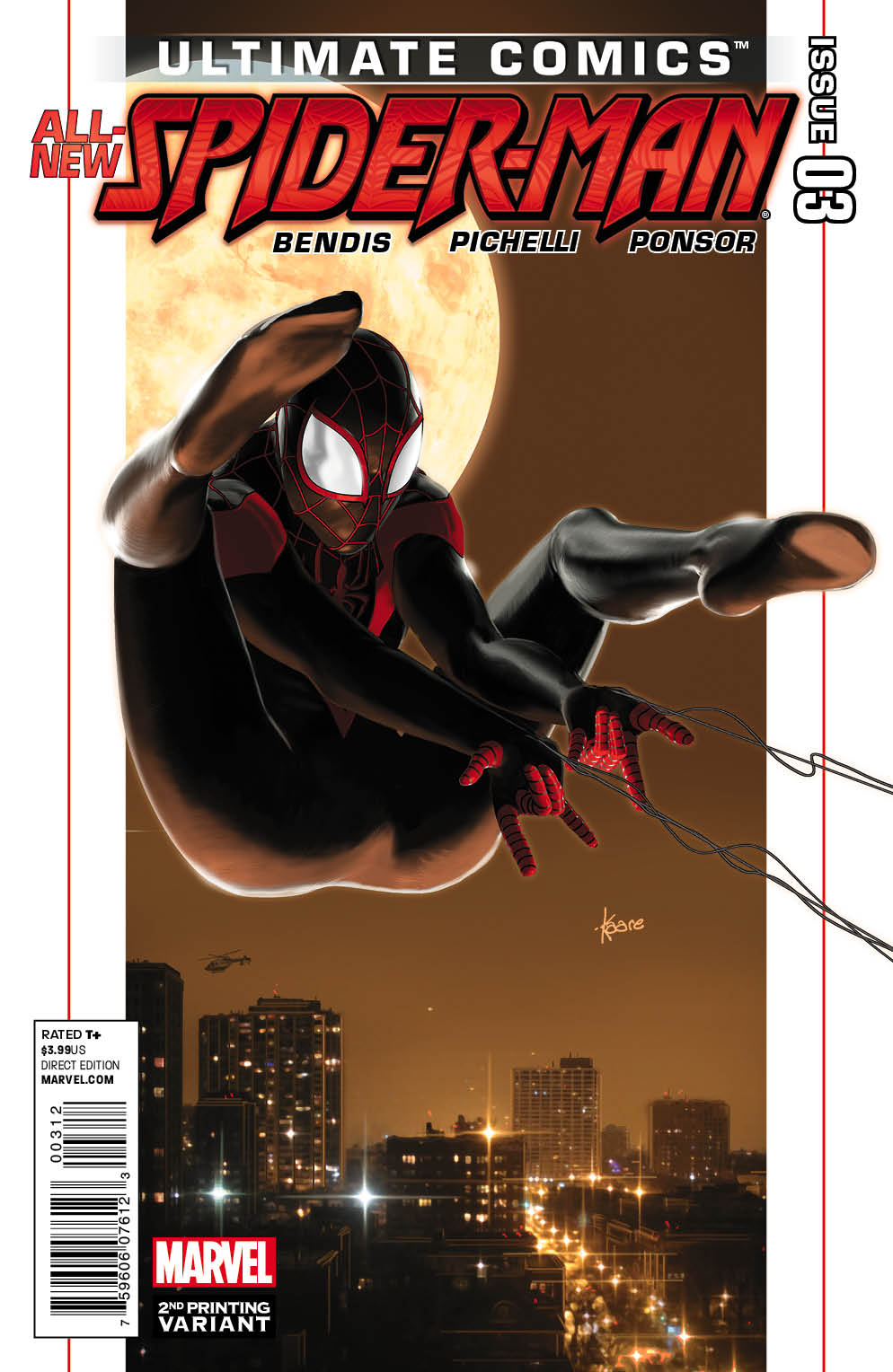
Your new series Ultimate Comics: Spider-Man was one of the most talked-about things going on in comics when it debuted in September. Miles Morales had gotten a lot of media attention due to both his position as the new Spider-Man and his race; he is a character many, many people are following closely. So far, the cover of every issue released (four months worth of comics) has featured Miles in the new Spider-Man costume, which itself has received an enormous amount of attention - it's already a t-shirt. And yet, in the comics themselves, Miles has so far appeared in-costume a total of...zero times. Yep, as of issue #4, he has not even received or made it yet.

It is our humble suggestion, then, that you get Miles Morales in that fucking costume already.

Your notoriously slow - sorry, decompressed - writing style has hemorrhaged - sorry, deterred - many people in the series' short run, but it seems to have settled at a steady readership of about 50,000. Surely Miles finally - sorry, finally - donning the costume, and the quickening in pace that would logically accompany it, would help restore sales to a fraction of the series' debut level. So let's get on with it already, Mr. Bendis. Give the people what they want, what those who still haven't jumped ship are so desperately waiting for. Because if you don't do it soon, there will be no one left to read about it when he does.

At the very least people would no longer be able to accuse Ultimate Comics: Spider-Man as false advertising.

Hugs and kisses,
Everybody

Jerry Robinson Died Today

He was 89 years old. His is the third passing of an industry giant this year, the other two of course being Dwayne McDuffie last February at a tragic 49 and the criminally under-appreciated Gene Colan this past June. Both prooker and I had the honor of meeting Mr. Robinson twice. He was a man of matchless presence, emanating an overwhelming sense of calm and civility - I remember when prooker and I were outside the convention center at Comic Con 2010, and I turned around and recognized the face right next to us as none other but Mr. Robinson's; in that moment, a serene aura enveloped us. It was as if we were in a timeless bubble, the three of us sheltered in the eye of the storm, pure composure amidst a raging chaotic sea of cosplayers. Many who make the pilgrimage describe Comic Con as a magical experience. During that encounter, I saw that magic at work.

A great man whose contributions will never be forgotten. Rest in peace.


Sunday, December 4, 2011

King of Komics, Interlude: Trust Me, I'm a Doctor


So I've been thinking about the last post I wrote, the first part of my big ol' essay on how Jack Kirby is responsible for the way the DC and Marvel Universes turned out -- for the operating principles that guide each of them, the big thematic differences we clearly see when we juxtapose the two. The end of that post - where I sort of threw all these other heroes into the equation - certainly seems rushed, and my desire to finish the fucking thing before 4 am and not have it explode into a 40 page thesis paper could easily be misread as a seeming inability or frustration on my part to soundly fit the bulk of Marvel's characters into my theory of how the MU "works." Recently I finished reading Dr. Atul Gawande's The Checklist Manifesto, which recounts the author's experiences as a surgeon over the course of his innovative, pioneering career. Dr. Gawande peppers the book with little nuggets of wisdom, one of which reminded me of my argument. It applies to Doctor Strange, one of the heroes I rather egregiously glossed over toward the end of my big post. I'll let Gawande help me fill in the missing gaps I was unwilling to properly address:

"The most common obstacle to effective teams, it turns out, is not the occasional fire-breathing, scalpel-flinging, terror-inducing surgeon, though some do exist...No, the more familiar and widely dangerous issue is a kind of silent disengagement, the consequence of specialized technicians sticking narrowly to their domains. 'That's not my problem' is possibly the worst thing people can think...but in medicine, we see it all the time."

Yup, that's crotchety Doc Strange to a T. 

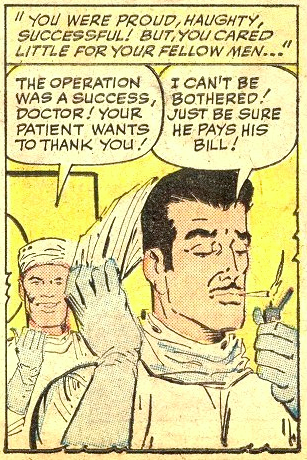
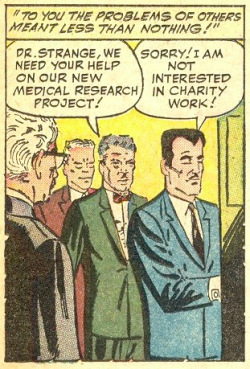
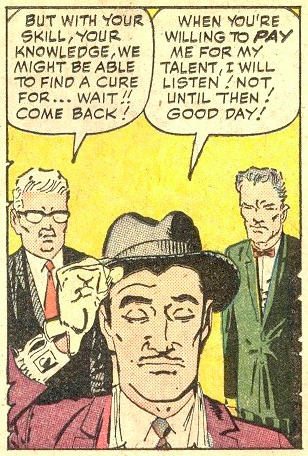
Quick back-story dump: Stephen Strange was an enormously talented, world-renowned surgeon whose skill was matched only by his greed, ego and callousness. Imagine Dr. House but even more curmudgeonly and without any redeeming qualities. I mean the guy didn't even have the human decency to treat patients without insurance, I'm pretty sure that's a felony. To him the Hippocratic oath meant nothing; he was in the business of helping people and all that mattered to him was the money and acclaim. Which is not to say he didn't help people - he was the best at what he did (and what he did was very nice!) if you could foot the bill - but the point was...well I'll let the panels speak for themselves:


What kind of doctor smokes outside the operating room?! Inevitably, Strange learns a traumatic lesson in humility - he gets into a car crash that subtly damages the nerves in his hands, meaning he can never pick up the scalpel again. Too proud to accept positions as a consultant or assistant, the good doctor searches all over the world for a way to mend his hands, eventually finding himself at the doorsteps of a mysterious temple in the Far East. From there things go pretty much how you'd expect them to: he becomes a pupil of a wise Oriental mystic known as the Ancient One and reevaluates his life while learning Zen and magic and shit. Or whatever. When he completes his training, he re-enters the business of helping people, but this time he's got the right attitude...and magic powers. So yeah Doctor Strange! Master of the Mystic Arts, Sorcerer Supreme, all that cool stuff! Whooo!

For a quick reminder, the big point I made in my last post was that the Marvel Universe represents not the dichotomy of good vs. evil, but selflessness vs. selfishness; essentially, it's about mankind's struggle against its own proclivity toward inaction. All of the MU's major heroes are proactive figures fighting against indifference, and most of them (Spidey, Strange, et al) were impelled toward do-goodery as repentance for great wrongs their own indifference caused in the past.

So before I leave you here, hopefully having convinced you that I at least know what I'm talking about, let's take another look at that quotation: "The most common obstacle to effective teams, it turns out, is not the occasional fire-breathing, scalpel-flinging, terror-inducing surgeon, though some do exist...No, the more familiar and widely dangerous issue is a kind of silent disengagement, the consequence of specialized technicians sticking narrowly to their domains. 'That's not my problem' is possibly the worst thing people can think...but in medicine, we see it all the time."

Doctor Strange's origin story clearly supports the idea at work in the greater fabric of the Marvel Universe, especially when bearing Gawande's insight in mind. If nothing else, his words should remind us all how relevant a lesson it truly is, and affirm the intrinsic value superhero comics have to offer.

Tuesday, October 18, 2011

King of Komics, Part I: First they came for the mutants...

First off guys - all what, one of you? - I'm sorry to say the Thor review I was talking about just ain't happening. My film major friend Dom, who was gonna guest-blog the review, is too busy with all his stuff to get it done (you can catch his most recent short film, The End, here) and since by now a review would be so far past the point of relevance anyway there's no reason to bother. I'll say it was definitely my favorite superhero movie of this past summer, and I loved how it didn't give two shits about its romance sub-plot, because who the fuck does in a superhero movie? The production design was spot-on, it totally captured the cosmic, sci-fi tech aesthetic Jack Kirby endowed the original comics with. Seeing those fantasy realms so fully realized was refreshing change of pace, considering how disappointingly earthbound the genre usually is, and I was surprised by how well they meshed with the sequences on our humble planet. Some people thought all the bird's-eye shots were distracting, but it's a movie where Gods look down at earth and pay us a visit from their astral plane, so to me it was a clever cinematographic choice; Kenneth Branagh is the man when he's following an internal logic instead of randomly adapting As You Like It to 19th century Japan. Chris Hemsworth and Tom Hiddleston were outstanding as Thor and Loki, respectively, even when the writing occasionally failed them (particularly the latter, who would have been better off written in the vein of those great Shakespearean rat-bastards). All in all, Thor is a well put together, thoroughly satisfying superhero flick that pulled off an epic scope with just the right mix of humor, action and mythological gravitas. Also Anthony Hopkins was in it and he was wearing an eye-patch. And there was a black dude in a suit of shining gold armor. It was awesome.

Although it had a pretty positive consensus, a number of celebrated writers and critics had some big problems with Thor. I couldn't help but find most of these cases to be astonishingly petty and spiteful, as if they disliked it for no other reason than they had to dislike the summer's biggest blockbuster. It was interesting to see such respected figures react with such personal bile and glibness; I wonder what going on in their heads as they saw the movie belied such insecure, venomous lashings-out.

Did I mention it had Anthony Hopkins with an eye-patch and a black dude in gold armor? 'Cause
that happened. It was awesome.


And now onto what this post was supposed to be about: the King of Comics.

If you know anything about superhero comics than you're familiar with Jack Kirby. He is perhaps the single most acclaimed and influential figure in the medium (the only person I can imagine coming close is Will Eisner) - Grant Morrison has equated him to the William Blake of comics. There's a reason he's called the King. I'm not going to delineate his incredible accomplishments or how he formed, innovated, REVOLUTIONIZED!! everything about the industry; hundreds of others have done a more comprehensive job at that than I ever could. But I am going to touch on one thing that I feel most people have missed.

Jack Kirby defined the DC and Marvel Universes.

Okay, so that's a very flippant way of putting what I'm trying to say, let me explain. We all know that Kirby created or co-created most of the Marvel Universe, and we know that his groundbreaking Fourth World saga became a cornerstone of the DC Universe, but I'm talking about something bigger. When people debate why Marvel is better than DC or vice-versa, they're not really arguing whether or not the Hulk is cooler than Superman; both worlds themselves are utterly distinct on a foundational level, and have their own unique aesthetic properties. These two worlds appeal to people in very separate ways, and I'd argue that is what fanboys battle over in the greasy, pathetic cesspools below the Android's Dungeon.

So what makes Marvel and DC so fundamentally different, and how did the King shape those fundamental differences? It all comes down to the baddies. What makes villains so important in superhero comics (besides the whole causing the story's conflict thing) is that they illuminate some aspect of the hero that would otherwise be left obscured. They serve to contextualize the hero, providing added dimensions to the ideas they embody: all great supervillains riff off of and further explore an element of the superhero's thematic core, either as twisted parallels or antitheses. We learn more about what Batman represents by juxtaposing him with the Joker or Two-Face; pitting Spidey against the Vulture and Doc Ock helps shed light on what our hero's all about. Kirby was the first to advance the conceit that superheroes and villains - like the figures of classical mythology - are heightened, abstract personifications of universal ideas, their battlegrounds the stages where they play out grand debates...WITH PROTON BLASTS!

It's Spring, 1966 and the Marvel Universe is still getting bigger and bigger, ever-expanding after the Big Bang that was Fantastic Four #1 five years ago. Stan Lee is content with things the way they are, with simply continuing to add new faces and circumstances to Marvel's ever-increasing batch of (lucrative!) icons. The rest of the bullpen, however, feels confined under Lee and have trouble reconciling their current situation with their loftier artistic/philosophical ambitions. Steve Ditko's starting to devote himself to Objectivism in all its forms; he'll leave Amazing Spider-Man in August. Kirby's work now can barely contain his cosmic imagination, which pushes the medium past what it was capable of at the time to craft a Space Age mythology. He wants to give a greater meaning to this universe he has created, and he thinks to himself, "if I can use a supervillain to contextualize a superhero, I can create a supervillain big enough to go up against all the heroes and contextualize their entire world!"

AND LO, MORTAL, SO DAWNS THE COMING OF GALACTUS...!


In Fantastic Four #48, Kirby introduced Galactus, the Big Bad of the Marvel Universe. He ain't the final boss of MvC3 for nuthin'. The fabulous image above is from Lee/Kirby's Thor #169 (Oct. 1969), and it pretty much lays out Galactus' shtick. He's the Devourer of Worlds, a tremendous Godlike being above myth, a legendary force of nature beyond reproach or opinion, beyond our mortal conceptions of good and evil. He survives by eating planets, so he comes back again and again to menace the heroes of Earth when it comes time to feed. What's important is that he's not doing it out of malicious intentions - he's not some diabolical monster like Loki or the Red Skull - it's just that a guy's gotta eat, right? You can't fault him for being self-interested and not wanting to starve to death, can you? Lee puts it really well in this splash page: "The puny survivors flee! I shall make no move to stop them! For I am indifferent to their fate!"

There it is, Galactus as the embodiment of indifference, of our natural inclination toward selfish inaction and apathy. That's the archenemy of the Marvel Universe. The MU isn't really concerned with the dichotomy of good vs. evil (which is why Mephisto feels so out-of-place in it), nor is it particularly conscious of it's own myth-making or iconography. Marvel was always considered the more naturalistic and grounded of the Big Two - that's what differentiated it from boring old DC Comics in the 60s, the flawed characters and real-world problems and all that revolutionary jazz - so it's appropriate that the MU is framed around a social reality affecting our society. The Marvel heroes stem from a tradition of social activism; at their very essences, all of them are taking a big stand against indifference.

Let's start with Spider-Man, since he's both the most obvious example and the most enduringly popular Marvel character. After he gets his powers, Peter Parker uses them to rake in cash as an entertainer. Selfish, perhaps, but...well yeah it's a pretty damn selfish way to use superpowers. Then he witnesses a robbery and, thinking there's no reason to get involved, does nothing to stop the burglar as he runs by Peter. This is something the movie screwed up big time: it gave Peter a reason to let the burglar get away. In the comics, he is simply predisposed to inaction, and that was the entire point. He pays for it when that same burglar ends up murdering dear old Uncle Ben that very night. "With great power there must also come -- great responsibility!" From that point on, Peter abandons his selfishness, vowing to never make the same mistake again - as Spider-Man he now fights against the pervasive apathy that led his uncle's death.


Next we have...how about Captain America? He was the first Marvel superhero after all, barring Namor and the original Human Torch. Cap punched Hitler in the jaw a full nine months before the US entered World War II, at a time when public sentiment was entrenched in isolationism. While the rest of America sat idly by, choosing not to intervene in the systematic execution of millions, scrawny Steve Rogers enlisted in the Army and volunteered for an incredibly dangerous super-soldier experiment. He refused to be crippled by the same inaction that plagued his beloved country, and inspired others to do the same (both in the comics and out of them). The Cap movie messed this up, too, but that movie messed a whole lotta things up. He and Bucky thwarted Nazi saboteurs and spy rings long before Pearl Harbor allowed them to thwart actual Nazis on the front lines.

We find a similar thread in the Fantastic Four's origin story. In the original tale, we're at the beginning of the Space Race. Those damn dirty Soviets got the heads-up on us and we've got a lot of catching up to do. In the Marvel Universe, America just can't get its act together, we're all too listlessly complacent to get anything done while those zany communists are up there making a space cannon or something. It's up to Reed Richards to build his own private rocket and put our flag on the moon before the cosmonauts get there. The story's been updated again and again, but every time the principle is still the same. Now it's Reed discovering an anomaly in space heading towards earth and saying, "hey these cosmic rays I'm seeing could be pretty dangerous, we should probably take a closer look at this or something," to which his colleagues, the government and the general public respond with a resounding "meh." As we know, Reed and his true believers get the last laugh when those cosmic rays give them all cool powers.

It's interesting to note that, at the climax of Galactus' first appearance, the Four scare him away with the threat of mutually assured destructing, bringing the greatest social concern of the Cold War to the attention of cosmic beings. Just sayin'.

The Hulk came next in Marvel's publication history; he, too, fits the mold. We're introduced to Bruce Banner as the head physicist for a modern-day Manhattan Project -- think of him as Oppenheimer without the humanity. He's aloof, reserved, emotionally withdrawn; about as indifferent as a person can get. He's also the man behind the gamma bomb, a WMD that makes Fat Man look like a spitball. And. He. Doesn't. Give. A. Fuck. So it's poetic justice that, after he's suddenly struck with conscience, Banner gets blasted with his own doomsday device and transforms into a furious, angst-ridden monster, a giant green cautionary tale on indifference toward human suffering. The same idea applies to Tony Stark, who didn't care that his career amounted to providing the world with tools for death and destruction...until it got him kidnapped and stuck with a battery for a heart. So to save the world from his own disinterest he becomes Iron Man! As Stark put it in the movie, which this time got it completely right, "I saw young Americans killed by the very weapons I created to defend them and protect them. And I saw that I had become part of a system that is comfortable with zero-accountability...I came to realize that I had more to offer this world than just making things that blow up."


Alright, who's left? Thor? Yeah, he definitely needed a lesson in humility, but the real reason daddy banished him was because he was set against the status quo (great link, btw): a non-aggression pact with the fucking Frost Giants, fer Chrissake! When Thor comes back he's no longer arrogant, but set against the complacent order of things more than ever. Doctor Strange? Same deal as Tony Stark, but with medical billing instead of weapons manufacturing and magic instead of a robot suit. The X-Men? For all the people who sling hate-filled "muties!", there must be many more who simply aren't invested in the issue enough to bother with mutant equality; it's a lot like the big problem facing gay marriage legislation outside of the South, I imagine. Daredevil? Indifference enshrouds his world like a fog. The Kingpin became as powerful as he is simply because no one bothered to try and stop him, and now his omnipresent influence can only be casually accepted as The Way Things Are. No one really cares about anything Daredevil does because they know he can't be anything more than a nuisance to the Kingpin's untouchable crime empire. Yet in spite of it all he continues to fight the good fight...and if anyone arsed themselves to look, including ol' Mr. Fisk, they'd discover what a difference he's actually making. It's all spelled out pretty explicitly in Born Again.

Have I covered all the bases yet?

As you can see, this theme always lurked just underneath the surface of Marvel's foundations. But that's all it was, a recurring idea buried deep within each individual mythos, only loosely connected to a greater whole. Kirby was perceptive enough to recognize this thread and, with the introduction of Galactus, brought it to light. Solidified it. Through Galactus, this cosmic God of Indifference constantly in the back of every other character's mind, Kirby was able to thematically unite the shared universe in a way never before seen; solely by the virtue of the character's existence he formally cemented the struggle against inaction as the core, fundamental tenet of the Marvel Comics world.


Tune in next time for Part II, when I do the exact same thing with DC. Fun stuff, I know!

Monday, October 3, 2011

At da moofies: Drive: A Real Hero and a Real Human Being

Wow, guys. Now THIS was a pleasant surprise. What was advertised as some B-list action thriller turned out to be - thanks to mesmerizing cinematography, outstanding performances from the entire cast, a killer story, a propulsive euro-synthpop soundtrack and striking art-house direction from Bronson's Nicolas Refn - hands-down the best movie of the year. If you haven't, now is the time to go out and see it. If you're reading this odds are you have time to kill. Also lots of spoilers, so there's that.

Drive at first seems to defy classification; it blends genres and styles as diverse as splatter, chase, crime drama and neo-noir with 60s antiheroes, David Lynch send-ups and 80s burnout aesthetics. The result is highly stylized, existentialist thrill ride...but trust me, it's a lot less pretentious than I'm making it sound! Anyway, what surprised me most about the movie - and this is something many people have picked up on - was the one genre that cohesively united all of Drive's disparate elements; it's totally a superhero film. It doesn't look like a superhero film at first (it hardly plays out like the dime-a-dozen origin stories on the screen these days) but if The Dark Knight showed us there could be a movie about a superhero that wasn't a superhero movie, this film has now proven the opposite. This is a superhero movie that is not about a superhero...or, more accurately, not about a superhero we instantly recognize as such. Refn, for his part, has commented extensively on the genre's influence on Drive. QUOTE BOMB:

"...Drive was essentially an allegory of a superhero in the making. He became a superhero at the end of the movie and that's why it's a happy ending...In the beginning, he is there for her as a human being and when she needs him as a hero, he's there as a hero. He is what you need him to be. It's why he will continue to roam the landscape being a driver of the night, the superhero with a scorpion sign on his back as he protects the innocents against injustice."

"By day, he was a human being, by night he was a hero. And the movie is about his transformation into this superhero, by bringing his human morals into the hero role, so that he does what he does for the right reasons."

"You can kind of say that the Driver is a man who is caught between two worlds. At night, he is a man in costume who roams the streets of L.A., wanting to protect the innocent. And in the day, he's a car mechanic and a stuntman. And through the course of the movie, he realizes he's schizophrenic in a sense that he doesn't have two personalities, but he's two people. And he, through the course of the movie, becomes the superhero that he plays in films, and saves the innocents against the evil … it's mythological storytelling, which is what superhero stories are."


Riding (OR SHOULD I SAY DRIVING HURHURRR) on Refn and Ryan Gosling's words, I want to take a closer look at how the aesthetics, symbols and conventions of the superhero genre have informed Drive. For starters, our protagonist is referred to only as the "Driver," a superhero-esque codename relating to his persona and abilities; the alias wouldn't feel out of place among one of the X-Men. Like all the great superheroes, the Driver is very much an archetype - he's that same antihero stock character as the Man With No Name or Frank Bullitt or any of the samurai Toshiro Mifune played, you've seen him in various media dozens of times before. Of course the Driver's a bit of a deconstruction of that trope too - his stoicism, rather than making him seem tougher, primarily softens him, his unassuming toothpick a stark contrast Clint Eastwood's gruff cigarillo. But this still plays into the superhero dynamic, because when in the last 25 years have superheroes not been all about deconstruction?

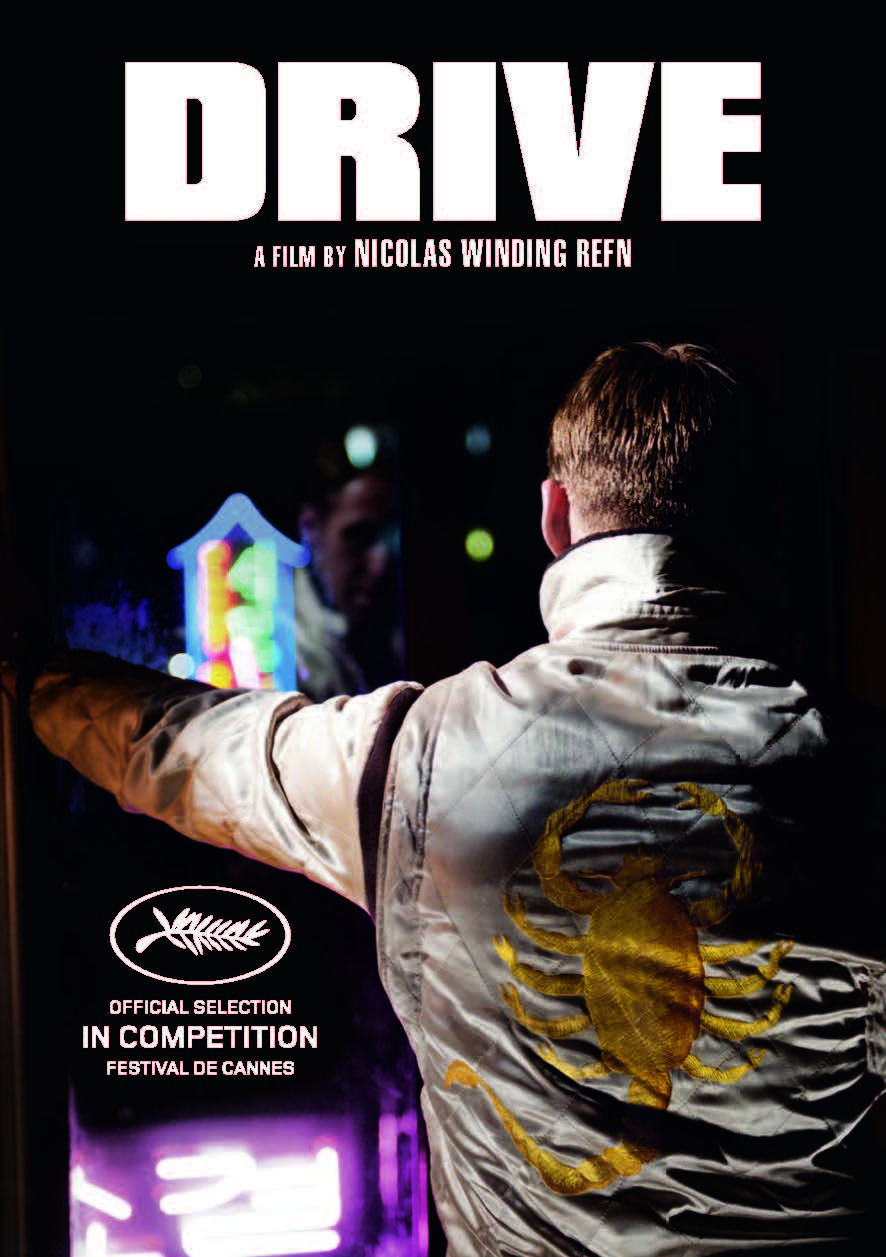
By day, the enigmatic Driver is a stunt...uhh, driver for Hollywood action films. Meta right? It's like this was written by Grant Morrison or something. By night, though, he's a wheelman-for-hire, the best at what he does (sound familiar?). But when innocent people - his neighbor/love interest Irene and her young son Benicio - are put in danger by the mob, the Driver abandons this selfish use of his skills and becomes a superhero (also sound familiar?), striking against organized crime from the darkness with impeccable combat prowess (also also sound familiar?). What most soundly cements the superhero analogy is the fact that he dons a costume during his nighttime exploits: a white satin jacket with a gold scorpion embroidered on the back. It may be more subtle than the capes and tights we're used to, but it is still quite clearly a superhero costume as it is utterly unique, it is worn solely when he asserts his extraordinary abilities and, most importantly, it invokes an animal totem.

Historically, animal totems have played an enormous role in the creation of superhero identities. Bruce Wayne was inspired to take on the archetypal qualities of a bat in what is perhaps the most iconic origin story. Peter Parker famously had the characteristics of a spider thrust upon him, and the best Spidey stories in recent memory have meditated on the totemic nature of Spider-Man's world and of superhero comics in general. Like these heroes and so many others, the Driver is conscious of his emblem, and when he puts on his jacket he takes up the mantle of the scorpion. It hearkens back to that cornerstone of all great superheroes and superhero stories, mythology. Specifically, the fable of the scorpion and the frog, which the Driver paraphrases to his archenemy. And here's where things get deeeeeeeeeeep...


You know the story. Scorpion needs to make it over the river so he tries to hitch a ride on top of a frog. Frog is afraid scorpion will sting him. Scorpion explains that if he did that they would both drown. So frog ferries scorpion along and wouldn't you know it, just before they reach land scorpion stings him in the back, dooming them both. Frog asks why scorpion would pull that shit, to which scorpion responds, "that is my nature." The question of human nature is what Drive is all about: are individuals predisposed to behave by a certain irreversible nature? Are they predisposed to conflicting drives struggling for dominance? Are they able to transcend or change their nature? Can they transform or elevate themselves by embracing their drives? Are people capable of understanding or recognizing what they even are? Can we be a real human being and a real hero? It's a regular Jodorowsky, this one.

There's a great scene that perfectly sums up the question Drive poses. The Driver and Benicio are watching a cartoon together early in the film, and Driver asks the boy if a shark in the cartoon is the bad guy.  Benicio says yes. "How can you tell he’s the bad guy?," Driver asks. "He’s a shark," the boy casually rationalizes. The Driver inquires, "Are all sharks bad?" and the young child nods his head. The scene could easily be (read: IS) referring to a number of characters in the movie, the most obvious being the Driver himself. It's also referencing Benicio's father, whom the audience is predisposed to hate until he actually appears onscreen and turns out to be a great person thrown into awful, inescapable circumstances. And to Driver's mentor (his Alfred, if you will), Shannon, another good guy who makes a bad choice that leads to disastrous consequences. Perhaps even to the antagonist Bernie Rose, a ruthless mobster who seems to genuinely regret the measures he must take to protect himself. Are any of these people intrinsically good or bad? Are any of them conscious of their individual human natures, if they even exist? Are their actions and behavior, their drives, determined by innate, instinctive characteristics? At first glance the Driver seems to serve as a profound 'YES' to these questions, but that's the beauty behind his lack of backstory and dialogue. We have no idea what he's thinking or feeling or how his environment may have shaped him; he's a total mystery to us. He's Rorschach without the caption boxes telling us his thoughts.

Compelling stuff, no?

Believe it or not, this digression I've taken ties in perfectly to the superhero stuff I'm supposed to be talking about. But first we have to take one last detour. Remember at the end of Batman Begins, when Bruce and Rachel are talking at the ruins of Wayne Manor? Rachel feels up Bruce's face (if I'm remembering the scene correctly) and declares "This is your mask. Your real face is the one that criminals now fear. The man I loved, the man who vanished...he never came back at all." Well all that is obviously a load of bullshit; it's not a simple dichotomy between Bruce and Batman. Batman is clearly not his true persona, just as his actual voice isn't a constipated chain smoker's. The Batman identity is just as much a mask as millionaire playboy Bruce is, and although Rachel may think otherwise for some ill-defined reason, that is not the personality she is addressing right now. The real person behind these facades, the man you loved and you think vanished, is the one you're fucking talking face-to-face to you dumb bitch: the highly disciplined, driven, perceptive, introspective, resourceful and self-reliant Bruce Wayne. The man who has devoted his life to a higher ideal and uses "Batman" as a tool to realize it.


 Alright, now to get back on track. We're at the final lap, folks! To finish his transformation, the Driver dons a mask to hide his identity near the end of his origin story, completing his superhero costume. Crucially, the mask is taken from his day job, when the Driver needed to look like one of the actors for a car crash scene. It belongs in the realm of secret identity, not superhero. Drive knows better than Rachel, you see; it recognizes that a man's identity, his true nature, is much more nebulous than any clear-cut duality, especially between hero and secret identity. The entities are not so clearly defined - far from it - nor are they completely separate from one another. Perhaps there are elements of both in one another. Perhaps one morphs into the other. If human nature is an unanswerable question, than any attempts to explain it by ghettoizing its aspects into two definitive, opposite camps will ring as false as Rachel's half-baked analysis.

It's funny how similar the ending of Drive is to that of The Dark Knight; both have the protagonist speeding off into the darkness, with the screen cutting to black. The difference is that the ending to The Dark Knight is ominous, because by the picture's end Batman is not supposed to be a hero, while the ending of Drive is hopeful for the opposite reason. We started out with a man without any drive and saw him self-actualize. We saw him fall in love, transcend and become a real hero.

If Drive is any indication, we may soon be seeing a comparable transformation in the superhero film genre. I was once afraid that in the near future the superhero flick would over-saturate the market and go the way of the Western, that the genre would devour itself as people flocked away from the same formulaic origin stories over and over again. We saw a hint of that this summer: Thor, X-Men: First Class and Captain America all did very, very well at the box office (not so much Green Lantern), but they nevertheless failed to meet studio expectations by a great deal. There was no Iron Man among this crop of new franchises, and the only one to come even somewhat close was the first released. In light of seeing the formula applied with such ingenuity and unconventionality in Drive, I'm now confident that the superhero movie will not just survive, but will thrive in ways we have now only begun to see as it is freed from the constraints that once bound it. Yeah, the superhero movie will be fine.

It's just the superhero comic book movies that are gonna be fucked.

Tuesday, September 6, 2011

DC New 52 and YOU!

prooker: Welcome to DC 52 and YOU!  mommy_made_of nails and I will be discussing all the nooks and crannies of DC's new 52 and I'm making my triumphant return to this here ol' blog.


mommy_made_of_nails: Woo yeah!  


So let's see, right now the only title taking place in the rebooted DCNU is Justice League #1, right?  This Wednesday we'll get a fresh batch of stories from the new 52 (like Morrison's Supes!), but for now we really don't know too much of the reboot/relaunch's ramifications yet (also bonus points for alliteration).  


prooker pointed out something real interesting about a connection between the old DCU and the DCNU in Flashpoint #5.  Take it away!


prooker: Spoilers Beware! The big twofer splash page of Flashpont #5 had a mysterious lady that (to the best of my knowledge) is a completely new character.


mommy_made_of_nails: She's sort of like a cosmic Madame Web, telling the Flash as he reshapes reality that a new 'Verse is being made with slight variations.


prooker: She makes her big deus-ex-machina turning the old DCU into the new by fusing together the 3 former imprints of DC's line: Vertigo, Wildstorm, and the DCU while also inexplicably placing Grifter right next to Superman, Wonder Woman, and Batman.


mommy_made_of_nails: And cyborg as a leading man in the Justice League.


prooker: It's a very strange move by DC to specifically make an old strand of the old universe to be continued into the new.   It's really counter-intuitive. Isn't their goal to create a new universe?  Why drag this new deadweight along with it?


mommy_made_of_nails: I imagine it's for 2 reasons.


1) It's a convenient - kind of cheap, but this kind of thing always is - way out if this if the whole reboot falls flat, a holdover that would allow the writers to restore the DCU to it's old state if things just don't work out.  


And more importantly 2) it's a way for the writers to impose a stricter regard for continuity on themselves, because historically that's been a big problem over at DC. As prooker pointed out to me, this space lady appears in the background of Justice League #1, at a high school football game featuring a pre-Cyborg Cyborg as star quarterback


prooker: It would be really great if she was just a really huge high-school football fan.


mommy_made_of_nails: Wouldn't it though? 


Having her appear in some function - most likely as a kind of behind-the-scenes seer/prophet - in each of these new titles may help establish interconnectivity and structure to the DCNU, which to us (and probably the writers) is a wild, uncharted territory.  OR it could just be really imposing and off-putting.


prooker: Yeah, she's also in a few other previews I've seen (Animal Man for one).


mommy_made_of_nails: Maybe she's Grant Morrison.


prooker: Wouldn't surprise me a bit.  


I'm not gonna lie I think that part of it, inserting her into every 52 #1 is pretty cool.  Has anything been so unitive among so many titles before?


mommy_made_of_nails: I doubt it, maybe for a crossover event but never in something actually important.


prooker: That was a sick backhand burn.


mommy_made_of_nails: They better get some ointment for that burn, son.


prooker: But yeah, I know they're just gonna end up resolving her mysterious appearance in the next event title, but wouldn't it be really cool if she just stayed in the backgrounds of every DC comic for years to come?


Just a voyeuristic spectre (is he still in the DCU?) that really likes comics, JUST LIKE US.  Even the bad ones.


mommy_made_of_nails: Oh man I never thought of it like that, though. She'd be like Bat-Mite from Brave and the Bold.


prooker: OH SNAP, BREAK TIME.  


10 MINUTES. 


ADVENTURE TIME IS ON.


mommy_made_of_nails: GODDAMN IT I HAVE NO TV.


prooker: Gender bending episodeee!  Cake the cat and Fionna the human!


mommy_made_of_nails: #greenwithenvy.  


This is going in the post, right?


prooker: Totes.


*10-15 minutes later*


Ok back, that was a great episode.  Highlights include: Neil Patrick Harris as Prince Gumball and Fionna wearing Sailer Moon's Dress.


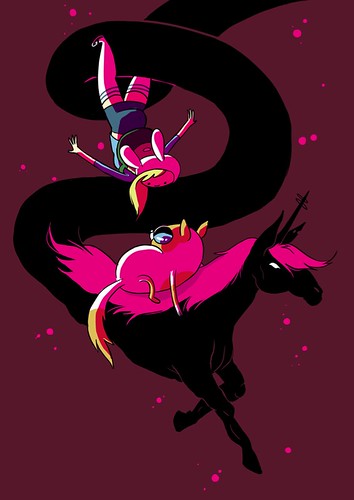
AND LORD MONOCHROMICORN.


Seriously f DC wanted to totally sell me on the new 52 they should really release an Adventure Time Comics #1


mommy_made_of_nails: GAAAAH.  I want it.  Both the episode and the comic.


prooker:  Away from cartoons and back to comics though.  So since we only have one issue of the new DCU out, what did you think of the Justice League?


mommy_made_of_nails: It had some nice moments, the buddy cop dynamic between Green Lantern and Batman was nice, but honestly it seemed pretty inconsequential.  It didn't feel like what the flagship of the DCNU should be.


It lacked gravitas, y'know?


prooker: Yeah if their mission was to be big and bold and different they completely miffed on that one.  I can see a small amount of new readers wanting to read this after the first issue, specifically those who saw the GL, Batman, and Supes movies though.  But honestly it's also a problem of the monthly serial format, with not every writer being capable to fit what feels like a full story into 20-30 something pages.


mommy_made_of_nails: It doesn't take a master craftsmen to make a big, exciting story under those parameters though.


I was gonna use Mark Waid's Daredevil #1 as an example of something feeling new and fresh but I remembered that Waid is a master craftsman.  You get the idea though.


prooker: Well anyways that's one of the big problems with being a newcomer to comics, in an industry that relies on creative talent over marketing.  Wait did i just say that ahahaha.


mommy_made_of_nails: HAHAHA, because that's not what the DCNU is at all.  


I do like the prospect of this mysterious lady bringing the ol' fashioned omniscient narrator back to comics. The internal monologue caption box is criminally overused. But I didn't see that in Justice League #1. It was same-old-same-old in every respect.


prooker: What I did like from JL  #1 was the overall lighthearted tone.  Geoff Johns does not shy away from gore in his work, and his biggest success Green Lantern is based on the premise of a huge, dark, operatic cop gun battles.  


IN SPACE.  


So it's good to see that he is taking a conscious shift from that, and also his obsession with continuity which he just can't mine from anymore.


mommy_made_of_nails: Yeah it'll be interesting to see what Johns does now that he can't fall back on the obscure continuity references that have defined his comics, it's uncharted land for reader and writer alike.  


Something that has surprised me for a while now is how hush-hush the DC editorial has been about the ramifications of the reboot. Like what exactly is changed? I thought initially that they were just maintaining a secret well, but now we're officially in the new 52 and we still really don't know what's different


prooker: Sure we do, Superman has no underwear.


mommy_made_of_nails: I wonder if that's true under his costume too...


prooker: That's the Superman for this new generation.  But i think they've said a lot about whats new and different in the DCU.


mommy_made_of_nails: Fill me in! I don't know these things.


prooker: It's not a total reboot because some elements do stay the same.  Batman and Green Lantern being the biggest ones to stay almost completely untouched.  But other than those notable two it's almost a complete scratch really. 


Also Barbara Gordon got her legs back.


mommy_made_of_nails: How Barbara Got Her Legs Back.


But the editorial said that many previous stories are still in continuity - one of them being The Killing Joke. How is that reconciled?


prooker: That's whats been hush-hush, but I'm sure the new #1's will fill us in soon enough


mommy_made_of_nails: Honestly the impression I get is almost that they themselves don't know, that they're making it up as they go along. Which can definitely be a bad thing, leading to the same kinds of continuity messes that partially necessitated this event. But it can also be a good thing, leading to a looser, more interesting mode of storytelling than we've seen in comics for at least two decades.  And I'm sure just as Post-Crisis gradually reincorporated the erased Silver Age elements, so too will the DCNU bring back stories theoretically booted from the current canon.


prooker: I don't know if you're giving them enough credit on this, the way I hear these new stories that were picked were specific pitches from writers about stories they really wanted to tell.


mommy_made_of_nails:
Writers like JT Krul.


prooker:
Yes.


I'm sure they've at least got a certain foresight for at least a year.


mommy_made_of_nails: One would hope so. I can see this reboot lasting for a long time, perhaps as long as the first Crisis and now.  Certain things will change - I'm betting that within 2 years all the major players (read: Supes) will be back to their iconic costumes - but this could have staying power if the fanboys are down.  With all the negative internet feedback, one has to wonder, though.  Will they be?  And will that be enough? Because DC editorial's goal of attracting new readers will definitely not be met.  Not with this as a business model.


prooker:  It's really disheartening to see so much pessimism about all this though.  Wouldn't it be awesome if this all just turned out all right?


mommy_made_of_nails: I'm not so much pessimistic about the content, my only complaints so far are the shitty Jim Lee costumes.  And Grifter.  Hell Cyborg on the Justice League could be pretty cool.  My beef is with what this reboot was really about, the whole readership is dying thing.  If this is the best they can do than superhero comics are fucked.  I mean of course not really, Warner Bros and Disney will keep them afloat for the intellectual property, but don't you wish the industry could actually sustain itself?  And let's pray to god Superhero movies don't eventually go the way of the Western, because then WB and Disney might actually consider letting them go under when the publishers can't pull their weight.


prooker: I think we're drifting off into another larger and broader conflict that could take hundreds of pages to really get into, even if it is extremely relevant to this new initiative.


mommy_made_of_nails: THE AVENGERS INITIATIVE.


Sorry I had to.


prooker: That's ok, I'll just pretend Samuel L. Jackson found his way into our discussion.


mommy_made_of_nails: In a perfect world, in a perfect world.


PROOKER YOU THINK YOU'RE THE ONLY SUPER-HERO


prooker: So let's leave it be and say we'll see.  I honestly hope all 52 books kick so much ass.


mommy_made_of_nails: Me too.  Except Grifter.  Fuck that noise.


prooker: I would write a Grifter ongoing.


mommy_made_of_nails: Also, Static Shock should have his own comic.  With his old costume.  Written by Spike Lee.


prooker: I may hate Spike Lee more than Grifter.


mommy_made_of_nails: Grifter written by Spike Lee.


prooker: The Perfect Storm.


Alright to wrap this thing up, which books in the new 52 are you gonna be picking up?


mommy_made_of_nails: I'm looking forward to Animal Man, Action Comics, Wonder Woman, Batwoman, ummm...


I need a list...


prooker: Hawk and Dove.


mommy_made_of_nails: LIEFELD ALL DAY ERRYDAY.


I was thinking Milligan's Red Lanterns but after Secret Seven I'm not sure.


prooker: The thing about Milligan is he's extremely hit and miss in his mainstream work.


mommy_made_of_nails: Umm what else is there? What are you looking forward to?


prooker: Well my pull list for this coming month are:


Animal Man written by Jeff Lemire and Travel Foreman which is looking to just be a gorgeous book


Action Comics which you really don't need to say anything more than Grant Morrison writes Superman, but Rags Morales doesn't hurt


Swamp Thing by Scott Snyder and Yanick Paquette


mommy_made_of_nails: Oh I forgot all about that one. Snyder's a real up-and-comer.


prooker: Yeah his run on detective comics will be one of those books in bookstores that just everyone will sit down and read all the way through.


mommy_made_of_nails:  Need dat trade.


prooker: And Paquette's work on batman Inc was rad.


Batwoman by J.H. Williams and Amy Reeder, which really has nothing to do with the reboot


Oh Batman as well also written by Snyder and drawn by Greg Capullo,  one of those Image guys, but his work as of late looks pretty great.


mommy_made_of_nails: Oh man! I'm gonna be so broke.


prooker:  Yeah! who said the new 52 didn't do it's job?  I'm already getting more comics than I used to.


mommy_made_of_nails:  Neckbeards.


prooker: Also I might - MIGHT - pick up Hawk and Dove.


mommy_made_of_nails: Too much Matt Seneca trying to convince you Liefeld is good.


prooker: ahahaha no way man, I hate seneca most of the time.  He can be such a douchebag.  He fucking smoked an issue of the new Punisher comic. That is so dumb.


mommy_made_of_nails: Hahaha that's dangerous.  Silly Matt.


prooker: Anyways what's on your "Stay away, FAR AWAY" list, also known as the "Burn it with Fire" list.


mommy_made_of_nails: GRIFTER.  


TEEN TITANS.  


The Krul stuff.


prooker: Watch all those things become DC's flagship properties for the next century.


mommy_made_of_nails: Wait Johns isn't doing Flash anymore is he?


prooker: Nope Manapul is on it with both art duties and writing.


mommy_made_of_nails: I could get into that.


prooker: So I'll check it out because i DESPERATELY want to like a Flash comic.


mommy_made_of_nails: Ummm what other comics are there? I'm kind of ignorant...


Superboy. Don't like the art.


prooker: What?? R.B. Silva is on it!  The guy who did the brilliant Jimmy Olsen backups in Action Comics


mommy_made_of_nails: Don't like the cover. 


OH DUDE.  DUDE.  WE FORGOT FRANKENSTEIN.  That looks awesome.


prooker: Frankenstein leads an elite taskforce of monsters.  SOLD.


Jeff Lemire doesn't hurt either.


mommy_made_of_nails: Exactly.


prooker: Ok just to add, I just saw some preview pages of Justice League International.  And apparently the whole 80's JLI is TOTALLY REBOOTED.


NO BLUE AND GOLD BOOSTER AND BEETLE


NO MARTIANS LOVING OREOS


NO BWAHAHAHAHA


NO ONE MORE PUNCH


mommy_made_of_nails:  I'm so sorry, prooker. So so sorry.


prooker: While I cry into my pillow, I think this is a good point to end at.  I really hope that these new comics will be absolutely phenomenal and I wish all the creators the best of luck.


Especially you Mr. Liefeld.


mommy_made_of_nails: I'm looking forward to more DC Comics than I have in a long time.


Except Grifter.