Wow, guys. Now THIS was a pleasant surprise. What was advertised as some B-list action thriller turned out to be - thanks to mesmerizing cinematography, outstanding performances from the entire cast, a killer story, a propulsive euro-synthpop soundtrack and striking art-house direction from Bronson's Nicolas Refn - hands-down the best movie of the year. If you haven't, now is the time to go out and see it. If you're reading this odds are you have time to kill. Also lots of spoilers, so there's that.
Drive at first seems to defy classification; it blends genres and styles as diverse as splatter, chase, crime drama and neo-noir with 60s antiheroes, David Lynch send-ups and 80s burnout aesthetics. The result is highly stylized, existentialist thrill ride...but trust me, it's a lot less pretentious than I'm making it sound! Anyway, what surprised me most about the movie - and this is something many people have picked up on - was the one genre that cohesively united all of Drive's disparate elements; it's totally a superhero film. It doesn't look like a superhero film at first (it hardly plays out like the dime-a-dozen origin stories on the screen these days) but if The Dark Knight showed us there could be a movie about a superhero that wasn't a superhero movie, this film has now proven the opposite. This is a superhero movie that is not about a superhero...or, more accurately, not about a superhero we instantly recognize as such. Refn, for his part, has commented extensively on the genre's influence on Drive. QUOTE BOMB:
"...Drive was essentially an allegory of a superhero in the making. He became a superhero at the end of the movie and that's why it's a happy ending...In the beginning, he is there for her as a human being and when she needs him as a hero, he's there as a hero. He is what you need him to be. It's why he will continue to roam the landscape being a driver of the night, the superhero with a scorpion sign on his back as he protects the innocents against injustice."
"By day, he was a human being, by night he was a hero. And the movie is about his transformation into this superhero, by bringing his human morals into the hero role, so that he does what he does for the right reasons."
"You can kind of say that the Driver is a man who is caught between two worlds. At night, he is a man in costume who roams the streets of L.A., wanting to protect the innocent. And in the day, he's a car mechanic and a stuntman. And through the course of the movie, he realizes he's schizophrenic in a sense that he doesn't have two personalities, but he's two people. And he, through the course of the movie, becomes the superhero that he plays in films, and saves the innocents against the evil … it's mythological storytelling, which is what superhero stories are."
Riding (OR SHOULD I SAY DRIVING HURHURRR) on Refn and Ryan Gosling's words, I want to take a closer look at how the aesthetics, symbols and conventions of the superhero genre have informed Drive. For starters, our protagonist is referred to only as the "Driver," a superhero-esque codename relating to his persona and abilities; the alias wouldn't feel out of place among one of the X-Men. Like all the great superheroes, the Driver is very much an archetype - he's that same antihero stock character as the Man With No Name or Frank Bullitt or any of the samurai Toshiro Mifune played, you've seen him in various media dozens of times before. Of course the Driver's a bit of a deconstruction of that trope too - his stoicism, rather than making him seem tougher, primarily softens him, his unassuming toothpick a stark contrast Clint Eastwood's gruff cigarillo. But this still plays into the superhero dynamic, because when in the last 25 years have superheroes not been all about deconstruction?
By day, the enigmatic Driver is a stunt...uhh, driver for Hollywood action films. Meta right? It's like this was written by Grant Morrison or something. By night, though, he's a wheelman-for-hire, the best at what he does (sound familiar?). But when innocent people - his neighbor/love interest Irene and her young son Benicio - are put in danger by the mob, the Driver abandons this selfish use of his skills and becomes a superhero (also sound familiar?), striking against organized crime from the darkness with impeccable combat prowess (also also sound familiar?). What most soundly cements the superhero analogy is the fact that he dons a costume during his nighttime exploits: a white satin jacket with a gold scorpion embroidered on the back. It may be more subtle than the capes and tights we're used to, but it is still quite clearly a superhero costume as it is utterly unique, it is worn solely when he asserts his extraordinary abilities and, most importantly, it invokes an animal totem.
Historically, animal totems have played an enormous role in the creation of superhero identities. Bruce Wayne was inspired to take on the archetypal qualities of a bat in what is perhaps the most iconic origin story. Peter Parker famously had the characteristics of a spider thrust upon him, and the best Spidey stories in recent memory have meditated on the totemic nature of Spider-Man's world and of superhero
comics in general. Like these heroes and so many others, the Driver is conscious of his emblem, and when he puts on his jacket he takes up the mantle of the scorpion. It hearkens back to that cornerstone of all great superheroes and superhero stories, mythology. Specifically, the fable of the scorpion and the frog, which the Driver paraphrases to his archenemy. And here's where things get deeeeeeeeeeep...
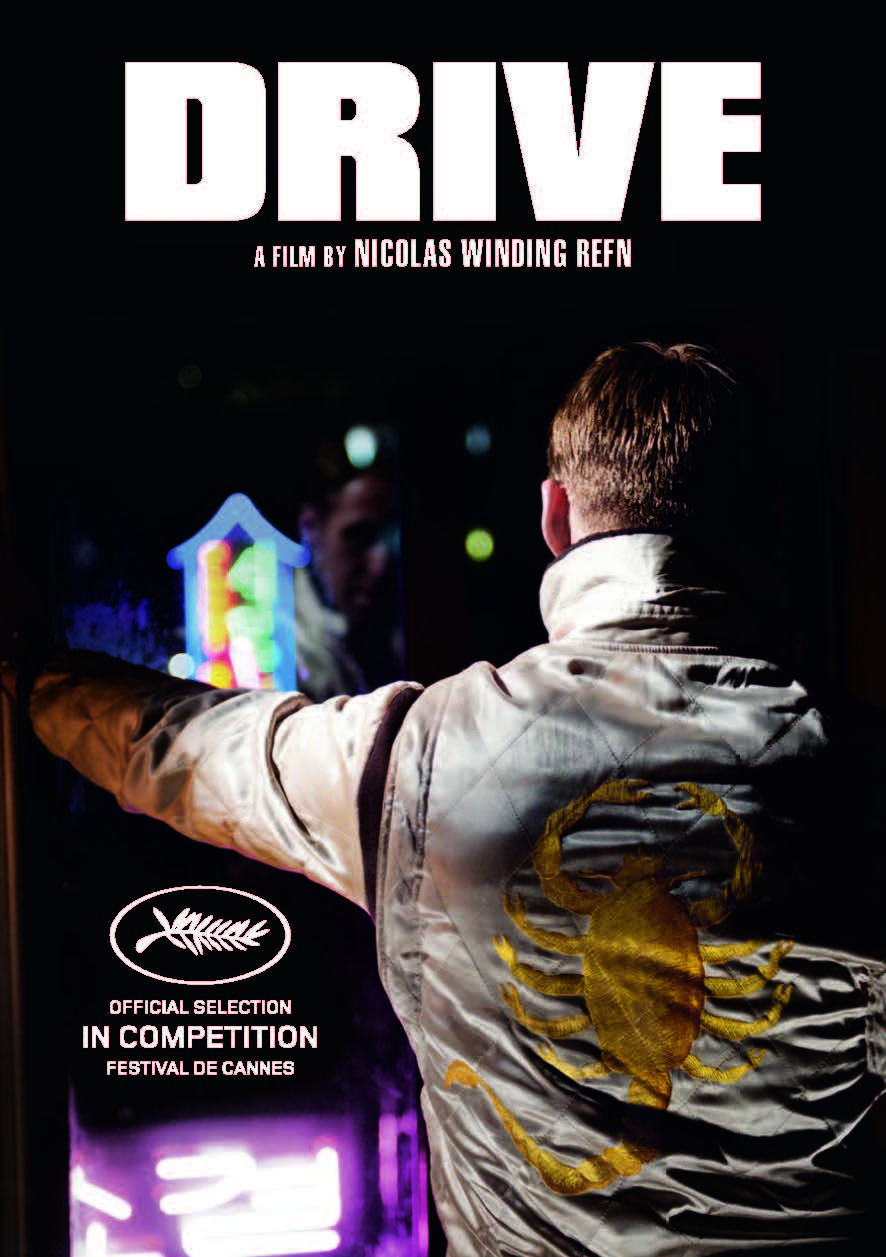
You know the story. Scorpion needs to make it over the river so he tries to hitch a ride on top of a frog. Frog is afraid scorpion will sting him. Scorpion explains that if he did that they would both drown. So frog ferries scorpion along and wouldn't you know it, just before they reach land scorpion stings him in the back, dooming them both. Frog asks why scorpion would pull that shit, to which scorpion responds, "that is my nature." The question of human nature is what Drive is all about: are individuals predisposed to behave by a certain irreversible nature? Are they predisposed to conflicting drives struggling for dominance? Are they able to transcend or change their nature? Can they transform or elevate themselves by embracing their drives? Are people capable of understanding or recognizing what they even are? Can we be a real human being and a real hero? It's a regular Jodorowsky, this one.
There's a great scene that perfectly sums up the question Drive poses. The Driver and Benicio are watching a cartoon together early in the film, and Driver asks the boy if a shark in the cartoon is the bad guy. Benicio says yes. "How can you tell he’s the bad guy?," Driver asks. "He’s a shark," the boy casually rationalizes. The Driver inquires, "Are all sharks bad?" and the young child nods his head. The scene could easily be (read: IS) referring to a number of characters in the movie, the most obvious being the Driver himself. It's also referencing Benicio's father, whom the audience is predisposed to hate until he actually appears onscreen and turns out to be a great person thrown into awful, inescapable circumstances. And to Driver's mentor (his Alfred, if you will), Shannon, another good guy who makes a bad choice that leads to disastrous consequences. Perhaps even to the antagonist Bernie Rose, a ruthless mobster who seems to genuinely regret the measures he must take to protect himself. Are any of these people intrinsically good or bad? Are any of them conscious of their individual human natures, if they even exist? Are their actions and behavior, their drives, determined by innate, instinctive characteristics? At first glance the Driver seems to serve as a profound 'YES' to these questions, but that's the beauty behind his lack of backstory and dialogue. We have no idea what he's thinking or feeling or how his environment may have shaped him; he's a total mystery to us. He's Rorschach without the caption boxes telling us his thoughts.
Compelling stuff, no?
Believe it or not, this digression I've taken ties in perfectly to the superhero stuff I'm supposed to be talking about. But first we have to take one last detour. Remember at the end of Batman Begins, when Bruce and Rachel are
talking at the ruins of Wayne Manor? Rachel feels up Bruce's face (if
I'm remembering the scene correctly) and declares "This is your mask.
Your real face is the one that criminals now fear. The man I loved, the
man who vanished...he never came back at all." Well all that is
obviously a load of bullshit; it's not a simple dichotomy between Bruce and Batman. Batman is clearly not his true persona, just as
his actual voice isn't a constipated chain smoker's. The Batman
identity is just as much a mask as millionaire playboy Bruce is, and although Rachel may think otherwise for some ill-defined reason, that is not the personality she is addressing right now. The
real person behind these facades, the man you loved and you think
vanished, is the one you're fucking talking face-to-face to you dumb
bitch: the highly disciplined, driven, perceptive, introspective,
resourceful and self-reliant Bruce Wayne. The man who has devoted his
life to a higher ideal and uses "Batman" as a tool to realize it.
Alright, now to get back on track. We're at the final lap, folks! To finish his transformation, the Driver dons a mask to hide his identity near the end of his origin story, completing his superhero costume. Crucially, the mask is taken from his day job, when the Driver needed to look like one of the actors for a car crash scene. It belongs in the realm of secret identity, not superhero. Drive knows better than Rachel, you see; it recognizes that a man's identity, his true nature, is much more nebulous than any clear-cut duality, especially between hero and secret identity. The entities are not so clearly defined - far from it - nor are they completely separate from one another. Perhaps there are elements of both in one another. Perhaps one morphs into the other. If human nature is an unanswerable question, than any attempts to explain it by ghettoizing its aspects into two definitive, opposite camps will ring as false as Rachel's half-baked analysis.
It's funny how similar the ending of Drive is to that of The Dark Knight; both have the protagonist speeding off into the darkness, with the screen cutting to black. The difference is that the ending to The Dark Knight is ominous, because by the picture's end Batman is not supposed to be a hero, while the ending of Drive is hopeful for the opposite reason. We started out with a man without any drive and saw him self-actualize. We saw him fall in love, transcend and become a real hero.
If Drive is any indication, we may soon be seeing a comparable transformation in the superhero film genre. I was once afraid that in the near future the superhero flick would over-saturate the market and go the way of the Western, that the genre would devour itself as people flocked away from the same formulaic origin stories over and over again. We saw a hint of that this summer: Thor, X-Men: First Class and Captain America all did very, very well at the box office (not so much Green Lantern), but they nevertheless failed to meet studio expectations by a great deal. There was no Iron Man among this crop of new franchises, and the only one to come even somewhat close was the first released. In light of seeing the formula applied with such ingenuity and unconventionality in Drive, I'm now confident that the superhero movie will not just survive, but will thrive in ways we have now only begun to see as it is freed from the constraints that once bound it. Yeah, the superhero movie will be fine.
It's just the superhero comic book movies that are gonna be fucked.
In the last stand of sentient beings in the universe two young bloggers took up their last fortification in THE JUNCTION TO NOWHERE.
Showing posts with label spider-man. Show all posts
Monday, October 3, 2011
Wednesday, August 17, 2011
A Message to Dan Slott
Dear Mr. Slott,
I have been reading your run on Amazing Spider-Man for a while now. Through doing so, I have come to realize that you are unaware of two things. Firstly, most readers - such as myself - have been following the title for a while now, and know from constant reiteration within each individual issue that Spider-Man is on two superhero teams, has a demanding high-end day job and a girlfriend that isn't MJ. More importantly, there's an intro page before the beginning of each issue that gives a crash-course on recent developments in Spider-Man's life. This introduction states that Spider-Man is on two superhero teams, has a demanding high-end day job and a girlfriend that isn't MJ.
I bring these up to help you realize that you do not have to spend one-third of every issue telling us that Spider-Man is on two superhero teams, has a demanding high-end day job and a girlfriend that isn't MJ. Which is exactly what it is, telling us. Describing it. Not offering insight into the effect it has on Peter's life, besides him continuously opining "doh boy it sure is crazy staying on top of all this busy stuff and not being poor anymore." It's just Peter saying to himself that he is, in fact, on two superhero teams, has a demanding high-end job and a girlfriend that isn't MJ. We all know about these things already. It has been made very, very clear to us.
It's getting increasingly difficult to trod through massive chunks of exposition that say the exact same thing issue after issue. I like the stories you've been writing during your tenure on Spider-Man, I like the way you handle the characters and the plots you put them in. "Spider Island" sounds like your coolest idea yet, I really want to read it. But I don't know if I can take another caption box of Spider-Man think-telling me about how he's on two superhero teams, has a demanding high-end job and a girlfriend that isn't MJ. I can use these things called pictures and this concept called character interaction to see that he's on two superhero teams, has a demanding high-end job and a girlfriend that isn't MJ.
Sincerely,
Everyone reading Amazing Spider-Man
I have been reading your run on Amazing Spider-Man for a while now. Through doing so, I have come to realize that you are unaware of two things. Firstly, most readers - such as myself - have been following the title for a while now, and know from constant reiteration within each individual issue that Spider-Man is on two superhero teams, has a demanding high-end day job and a girlfriend that isn't MJ. More importantly, there's an intro page before the beginning of each issue that gives a crash-course on recent developments in Spider-Man's life. This introduction states that Spider-Man is on two superhero teams, has a demanding high-end day job and a girlfriend that isn't MJ.
I bring these up to help you realize that you do not have to spend one-third of every issue telling us that Spider-Man is on two superhero teams, has a demanding high-end day job and a girlfriend that isn't MJ. Which is exactly what it is, telling us. Describing it. Not offering insight into the effect it has on Peter's life, besides him continuously opining "doh boy it sure is crazy staying on top of all this busy stuff and not being poor anymore." It's just Peter saying to himself that he is, in fact, on two superhero teams, has a demanding high-end job and a girlfriend that isn't MJ. We all know about these things already. It has been made very, very clear to us.
It's getting increasingly difficult to trod through massive chunks of exposition that say the exact same thing issue after issue. I like the stories you've been writing during your tenure on Spider-Man, I like the way you handle the characters and the plots you put them in. "Spider Island" sounds like your coolest idea yet, I really want to read it. But I don't know if I can take another caption box of Spider-Man think-telling me about how he's on two superhero teams, has a demanding high-end job and a girlfriend that isn't MJ. I can use these things called pictures and this concept called character interaction to see that he's on two superhero teams, has a demanding high-end job and a girlfriend that isn't MJ.
Sincerely,
Everyone reading Amazing Spider-Man
Sunday, June 19, 2011
Monday Review: Spider-Man Reboo...t!
Damn! So close to a rhyming title.
So last May I saw Spider-Man: Turn Off the Dark with my friend Kullan on its second day of new previews, fresh off its month-long, completely-reworking-everything-after-being-universally-panned-and-hemorrhaging-millions hiatus. I imagine if this was the first time I saw the show, I would have found it pretty mediocre. But I had the dubious privilege of seeing the show pre-boot, and Jesus. Fucking. Christ. THERE IS SO MUCH IMPROVEMENT! Seeing Spidey 2.0 after witnessing the Taymor trainwreck is such an experience. The latter was the worst show in the history of Broadway; the former may not be great, maybe not even good, but it's far from the worst thing on Broadway THIS SEASON.
If you can't appreciate that degree of improvement on such a complicated production in a one month time span, then there is something wrong with you on a fundamental level. You should reevaluate your life.

So what's so different? Well the biggest thing is that former Turn Off the Dark mastermind Julie Taymor was completely dropped from the show, and with it her...umm, unique...vision of webhead, his mythology, and the larger nature of the musical theatre experience. With Taymor out of the picture, the story could molded be into something more recognizably Spider-Man. That insufferable Geek Chorus is gone, and Arachne - Taymor's authorial avatar and the big bad of Spidey 1.0 - is reduced to little more than a glorified cameo.
The book, resuscitated by comics veteran and celebrated playwright - that rare breed! - Roberto Aguirre-Sacasa, is finally coherent. Sacasa removed the Arachne subplot that dominated the show's second act, instead opting to lengthen the more-or-less unrelated story of the first into the show's entirety. Gone are her eight-legged furies and her maniacal quest to steal shoes better than MJ's (...I, uh, I think that's what was in the old version. I'm still trying to work out what the hell was going on). Sacasa's plot is considerably more streamlined, cohesive, and rewarding to the audience; Sacasa gives Spidey and the Green Goblin much-needed breathing space to develop. In Taymor's crammed book, the first act ended with Gobby's death; in the new version, it ends with his origin.
Many of the songs were reworked, some were cut, and a new one was added: "A Freak Like Me Needs Company." It's an 80s-style dance-romp pastiche at the beginning of Act II, and probably the best song in the whole damn show. "I'm a 65 million dollar circus tragedy -- well maybe more like 75 million!" Osborn sneers as he mutates his two-faced colleagues in the same accident that birthed his villainous alter ego. It's a clever way to introduce the Sinister Six, who before were created on the half-baked whims of the Geek Chorus. God what a fucking lazy narrative device.
For what it's worth, I chuckled at the self-reference, too. Meta is handled pretty sloppily in musical theatre these days, so I appreciate when it can elicit an emotion other than facepalm.

The best part about Sacasa's new song is that, unlike the Bono-penned tunes in the rest of the show, "A Freak Like Me" actually advances the plot, which is kind of what a song in a musical is supposed to do. And speaking of the insufferable Irishman, you'll all be happy to know that "Vertigo" was removed from the club scene, replaced by generic untz-untz rave music. Unfortunately, "Bullying By Numbers" remains. Ears bled. I just wish "bullying by numbers" was an actual phrase so the song would at least make a nugget of fucking sense.
A number of other additions and changes were made to the production. True Believers will be happy to know that, through the magic of prerecorded lines blasted through speakers (TRULY WE ARE IN THE FUTURE), Spider-Man now cracks jokes as he swings through the Foxwoods Theater. I squealed at that a bit, not gonna lie. Also that scene early in Act I where Peter's home life - where he whines and angsts because he gets bullied at school and his parents who aren't his actual parents just don't know what it's like to be a teenager, maaaan - is juxtaposed with Mary Jane's - where she's verbally and physically abused by her alcoholic father - is made a little less appallingly awful. Now the father is a drunk of the sad, pathetic, harmless variety, the kind you simultaneously pity and root for. In other words, Tony Stark circa 1979. COME ON MJ'S DAD YOU CAN GET OFFA THE STUFF IF YOU JUST TRY. Anyway the implication that Peter and Mary Jane's lives are equally tragic works a bit better. A bit.
Of course, Turn Off the Dark is not without its problems, namely its inability to completely reconcile the new, less fantastical narrative with Taymor's astronomically expensive vision. This was inevitable; they spent all that fucking money creating vaguely racist masks, blow-up doll Bonesaws and LED screens for shitty Sinister Six music videos, of course they can't afford to scrap any of that stuff. Sacasa does the best he - or anyone, I imagine - can integrating all the overpriced incoherence into the story, but the dissonance is jarring. Arachne is the most obvious casualty; there's really no reason for the character to remain in the show, besides her spider suit probably costing a few hundred thousand dollars. As a "guardian angel" that confers with Peter in two dream sequences, the role serves little purpose, existing only to belt out "Rise Above" and for some cool Cirque du Soleil stuff (itself another out-of-place Taymor remnant irrelevant to the plot) at the beginning of the musical. I almost wish Arachne had more stage time, if only to better integrate her into the story. Y'know, give her a reason to be in that list of characters or something.

One final thing I noticed was that Sacasa's book contains a lot more insider references to life in New York City, which is another really interesting and well done metafictional element to Spidey 2.0. The show has, after all, become part and particle of the city, the talk of the town in virtually every circle. Turn Off the Dark reached fruition during my first year living in Manhattan, and the notorious production was always in the headlines, always THE topic of conversation. This "65 million dollar circus tragedy" may have had a much larger influence on NYC than people currently acknowledge, one that may have lasting effects on its culture, economy, and society. Only time will tell.
God I can't wait to leave boring, touristy D.C. and get back there. I'll be able to bow my head in embarrassment as I admit to all my elitist drama major friends that I kinda liked how Spider-Man: Turn Off the Dark 2.0 turned out.
And Reeve Carney still rocks that ballin' Spider-Man jacket. In these trying times that's all anyone can really ask for.
So last May I saw Spider-Man: Turn Off the Dark with my friend Kullan on its second day of new previews, fresh off its month-long, completely-reworking-everything-after-being-universally-panned-and-hemorrhaging-millions hiatus. I imagine if this was the first time I saw the show, I would have found it pretty mediocre. But I had the dubious privilege of seeing the show pre-boot, and Jesus. Fucking. Christ. THERE IS SO MUCH IMPROVEMENT! Seeing Spidey 2.0 after witnessing the Taymor trainwreck is such an experience. The latter was the worst show in the history of Broadway; the former may not be great, maybe not even good, but it's far from the worst thing on Broadway THIS SEASON.
If you can't appreciate that degree of improvement on such a complicated production in a one month time span, then there is something wrong with you on a fundamental level. You should reevaluate your life.
So what's so different? Well the biggest thing is that former Turn Off the Dark mastermind Julie Taymor was completely dropped from the show, and with it her...umm, unique...vision of webhead, his mythology, and the larger nature of the musical theatre experience. With Taymor out of the picture, the story could molded be into something more recognizably Spider-Man. That insufferable Geek Chorus is gone, and Arachne - Taymor's authorial avatar and the big bad of Spidey 1.0 - is reduced to little more than a glorified cameo.
The book, resuscitated by comics veteran and celebrated playwright - that rare breed! - Roberto Aguirre-Sacasa, is finally coherent. Sacasa removed the Arachne subplot that dominated the show's second act, instead opting to lengthen the more-or-less unrelated story of the first into the show's entirety. Gone are her eight-legged furies and her maniacal quest to steal shoes better than MJ's (...I, uh, I think that's what was in the old version. I'm still trying to work out what the hell was going on). Sacasa's plot is considerably more streamlined, cohesive, and rewarding to the audience; Sacasa gives Spidey and the Green Goblin much-needed breathing space to develop. In Taymor's crammed book, the first act ended with Gobby's death; in the new version, it ends with his origin.
Many of the songs were reworked, some were cut, and a new one was added: "A Freak Like Me Needs Company." It's an 80s-style dance-romp pastiche at the beginning of Act II, and probably the best song in the whole damn show. "I'm a 65 million dollar circus tragedy -- well maybe more like 75 million!" Osborn sneers as he mutates his two-faced colleagues in the same accident that birthed his villainous alter ego. It's a clever way to introduce the Sinister Six, who before were created on the half-baked whims of the Geek Chorus. God what a fucking lazy narrative device.
For what it's worth, I chuckled at the self-reference, too. Meta is handled pretty sloppily in musical theatre these days, so I appreciate when it can elicit an emotion other than facepalm.
The best part about Sacasa's new song is that, unlike the Bono-penned tunes in the rest of the show, "A Freak Like Me" actually advances the plot, which is kind of what a song in a musical is supposed to do. And speaking of the insufferable Irishman, you'll all be happy to know that "Vertigo" was removed from the club scene, replaced by generic untz-untz rave music. Unfortunately, "Bullying By Numbers" remains. Ears bled. I just wish "bullying by numbers" was an actual phrase so the song would at least make a nugget of fucking sense.
A number of other additions and changes were made to the production. True Believers will be happy to know that, through the magic of prerecorded lines blasted through speakers (TRULY WE ARE IN THE FUTURE), Spider-Man now cracks jokes as he swings through the Foxwoods Theater. I squealed at that a bit, not gonna lie. Also that scene early in Act I where Peter's home life - where he whines and angsts because he gets bullied at school and his parents who aren't his actual parents just don't know what it's like to be a teenager, maaaan - is juxtaposed with Mary Jane's - where she's verbally and physically abused by her alcoholic father - is made a little less appallingly awful. Now the father is a drunk of the sad, pathetic, harmless variety, the kind you simultaneously pity and root for. In other words, Tony Stark circa 1979. COME ON MJ'S DAD YOU CAN GET OFFA THE STUFF IF YOU JUST TRY. Anyway the implication that Peter and Mary Jane's lives are equally tragic works a bit better. A bit.
Of course, Turn Off the Dark is not without its problems, namely its inability to completely reconcile the new, less fantastical narrative with Taymor's astronomically expensive vision. This was inevitable; they spent all that fucking money creating vaguely racist masks, blow-up doll Bonesaws and LED screens for shitty Sinister Six music videos, of course they can't afford to scrap any of that stuff. Sacasa does the best he - or anyone, I imagine - can integrating all the overpriced incoherence into the story, but the dissonance is jarring. Arachne is the most obvious casualty; there's really no reason for the character to remain in the show, besides her spider suit probably costing a few hundred thousand dollars. As a "guardian angel" that confers with Peter in two dream sequences, the role serves little purpose, existing only to belt out "Rise Above" and for some cool Cirque du Soleil stuff (itself another out-of-place Taymor remnant irrelevant to the plot) at the beginning of the musical. I almost wish Arachne had more stage time, if only to better integrate her into the story. Y'know, give her a reason to be in that list of characters or something.
One final thing I noticed was that Sacasa's book contains a lot more insider references to life in New York City, which is another really interesting and well done metafictional element to Spidey 2.0. The show has, after all, become part and particle of the city, the talk of the town in virtually every circle. Turn Off the Dark reached fruition during my first year living in Manhattan, and the notorious production was always in the headlines, always THE topic of conversation. This "65 million dollar circus tragedy" may have had a much larger influence on NYC than people currently acknowledge, one that may have lasting effects on its culture, economy, and society. Only time will tell.
God I can't wait to leave boring, touristy D.C. and get back there. I'll be able to bow my head in embarrassment as I admit to all my elitist drama major friends that I kinda liked how Spider-Man: Turn Off the Dark 2.0 turned out.
And Reeve Carney still rocks that ballin' Spider-Man jacket. In these trying times that's all anyone can really ask for.
Tuesday, May 24, 2011
...He's Probably Just Like Me: A Mother. F***ing. Goblin.
Excuse the title, I've been getting into Tyler a lot lately. Just like every suburban white kid.
Well it has been a while, hasn’t it? Schoolwork and women and a few nasty medical issues have kept me away from here – life likes to throw wrenches in our routines with crazy stuff like that. The other blogger on here is just super lazy and spends his time drunk go-karting in drag at weddings. Oh Gabriel, you and your antics. But that’s a story for another time, and I pwomise I’ll be posting more often in the coming months. Now I swore to myself that I would stop with these damn Spidey villain posts, I'm just so tired of them. But this one, this one I had to bang out -- it was born out of necessity. NECESSITY!! And besides, why not cap these off with a post on web-head's baddest baddie?*

*Personally I always thought Doc Ock was a better candidate for archenemy status. Stan agrees with me, so yeah. But, y'know, whatevs...
So here's how it all started: a couple months ago my friend Dom and I were watching the first Spider-Man movie with his buddies Tim and Seth. Right around the part where Willem Dafoe croaks out "Back to formula?", Dom turns to me and asks: “So what's Green Goblin’s deal, what makes him so significant as a Spider-Man villain? What makes him the archenemy?”
Good. Question.
A lot of the true believers have a really tough time with the Green Goblin. On one hand, he's supposedly the web-slinger's greatest nemesis. No other foe has made such an indelible mark on the mythos, has caused our hero so much grief and torment. On the other hand, he's so out of place with the rest of the rogues. He's a total anomaly; not a consciously boisterous showman, not a team player like the guys in the Sinister Six, not an animal-themed totem or a symbiote Doppelgänger - nothing about him syncs up. Worse still, Gobby simply seems to lack any deeper thematic significance, possessing none of those weighty opposites or parallels that drive the best superhero-villain relationships. He just doesn't appear to riff off of any aspects of Peter/Spidey in the way that a great supervillain, archenemy or not, should. Better men than I have tried to wrassle with GG with a good deal of success (here and here, you guys should read 'em and stuff), but every analysis I've come across can't help but fall a bit flat against the sheer enormity of the spider-goblin rivalry. It can't all come from the soap operatics and father-figure underpinnings - from the initial mystery of his identity, his personal connection to Peter and Harry, and the Night Gwen Stacy Died. There's got to be something about Osborn and his demon at the conceptual level that appeals to people, right?
Don't worry, there is! There is in spades!! And once we dig it out, you'll totally understand why this guy is Spider-Man's one true nemesis in the eyes of most fans.
But first, digression! So in one of my drama classes this year, Voice & Speech, we all had to recite a Shakespearean sonnet. One of the shier students was rehearsing hers for our teacher in front of the group, and to get her to project better the teacher asked her to sing the sonnet. This backfired rather ingloriously: the student’s voice began to diminish and waver with hesitation. She became apprehensive, started to choke up. The teacher kept pushing her and pushing her until eventually she broke down and started to cry – as we were all soon to discover in the coming moments, this girl was super self-conscious about her singing voice. So much so, in fact, that the whole ordeal was like a nightmare come to life for her. The class necessarily turned into a group therapy session, with the teacher taking the reigns: “We all have that voice in the back of our heads that just wants to get us down sometimes, and it can be hard. I have it too: 'Your boobs are too small.' 'You're getting old, getting ugly wrinkles on your face.' 'You're not a good actress.' But you know what? It's not helpful at all, and it's just plain wrong, so you've just got to find that little bastard telling you 'you're a bad singer' and tune it out. Get that goblin out of your head.”
“Get that goblin out of your head.”
That, that right there is what Osborn’s monster is all about.

You know those quirky indie dramadies where the protagonist’s insecurities manifest as physical people he can have a dialogue with? The Green Goblin is that for Peter. He’s the personification of all Peter’s nagging self-doubt, the voice in his head from where all his inner anxiety arises. We all have it to varying degrees, telling us there is something fundamentally wrong with your body or personality or thought process, etc. that makes you undesirable, inadequate, worthless, inferior.
And until you stop trying to fight it, that voice says, I’ll always be here, in the back of your head, to remind you again and again and again. Just when life seems to be getting good, I’ll be there to tell you all the reasons to hate yourself. I’ll be there to destroy everything you love and make your life miserable.
I’ll be there to drop your true love off a bridge and turn your best friend into a schizo suicidal junkie. Oh, and the Clone Saga, that too. Everybody lost out with that one.
Of course, while those guys in the movies are figments of some paranoid schmuck’s imagination, Gobby is a living, flesh-and-blood proxy, so he takes on a much more threatening antagonistic role. On the elevated plane of superheroics, where big ideas duke it out in the streets of Metropolis or Gotham, the inner conflict becomes externalized – the fight in Peter’s psyche is literalized into a physical brawl between two entities. That’s probably why GG won’t stay dead; you can triumph over your inner demons, but you can never quite get rid of them entirely.
Maybe that’s because they can be so damn tempting sometimes. The same voice that points out your perceived faults and misfortunes also has a habit of demanding retribution for them. To make others pay for the unfairness, the injustice of it all. It’s a bad emotional place that’s all too appealing to go to, encompassing jealousy, envy, anger towards the ex that cheated on or dumped you, resentment towards the bully that emasculates you, etc. etc. All that nasty Columbine-fuel.
Too soon? Too soon…
As you might expect, GG also embodies this aspect of Peter’s inner life. And so here, for context's sake, we find a relation between web-head's two most essential foes: if Doctor Octopus is what Spidey will become if he compromises his principles and succumbs to his own heaping angst, the Green Goblin is the voice in Spidey’s head telling him to do just that. He whispers into Peter’s ears: there’s always a way out, a way to free yourself and vent all your self-loathing away. Give up the good fight, don’t try to go against the tide of a cruel, apathetic world. Surrender to your frustration, your bitterness – let life make a cynic out of you. Lash out! It’s liberating! Just ask Norman, he’s so much better now…
And how does Norman factor into all this? It’s important to remember that Osborn was a nasty guy even before the accident, but he was motivated by a profound sense (more accurately misunderstanding) of responsibility. Like the rest of us, Norm had a goblin in his head too, reminding him over and over again of the enormous responsibilities he had - to his corporation, his thousands of employees, his clients, his son - all of which he was failing to meet. A mid-life crisis didn't do him any favors, either. So the pressure got to him and the voice in his head started calling the shots. When that serum exploded in his face and messed up his mind, his inner goblin took complete control...but not in the way it usually goes down. He didn’t succumb to it, a la Doc Ock with his never-ending insecurities, so much as he actually became it. And through this almost shamanistic process, he learned something: with great power comes freedom from responsibility!
So Gobbs puts on a crazy costume befitting his nature, and just like that he's a boogeyman straight out of some neurotic loser's nightmares, an embodiment of all his fears and doubts and emotional/psychological baggage. Problem is, GG doesn't have that neurotic loser to torment yet. But from the start he knows Spider-Man is the one. I mean look no further than the Goblin's debut in Amazing Spider-Man #14, where he tracks Spidey down and proposes that the two of them star in a Hollywood blockbuster together...which Spider-Man accepts!! It's so ridiculous, I love it. God those comics are fucking great. Their connection borders on supernatural or predestination, like that other great superhero rivalry. One simply can't exist without the other.

There's a concept that describes the relationship between the Green Goblin and our hero perfectly: duende. It's a term coined by Federico Garcia Lorca, borrowed from the mythical goblins (OH HO SEE WHUT I DID THAR) of Spanish/Latin American folklore. He describes duende as a mysterious, inexplicable force that arises from within us as a raw physical and emotional response. The kind of idea invoked by a Movement Techniques teacher when she wants you to do weird abstract performance art stuff (no one said drama majors take real classes). In Lorca's context, the duende is a demonic spirit who allows an artist to see the limitations of rationality. It brings the artist face-to-face with death and pure emotional experience, all to help him produce truly great art. The artist does not simply surrender to duende, however, but skillfully battles it in hand-to-hand combat; through this process the art is created (all of this has been ripped pretty shamelessly from In Search of Duende, if anyone's interested). Replace duende with Gobbs and the artist with Spidey and you've got some seriously meta shit going on there.
Duende actually popped up in Batman Inc. #3 last March, where Bruce Wayne described it more generally as "the fierce lust for life when we feel and express when we know death is near." Among the elements that comprise duende are irrationality, diabolicalness and a heightened awareness of death...all of which also describe Gobby pretty well, don't they? He's certainly diabolical, and anybody who rides on a glider like that without a goddamn helmet has the death drive thing down. He's obviously irrational, too - we're talking about a guy who spends his nights in a lab building grenades that look like pumpkins, like actually taking the time to make sure they look like pumpkins. What kind of fucking freak does that?
Maybe the kind who spends his nights in his foster parents' basement building wrist-mounted devices to shoot high-tensile silly string? (Don't even get me started on that organic webbing bullshit) Spider-Man was a hero conceived with a deliberately icky edge, and most of Spidey's rogues are extensions of his murkier dimensions, extensions which must at least potentially exist deep within Pete's psyche. Like a corrupt, malicious version of duende the Green Goblin wants to bring all that darkness out, which is why he brings Peter face-to-face with irrationality and diabolicalness and death. Ever since his first appearance in Amazing #14, where Ditko drew the Goblin as a carnivalesque monster, his cartoonish features grotesquely incongruous with the sickly realism that informed the rest of the art. Ever since his master plan in Amazing #39 which, as simple as it was, to this day remains one of the most demoniac in supervillain history. Ever since his apparent demise in Amazing #122, when Gwen Stacy snapped her neck and everything changed forever.
I imagine the Green Goblin finds this renewed-self-confidence-nobody-dies phase going on in Peter's life right now to be so adorably quaint. You can bet that he'll be the one to end it. Sometimes just when you think you've conquered your demons, they come back stronger than ever before.
Tune in next time for a review of the revamped Spidey musical, fresh off its month-long hiatus. Guess what guys, it's not that bad anymore! I mean, it's not great, I'd hesitate before even calling it good, but it's a far, far cry from the shitshow trainwreck I saw in February. Hooray!!
Well it has been a while, hasn’t it? Schoolwork and women and a few nasty medical issues have kept me away from here – life likes to throw wrenches in our routines with crazy stuff like that. The other blogger on here is just super lazy and spends his time drunk go-karting in drag at weddings. Oh Gabriel, you and your antics. But that’s a story for another time, and I pwomise I’ll be posting more often in the coming months. Now I swore to myself that I would stop with these damn Spidey villain posts, I'm just so tired of them. But this one, this one I had to bang out -- it was born out of necessity. NECESSITY!! And besides, why not cap these off with a post on web-head's baddest baddie?*
*Personally I always thought Doc Ock was a better candidate for archenemy status. Stan agrees with me, so yeah. But, y'know, whatevs...
So here's how it all started: a couple months ago my friend Dom and I were watching the first Spider-Man movie with his buddies Tim and Seth. Right around the part where Willem Dafoe croaks out "Back to formula?", Dom turns to me and asks: “So what's Green Goblin’s deal, what makes him so significant as a Spider-Man villain? What makes him the archenemy?”
Good. Question.
A lot of the true believers have a really tough time with the Green Goblin. On one hand, he's supposedly the web-slinger's greatest nemesis. No other foe has made such an indelible mark on the mythos, has caused our hero so much grief and torment. On the other hand, he's so out of place with the rest of the rogues. He's a total anomaly; not a consciously boisterous showman, not a team player like the guys in the Sinister Six, not an animal-themed totem or a symbiote Doppelgänger - nothing about him syncs up. Worse still, Gobby simply seems to lack any deeper thematic significance, possessing none of those weighty opposites or parallels that drive the best superhero-villain relationships. He just doesn't appear to riff off of any aspects of Peter/Spidey in the way that a great supervillain, archenemy or not, should. Better men than I have tried to wrassle with GG with a good deal of success (here and here, you guys should read 'em and stuff), but every analysis I've come across can't help but fall a bit flat against the sheer enormity of the spider-goblin rivalry. It can't all come from the soap operatics and father-figure underpinnings - from the initial mystery of his identity, his personal connection to Peter and Harry, and the Night Gwen Stacy Died. There's got to be something about Osborn and his demon at the conceptual level that appeals to people, right?
Don't worry, there is! There is in spades!! And once we dig it out, you'll totally understand why this guy is Spider-Man's one true nemesis in the eyes of most fans.
But first, digression! So in one of my drama classes this year, Voice & Speech, we all had to recite a Shakespearean sonnet. One of the shier students was rehearsing hers for our teacher in front of the group, and to get her to project better the teacher asked her to sing the sonnet. This backfired rather ingloriously: the student’s voice began to diminish and waver with hesitation. She became apprehensive, started to choke up. The teacher kept pushing her and pushing her until eventually she broke down and started to cry – as we were all soon to discover in the coming moments, this girl was super self-conscious about her singing voice. So much so, in fact, that the whole ordeal was like a nightmare come to life for her. The class necessarily turned into a group therapy session, with the teacher taking the reigns: “We all have that voice in the back of our heads that just wants to get us down sometimes, and it can be hard. I have it too: 'Your boobs are too small.' 'You're getting old, getting ugly wrinkles on your face.' 'You're not a good actress.' But you know what? It's not helpful at all, and it's just plain wrong, so you've just got to find that little bastard telling you 'you're a bad singer' and tune it out. Get that goblin out of your head.”
“Get that goblin out of your head.”
That, that right there is what Osborn’s monster is all about.
You know those quirky indie dramadies where the protagonist’s insecurities manifest as physical people he can have a dialogue with? The Green Goblin is that for Peter. He’s the personification of all Peter’s nagging self-doubt, the voice in his head from where all his inner anxiety arises. We all have it to varying degrees, telling us there is something fundamentally wrong with your body or personality or thought process, etc. that makes you undesirable, inadequate, worthless, inferior.
And until you stop trying to fight it, that voice says, I’ll always be here, in the back of your head, to remind you again and again and again. Just when life seems to be getting good, I’ll be there to tell you all the reasons to hate yourself. I’ll be there to destroy everything you love and make your life miserable.
I’ll be there to drop your true love off a bridge and turn your best friend into a schizo suicidal junkie. Oh, and the Clone Saga, that too. Everybody lost out with that one.
Of course, while those guys in the movies are figments of some paranoid schmuck’s imagination, Gobby is a living, flesh-and-blood proxy, so he takes on a much more threatening antagonistic role. On the elevated plane of superheroics, where big ideas duke it out in the streets of Metropolis or Gotham, the inner conflict becomes externalized – the fight in Peter’s psyche is literalized into a physical brawl between two entities. That’s probably why GG won’t stay dead; you can triumph over your inner demons, but you can never quite get rid of them entirely.
Maybe that’s because they can be so damn tempting sometimes. The same voice that points out your perceived faults and misfortunes also has a habit of demanding retribution for them. To make others pay for the unfairness, the injustice of it all. It’s a bad emotional place that’s all too appealing to go to, encompassing jealousy, envy, anger towards the ex that cheated on or dumped you, resentment towards the bully that emasculates you, etc. etc. All that nasty Columbine-fuel.
Too soon? Too soon…
As you might expect, GG also embodies this aspect of Peter’s inner life. And so here, for context's sake, we find a relation between web-head's two most essential foes: if Doctor Octopus is what Spidey will become if he compromises his principles and succumbs to his own heaping angst, the Green Goblin is the voice in Spidey’s head telling him to do just that. He whispers into Peter’s ears: there’s always a way out, a way to free yourself and vent all your self-loathing away. Give up the good fight, don’t try to go against the tide of a cruel, apathetic world. Surrender to your frustration, your bitterness – let life make a cynic out of you. Lash out! It’s liberating! Just ask Norman, he’s so much better now…
And how does Norman factor into all this? It’s important to remember that Osborn was a nasty guy even before the accident, but he was motivated by a profound sense (more accurately misunderstanding) of responsibility. Like the rest of us, Norm had a goblin in his head too, reminding him over and over again of the enormous responsibilities he had - to his corporation, his thousands of employees, his clients, his son - all of which he was failing to meet. A mid-life crisis didn't do him any favors, either. So the pressure got to him and the voice in his head started calling the shots. When that serum exploded in his face and messed up his mind, his inner goblin took complete control...but not in the way it usually goes down. He didn’t succumb to it, a la Doc Ock with his never-ending insecurities, so much as he actually became it. And through this almost shamanistic process, he learned something: with great power comes freedom from responsibility!
So Gobbs puts on a crazy costume befitting his nature, and just like that he's a boogeyman straight out of some neurotic loser's nightmares, an embodiment of all his fears and doubts and emotional/psychological baggage. Problem is, GG doesn't have that neurotic loser to torment yet. But from the start he knows Spider-Man is the one. I mean look no further than the Goblin's debut in Amazing Spider-Man #14, where he tracks Spidey down and proposes that the two of them star in a Hollywood blockbuster together...which Spider-Man accepts!! It's so ridiculous, I love it. God those comics are fucking great. Their connection borders on supernatural or predestination, like that other great superhero rivalry. One simply can't exist without the other.
There's a concept that describes the relationship between the Green Goblin and our hero perfectly: duende. It's a term coined by Federico Garcia Lorca, borrowed from the mythical goblins (OH HO SEE WHUT I DID THAR) of Spanish/Latin American folklore. He describes duende as a mysterious, inexplicable force that arises from within us as a raw physical and emotional response. The kind of idea invoked by a Movement Techniques teacher when she wants you to do weird abstract performance art stuff (no one said drama majors take real classes). In Lorca's context, the duende is a demonic spirit who allows an artist to see the limitations of rationality. It brings the artist face-to-face with death and pure emotional experience, all to help him produce truly great art. The artist does not simply surrender to duende, however, but skillfully battles it in hand-to-hand combat; through this process the art is created (all of this has been ripped pretty shamelessly from In Search of Duende, if anyone's interested). Replace duende with Gobbs and the artist with Spidey and you've got some seriously meta shit going on there.
Duende actually popped up in Batman Inc. #3 last March, where Bruce Wayne described it more generally as "the fierce lust for life when we feel and express when we know death is near." Among the elements that comprise duende are irrationality, diabolicalness and a heightened awareness of death...all of which also describe Gobby pretty well, don't they? He's certainly diabolical, and anybody who rides on a glider like that without a goddamn helmet has the death drive thing down. He's obviously irrational, too - we're talking about a guy who spends his nights in a lab building grenades that look like pumpkins, like actually taking the time to make sure they look like pumpkins. What kind of fucking freak does that?
Maybe the kind who spends his nights in his foster parents' basement building wrist-mounted devices to shoot high-tensile silly string? (Don't even get me started on that organic webbing bullshit) Spider-Man was a hero conceived with a deliberately icky edge, and most of Spidey's rogues are extensions of his murkier dimensions, extensions which must at least potentially exist deep within Pete's psyche. Like a corrupt, malicious version of duende the Green Goblin wants to bring all that darkness out, which is why he brings Peter face-to-face with irrationality and diabolicalness and death. Ever since his first appearance in Amazing #14, where Ditko drew the Goblin as a carnivalesque monster, his cartoonish features grotesquely incongruous with the sickly realism that informed the rest of the art. Ever since his master plan in Amazing #39 which, as simple as it was, to this day remains one of the most demoniac in supervillain history. Ever since his apparent demise in Amazing #122, when Gwen Stacy snapped her neck and everything changed forever.
I imagine the Green Goblin finds this renewed-self-confidence-nobody-dies phase going on in Peter's life right now to be so adorably quaint. You can bet that he'll be the one to end it. Sometimes just when you think you've conquered your demons, they come back stronger than ever before.
Tune in next time for a review of the revamped Spidey musical, fresh off its month-long hiatus. Guess what guys, it's not that bad anymore! I mean, it's not great, I'd hesitate before even calling it good, but it's a far, far cry from the shitshow trainwreck I saw in February. Hooray!!
Monday, March 21, 2011
Rules of Carnage
In my last Spidey villain article - which I'm not too happy with but whatever, read it for the lulzy vid in the intro - I briefly touched on the idea of the Sandman as a horror monster. It started to get me thinking about the other A-list monster foes that plague Spider-Man. Venom and the Lizard are pretty foolproof characters whose thematic appeal is obvious; I don't see any inherent conceptual problems that need to be worked out like with the Sandman, Electro and Mysterio (Part I, Part II). You can still expect a Lizard article eventually since he's my favesies and is gonna be the big bad for the new Spidey flick, but with those two rogues being so obviously sound there's only one real A-list monster villain left. One that could really use a hand these days.
Yup, Carnage, that exemplar of 90s comics excess. He managed to weasel his way into the highest echelons of the Spider-Man villain community by coasting on fan-favoritism and to this day he remains easily the most controversial of web-head's foes. A lot of people, mostly younger kids and folks who were younger kids in the 90s, really love the guy. He's stronger than Venom! He's crazy! He kills people and writes "Carnage Rules" in their blood! He's got fangs and claws and is scary and can morph his arms into swords and stuff!
A lot of other people, mostly the older, more mature readers, really hate the guy. He's derivative! He's creatively bankrupt! He's insipid, has no character, no intrinsic meaning or value! He's a shining example of everything wrong with the mindlessly ultra-violent superhero comics of his golden age!
Me? I remember as a little kid I thought he was so freakin' kool. For the yung'uns who can't remember, this guy was HUGE in the 90s. He was everywhere, probably just as overexposed as Wolverine and Venom were, maybe for a while even more. He was the star of a sweet-ass Sega Genesis game I would always play at my friend's house. I don't know how popular he is today - I get the feeling that the negative opinion of him is the norm now, if only because that's my opinion of him now - but regardless of how poorly-conceived the character may be, Carnage's position is secured. For better or for worse, he's definitely top 10 web-slinger villains material.
Wouldn't it be great, then, if he could actually be made interesting? If he could be re-assembled into a proper foe worthy of Spider-Man while retaining and expanding what little personality is already there?
Ah, but he can be! And it's not as difficult as you might think. Carnage was conceived and pitched as the Joker (or a caricature of the Joker) with a symbiote. To make Carnage a worthwhile enemy, all we have to do is take the symbiote off the Clown Prince of Crime and stick it onto Doctor Hurt.
What, you don't know who Doctor Hurt is? Go out and buy (who am I kidding, pirate) Grant Morrison's recent Batman epic. Some parts are better than others, but it's unquestionably the most innovative interpretation of Batman and his mythos since Frank Miller made him dark again in the mid-80s. And it gave us hands-down the greatest new supervillain of the 21st century. In the saga, Doctor Hurt and his legion of allies attempt to break down the World's Greatest Detective in body, mind and spirit, to unravel his mythology at the seams and annihilate him at the core conceptual level. "Twist and destroy the Batman and his legacy." It was Batman deconstructed to the brink of the abyss as his entire reality crumbled away, then reconstructed as the Dark Knight looked evil's greatest plan straight in the eye, kicked its fucking ass and stood triumphantly validated. Beautiful, inspirational stuff.

Spider-Man's never been properly deconstructed, let alone reconstructed in this way. The closest thing we've had was that Morlun saga by J. Michael Straczynski. It's a good read (JMS hadn't yet jumped the shark at that point) but the profound realizations the story explored basically amounted to "hey, all of these guys are themed after animals" and "eww, a kid with spider powers is actually really gross." It's a damn shame Spidey's never been put through deconstruction, because he's up there with the Caped Crusader as one of the most inspirational comics heroes (definitely not aspirational though, it would suck to be that guy), and because that mode of storytelling is such a natural fit for the genre. Stripping the character and the surrounding mythology, its symbols and milestones, down to pure idea, pure concept. Pure icon. Working out the representational metonymy we all find so compelling to its foundational, universally appealing core. And, since the hero-as-idea is (or at least should be) right, to then reconstruct it: to affirm the fundamental truth behind the concept and build it back up anew.
The physical and psychological agonies inflicted upon Peter is one of the Spider-Man comics' defining features, so it's strange that this has never extended to existential agonies. Obviously these come in spades in deconstruction tales. I mean, I guess there was existential agony in One More Day, but that ended up wrong. Spidey fell, succumbed to the pressure and compromised his values: he made a deal with the Devil in order to play God. The whole affair was very un-Spider-Man. So now we have a hero in need of great redemption, and Carnage, being the most explicitly demonic villain in his rogues gallery, can fill this necessary void. "The hole in things."
Oh oh oh wait, here's a more accessible analogy to tie you down while that Batman torrent finishes downloading: instead of being modeled after slasher flick bad guys, Carnage should take after the Universal monsters. And not just because I've been obsessed with them since I saw Abbott and Costello Meet Frankenstein when I was three years old.
To rid Carnage of his reputation as a derivative, insipid, valueless character, we need to inject some atmosphere into his stories, like the kind we see in all those great old monster flicks. But we have to derive it from something that already exists in the character or else we can't call the end result Carnage, can we? Good thing we've got everything we need. Carnage is very interesting in that he's one of the only comic book characters with an explicit philosophical leaning: absurdism. The school of thought is closely related to existentialism as well as nihilism, and asserts that if there is an inherent meaning or value in life/the universe, there is no way humanity can ever know it. One must learn to accept this human impossibility - the Absurd - and continue to live in spite of it; doing so totally frees the individual from all constraints and allows one to create personal meaning in their own life.

For Cletus Kasady, this constructed meaning came in the form of a calling to mass murder, because...umm....that's what cool villains do, I guess. Remember, we're talking about 90s superhero comics here, so Carnage's absurdist philosophy manifests in such gems as "Life is utterly meaningless! Chaos! The universe has no center! Its creator is a drooling idiot!" and "Order's just a lie, built on fantasies...like law, an' morals! I remember when I first realized that! How without those illusions, I could do anything!" and "Life is totally absurd – and madness is the only sane response." In just three lines I think Cletus has laid out every single cliché of supervillain cod-philosophy. So as you can see he's kind of a neophyte moron, expressing a pathetically bastardized/simplified version of the ideology to justify dumb senseless murder. We're not exactly having a dialogue with Kierkegaard or Camus, here. And, in my opinion, that's the problem.
Spidey has no shortage of dimwitted foes, and most of the intelligent ones are of the left-brained bookworm variety - all mad scientists and corrupt businessman. So why don't we make Carnage someone actually well-acquainted with the tenets of absurdism, someone with an intimate knowledge of philosophy? Give him the characteristics of a Universal monster - all Gothic horror veneer, deadly sophistication belying evil, deranged obsession. A person of culture, perhaps an intellectual or academic. The kind of creepy aristocratic guy who listens to Shostakovich on an old victrola and gets orchestra seats to Mefistofele at the Met. The kind of guy who reclines in his giant, bookshelf-lined study and calculates cryptic diabolical plans amidst the shadows. Less Freddy Kruger, more Dracula or Imhotep or Dr. Frankenstein (or Hannibal Lecter).
There's also another quality to these Universal monster movies that can help us grasp Carnage's endgame. People complain nonstop about how the Twilight films are ruining vampires and werewolves, how the movies are messing with the established mythologies of all these great monster archetypes by essentially making up their own rules. As a fan of all the classic monster movies I can see where these detractors are coming from, but here's the thing they don't realize: those great films took just as many - if not more - liberties with the actual mythology as the Twilight movies do today. Almost everything we think we know about these monsters is wrong, coming not from the actual myths, legends and folklore, but from the films based on them. If you go back to the source material, you'll find a very different picture of these creatures, one that might actually be closer to what we see in Twilight (purely by coincidence, because I'm sure as shit Stephanie Meyers didn't research any of this, and I haven't even seen the movies so I could be way off). I mean Christ, vampires didn't even have an aversion to sunlight until Nosferatu in 1922; even in the novel Dracula only 25 years earlier, the titular character dicks around in broad daylight all the time. And don't even get me started on werewolves, literally over half that shit we think of was made up in either Werewolf of London or The Wolf Man. Weakness to silver? Become a werewolf after being bit by one? Forced transformation specifically under a full moon? None of that exists in the source material.
I guess you could argue that these monster flicks should be considered part of the mythology and its natural evolution over time, but then Twilight - as infuriatingly unconcerned as it may be with producing quality interpretations of these archetypes - should have just as much a right to be a part of it as any other film. And besides, that would be like saying it's okay to change the comics so Peter had organic web-shooters all along, because that's how it was in the first Spider-Man film (Marvel actually did that for a while right after it came out and people flipped a shit). You know how angry we Spidey fans get when people who only know him from the movies think that's how Spider-Man actually is? It's the same deal, guys. So hate Twilight because it's poorly written, directed and acted, not because its vampires sparkle.
To relate this massive digression back to what I'm supposed to be talking about, this same idea of uprooting and corrupting the established mythology should be what Carnage is all about. Because really, what else would cause a superhero more carnage? As much as we like to try with psychology, myth is the only thing that adequately explains any of the stuff we see in comics. The mythology that makes up a hero is more than their personal oaths, creeds and world views - they are universal ideas predicated on a world with inherent significance. Superheroes - at least the iconic ones - are literally defined by the mythos surrounding them, it's the fabric that holds them together. What would it make Batman if Thomas Wayne faked his death to cover up a secret life of debauchery? The entire foundation behind "Batman," the reasons behind this mission Bruce has literally devoted his entire life to, would be utterly compromised. The ideology holding Batman together would fall apart, he would be forced to succumb to the Absurd as his entire world came crashing down on him. Probably end up a mad raving loon in Arkham...or dead in Crime Alley.
Carnage's assault should attempt to infect Spidey's mythology like a devastating virus: he would distort it with misinformation and wickedness into something of his own malevolent design, then peel back the decaying layers to reveal falseness behind any pretensions of importance or value. To rip apart Peter's very soul. "Ah, demoniacal madness!" Every important, hell, every event in his life predetermined as part of some behind-the-scenes plan decades in the making. "Spider-Man" and the reasoning behind it entirely rooted in deceit, "With great power there must also come --- great responsibility!" as a hollow dogma, Peter's decision to become a crime-fighter a meaningless, preordained exercise designed to assure his own destruction (Spider-Man as Peter's archenemy is always juicy, no matter how much it's overused). The radioactive spider was planted, Uncle Ben's murder was a hit, Gwen was a fall guy (HURR DURR), Aunt May is a deviant, Carnage is Richard Parker, etc. All elaborate lies - actually changing the established mythology would defeat the purpose - expertly-orchestrated to destroy the very essence of Spider-Man. Character assassination on a mythic scale, fatally undermining Peter's entire ideology and moral foundation. Carnage should instigate devastating mind games and unending gauntlets that challenge Spidey in ways he simply doesn't know how to deal with, all the while hissing, "Every moment of joy and happiness in your life, all your memories, lies! Your history is MINE!" And Peter, being the paranoid guy he is, would completely buy into the conspiracy theory. Little Puny Parker all alone against the void.
Now isn't all this so much more interesting than some grungy psycho who writes his name in blood? It's definitely a story I'd want to read. Hell, it's a story I'd want to write.
God I wish I wrote comics so bad...
But despite all the gloom and doom, there will be none of that One More Day shit going on here; he'll go through a hell worse than anything he's ever experienced before, but the ol' wall-crawler will come out on top in the end. Because Spider-Man the idea does have intrinsic value. Because Spider-Man is not Absurd. Because Spider-Man can take it, he can endure deconstruction. As I've said again and again, one of the most important things Spider-Man represents is fortitude in the face of seemingly unending hardship. Humanity's capacity to be indefatigable and have steadfast faith in a better future: life sucks now, but it can get so much better as long as we don't let it beat us down, as long as we work towards improving it and keep our hope alive. Carnage's motivation is clear: he has to snuff out this hope as a symbolic and literal victory on his way to engulfing the world in darkness. In the "gentle indifference" of absurdism. He's already won over Spidey's stomping grounds - this is the postmodern NYC, all unyielding cynicism and unhelpful sneering irony! Who does this freak think he is, swinging around giving people a reason to be sincere? Carnage must destroy Spider-Man because, by virtue of his very existence, our hero invalidates everything his foe very consciously represents. This town's not big enough for two big ideas.
Too bad for Carnage, the immovable object is right there in our champion's name - Peter, derived from the Greek word petros meaning stone or rock, and Parker for, well, something parked firmly in place. Spidey tells us we can't let life's apparent indifference crush our spirits, because under that one nasty surface layer - the breakups, awful workloads, financial straits, that shitty Friday night that left you a pathetic sniveling train wreck - life's a beautiful, inspiring, amazing thing. Ebb and flow. We all go through rough patches once in a while, that's why we have family and friends and our own inner life. If you're not at least trying to be a forward-thinking optimist, what's the fucking point of it all? That's certainly what keeps Spidey going; unlike Carnage, he knows that life isn't a black hole - it's a bunch of lights at the ends of tunnels.
So now that we've figured out the man inside the costume, let's finish up by taking a look at the symbiote itself. I guess the big thing here is that it's a more X-TREEM version of Venom. The villainous symbiotes are pretty obvious addictive drug metaphors (keeping in the Marvel framework of social activism in the face of ambivalence) but if Venom is da crack rock, Carnage is fucking PCP. The Venom symbiote will eventually try to assert its rage-filled sovereignty over its host, but it seems above all self-interested, for a while even taking a stab at a true symbiotic relationship. When it first bonds it seems to compromise, contouring to the body shape and skin of its host. It wants to use that body, not use it up.
The Carnage symbiote, on the other hand, still retains its goopy alien texture after bonding - it's much more domineering, controlling and aggressive. It's reckless, couldn't concern itself less with it's own well-being, completely foregone in its passion for destruction and chaotic revelry. It seeks to consume the host much more quickly, and the end result looks like a revenant flayed alive oozing fresh blood everywhere. This juxtaposition of monster and man, of life and death reveals the Carnage symbiote's overtly parasitic nature. It should sap the nutrients from its host, wither him away even as it empowers him with superhuman abilities. It should leave the host reduced to a bald emaciated skeleton, like the people in those hard-to-bear images of Holocaust victims and early AIDS patients (symbolism for the latter is already there in the character: Carnage was created when the Venom symbiote entered an open wound and mixed with Cletus Kasady's blood). And it should of course warp the mind just as badly, leaving the host a mad, babbling lunatic foaming at the mouth with macabre apocalyptic delusions. There would be a great irony at work here: Carnage attempting to break Spider-Man down to his fundamental core while the symbiote did the same to Carnage, stripping away the facade of suave, calculating sophistication to reveal the base, raving insanity and violently demonic obsession that drives him in his purest form.
Cletus Kasady could totally work if he was reshaped into something remotely believable, but I think it would be better to move the symbiote to a different host. Venom did just fine without Eddie Brock, after all. Carnage could be a priest or a demon or an occultist or a cultist or a crime lord or a Burglar or a master of disguise or a schizophrenic or a psychiatrist or a scientist or an old face back from the dead. He can be a Karloff or a Lugosi, or a Meursault. He can be any and all of these things; anything's better than what he is now, than Cletus the straw man psychopath. With the absurdism angle to ground him as a character, Carnage can take the Spidey books on an existential roller coaster to novel, wildly inventive territory. Like Doctor Hurt to Batman (that damn torrent better be finishing up) or the Universal monsters to the horror genre.

Maximum Carnage may be one of my least favorite stories in all superherodom, but I gotta say that cover is spot fuckin' on. The specter of Carnage maniacally leers - ready to pounce - above a superimposed Manhattan, like a poltergeist for the entire city. New York and sky above it scorched to eschatological blacks and reds, singed to be one with the symbiote's skin. It's Beelzebub rising atop his throne of skulls, ready to retake the city of sin in apocalyptic hellfire. And the only thing standing in his way is a single champion, one lone embodiment of everything worth saving. But how can ol' web-head defeat an enemy that can undo those very things our hero embodies?
The battle for New York's soul is at hand! No holds barred!
Carnage rules when the rules are carnage.
A lot of other people, mostly the older, more mature readers, really hate the guy. He's derivative! He's creatively bankrupt! He's insipid, has no character, no intrinsic meaning or value! He's a shining example of everything wrong with the mindlessly ultra-violent superhero comics of his golden age!
Me? I remember as a little kid I thought he was so freakin' kool. For the yung'uns who can't remember, this guy was HUGE in the 90s. He was everywhere, probably just as overexposed as Wolverine and Venom were, maybe for a while even more. He was the star of a sweet-ass Sega Genesis game I would always play at my friend's house. I don't know how popular he is today - I get the feeling that the negative opinion of him is the norm now, if only because that's my opinion of him now - but regardless of how poorly-conceived the character may be, Carnage's position is secured. For better or for worse, he's definitely top 10 web-slinger villains material.
Wouldn't it be great, then, if he could actually be made interesting? If he could be re-assembled into a proper foe worthy of Spider-Man while retaining and expanding what little personality is already there?
Ah, but he can be! And it's not as difficult as you might think. Carnage was conceived and pitched as the Joker (or a caricature of the Joker) with a symbiote. To make Carnage a worthwhile enemy, all we have to do is take the symbiote off the Clown Prince of Crime and stick it onto Doctor Hurt.
What, you don't know who Doctor Hurt is? Go out and buy (who am I kidding, pirate) Grant Morrison's recent Batman epic. Some parts are better than others, but it's unquestionably the most innovative interpretation of Batman and his mythos since Frank Miller made him dark again in the mid-80s. And it gave us hands-down the greatest new supervillain of the 21st century. In the saga, Doctor Hurt and his legion of allies attempt to break down the World's Greatest Detective in body, mind and spirit, to unravel his mythology at the seams and annihilate him at the core conceptual level. "Twist and destroy the Batman and his legacy." It was Batman deconstructed to the brink of the abyss as his entire reality crumbled away, then reconstructed as the Dark Knight looked evil's greatest plan straight in the eye, kicked its fucking ass and stood triumphantly validated. Beautiful, inspirational stuff.
Spider-Man's never been properly deconstructed, let alone reconstructed in this way. The closest thing we've had was that Morlun saga by J. Michael Straczynski. It's a good read (JMS hadn't yet jumped the shark at that point) but the profound realizations the story explored basically amounted to "hey, all of these guys are themed after animals" and "eww, a kid with spider powers is actually really gross." It's a damn shame Spidey's never been put through deconstruction, because he's up there with the Caped Crusader as one of the most inspirational comics heroes (definitely not aspirational though, it would suck to be that guy), and because that mode of storytelling is such a natural fit for the genre. Stripping the character and the surrounding mythology, its symbols and milestones, down to pure idea, pure concept. Pure icon. Working out the representational metonymy we all find so compelling to its foundational, universally appealing core. And, since the hero-as-idea is (or at least should be) right, to then reconstruct it: to affirm the fundamental truth behind the concept and build it back up anew.
The physical and psychological agonies inflicted upon Peter is one of the Spider-Man comics' defining features, so it's strange that this has never extended to existential agonies. Obviously these come in spades in deconstruction tales. I mean, I guess there was existential agony in One More Day, but that ended up wrong. Spidey fell, succumbed to the pressure and compromised his values: he made a deal with the Devil in order to play God. The whole affair was very un-Spider-Man. So now we have a hero in need of great redemption, and Carnage, being the most explicitly demonic villain in his rogues gallery, can fill this necessary void. "The hole in things."
Oh oh oh wait, here's a more accessible analogy to tie you down while that Batman torrent finishes downloading: instead of being modeled after slasher flick bad guys, Carnage should take after the Universal monsters. And not just because I've been obsessed with them since I saw Abbott and Costello Meet Frankenstein when I was three years old.
To rid Carnage of his reputation as a derivative, insipid, valueless character, we need to inject some atmosphere into his stories, like the kind we see in all those great old monster flicks. But we have to derive it from something that already exists in the character or else we can't call the end result Carnage, can we? Good thing we've got everything we need. Carnage is very interesting in that he's one of the only comic book characters with an explicit philosophical leaning: absurdism. The school of thought is closely related to existentialism as well as nihilism, and asserts that if there is an inherent meaning or value in life/the universe, there is no way humanity can ever know it. One must learn to accept this human impossibility - the Absurd - and continue to live in spite of it; doing so totally frees the individual from all constraints and allows one to create personal meaning in their own life.
For Cletus Kasady, this constructed meaning came in the form of a calling to mass murder, because...umm....that's what cool villains do, I guess. Remember, we're talking about 90s superhero comics here, so Carnage's absurdist philosophy manifests in such gems as "Life is utterly meaningless! Chaos! The universe has no center! Its creator is a drooling idiot!" and "Order's just a lie, built on fantasies...like law, an' morals! I remember when I first realized that! How without those illusions, I could do anything!" and "Life is totally absurd – and madness is the only sane response." In just three lines I think Cletus has laid out every single cliché of supervillain cod-philosophy. So as you can see he's kind of a neophyte moron, expressing a pathetically bastardized/simplified version of the ideology to justify dumb senseless murder. We're not exactly having a dialogue with Kierkegaard or Camus, here. And, in my opinion, that's the problem.
Spidey has no shortage of dimwitted foes, and most of the intelligent ones are of the left-brained bookworm variety - all mad scientists and corrupt businessman. So why don't we make Carnage someone actually well-acquainted with the tenets of absurdism, someone with an intimate knowledge of philosophy? Give him the characteristics of a Universal monster - all Gothic horror veneer, deadly sophistication belying evil, deranged obsession. A person of culture, perhaps an intellectual or academic. The kind of creepy aristocratic guy who listens to Shostakovich on an old victrola and gets orchestra seats to Mefistofele at the Met. The kind of guy who reclines in his giant, bookshelf-lined study and calculates cryptic diabolical plans amidst the shadows. Less Freddy Kruger, more Dracula or Imhotep or Dr. Frankenstein (or Hannibal Lecter).
There's also another quality to these Universal monster movies that can help us grasp Carnage's endgame. People complain nonstop about how the Twilight films are ruining vampires and werewolves, how the movies are messing with the established mythologies of all these great monster archetypes by essentially making up their own rules. As a fan of all the classic monster movies I can see where these detractors are coming from, but here's the thing they don't realize: those great films took just as many - if not more - liberties with the actual mythology as the Twilight movies do today. Almost everything we think we know about these monsters is wrong, coming not from the actual myths, legends and folklore, but from the films based on them. If you go back to the source material, you'll find a very different picture of these creatures, one that might actually be closer to what we see in Twilight (purely by coincidence, because I'm sure as shit Stephanie Meyers didn't research any of this, and I haven't even seen the movies so I could be way off). I mean Christ, vampires didn't even have an aversion to sunlight until Nosferatu in 1922; even in the novel Dracula only 25 years earlier, the titular character dicks around in broad daylight all the time. And don't even get me started on werewolves, literally over half that shit we think of was made up in either Werewolf of London or The Wolf Man. Weakness to silver? Become a werewolf after being bit by one? Forced transformation specifically under a full moon? None of that exists in the source material.
I guess you could argue that these monster flicks should be considered part of the mythology and its natural evolution over time, but then Twilight - as infuriatingly unconcerned as it may be with producing quality interpretations of these archetypes - should have just as much a right to be a part of it as any other film. And besides, that would be like saying it's okay to change the comics so Peter had organic web-shooters all along, because that's how it was in the first Spider-Man film (Marvel actually did that for a while right after it came out and people flipped a shit). You know how angry we Spidey fans get when people who only know him from the movies think that's how Spider-Man actually is? It's the same deal, guys. So hate Twilight because it's poorly written, directed and acted, not because its vampires sparkle.
Carnage's assault should attempt to infect Spidey's mythology like a devastating virus: he would distort it with misinformation and wickedness into something of his own malevolent design, then peel back the decaying layers to reveal falseness behind any pretensions of importance or value. To rip apart Peter's very soul. "Ah, demoniacal madness!" Every important, hell, every event in his life predetermined as part of some behind-the-scenes plan decades in the making. "Spider-Man" and the reasoning behind it entirely rooted in deceit, "With great power there must also come --- great responsibility!" as a hollow dogma, Peter's decision to become a crime-fighter a meaningless, preordained exercise designed to assure his own destruction (Spider-Man as Peter's archenemy is always juicy, no matter how much it's overused). The radioactive spider was planted, Uncle Ben's murder was a hit, Gwen was a fall guy (HURR DURR), Aunt May is a deviant, Carnage is Richard Parker, etc. All elaborate lies - actually changing the established mythology would defeat the purpose - expertly-orchestrated to destroy the very essence of Spider-Man. Character assassination on a mythic scale, fatally undermining Peter's entire ideology and moral foundation. Carnage should instigate devastating mind games and unending gauntlets that challenge Spidey in ways he simply doesn't know how to deal with, all the while hissing, "Every moment of joy and happiness in your life, all your memories, lies! Your history is MINE!" And Peter, being the paranoid guy he is, would completely buy into the conspiracy theory. Little Puny Parker all alone against the void.
Now isn't all this so much more interesting than some grungy psycho who writes his name in blood? It's definitely a story I'd want to read. Hell, it's a story I'd want to write.
God I wish I wrote comics so bad...
But despite all the gloom and doom, there will be none of that One More Day shit going on here; he'll go through a hell worse than anything he's ever experienced before, but the ol' wall-crawler will come out on top in the end. Because Spider-Man the idea does have intrinsic value. Because Spider-Man is not Absurd. Because Spider-Man can take it, he can endure deconstruction. As I've said again and again, one of the most important things Spider-Man represents is fortitude in the face of seemingly unending hardship. Humanity's capacity to be indefatigable and have steadfast faith in a better future: life sucks now, but it can get so much better as long as we don't let it beat us down, as long as we work towards improving it and keep our hope alive. Carnage's motivation is clear: he has to snuff out this hope as a symbolic and literal victory on his way to engulfing the world in darkness. In the "gentle indifference" of absurdism. He's already won over Spidey's stomping grounds - this is the postmodern NYC, all unyielding cynicism and unhelpful sneering irony! Who does this freak think he is, swinging around giving people a reason to be sincere? Carnage must destroy Spider-Man because, by virtue of his very existence, our hero invalidates everything his foe very consciously represents. This town's not big enough for two big ideas.
So now that we've figured out the man inside the costume, let's finish up by taking a look at the symbiote itself. I guess the big thing here is that it's a more X-TREEM version of Venom. The villainous symbiotes are pretty obvious addictive drug metaphors (keeping in the Marvel framework of social activism in the face of ambivalence) but if Venom is da crack rock, Carnage is fucking PCP. The Venom symbiote will eventually try to assert its rage-filled sovereignty over its host, but it seems above all self-interested, for a while even taking a stab at a true symbiotic relationship. When it first bonds it seems to compromise, contouring to the body shape and skin of its host. It wants to use that body, not use it up.
The Carnage symbiote, on the other hand, still retains its goopy alien texture after bonding - it's much more domineering, controlling and aggressive. It's reckless, couldn't concern itself less with it's own well-being, completely foregone in its passion for destruction and chaotic revelry. It seeks to consume the host much more quickly, and the end result looks like a revenant flayed alive oozing fresh blood everywhere. This juxtaposition of monster and man, of life and death reveals the Carnage symbiote's overtly parasitic nature. It should sap the nutrients from its host, wither him away even as it empowers him with superhuman abilities. It should leave the host reduced to a bald emaciated skeleton, like the people in those hard-to-bear images of Holocaust victims and early AIDS patients (symbolism for the latter is already there in the character: Carnage was created when the Venom symbiote entered an open wound and mixed with Cletus Kasady's blood). And it should of course warp the mind just as badly, leaving the host a mad, babbling lunatic foaming at the mouth with macabre apocalyptic delusions. There would be a great irony at work here: Carnage attempting to break Spider-Man down to his fundamental core while the symbiote did the same to Carnage, stripping away the facade of suave, calculating sophistication to reveal the base, raving insanity and violently demonic obsession that drives him in his purest form.
Cletus Kasady could totally work if he was reshaped into something remotely believable, but I think it would be better to move the symbiote to a different host. Venom did just fine without Eddie Brock, after all. Carnage could be a priest or a demon or an occultist or a cultist or a crime lord or a Burglar or a master of disguise or a schizophrenic or a psychiatrist or a scientist or an old face back from the dead. He can be a Karloff or a Lugosi, or a Meursault. He can be any and all of these things; anything's better than what he is now, than Cletus the straw man psychopath. With the absurdism angle to ground him as a character, Carnage can take the Spidey books on an existential roller coaster to novel, wildly inventive territory. Like Doctor Hurt to Batman (that damn torrent better be finishing up) or the Universal monsters to the horror genre.
Maximum Carnage may be one of my least favorite stories in all superherodom, but I gotta say that cover is spot fuckin' on. The specter of Carnage maniacally leers - ready to pounce - above a superimposed Manhattan, like a poltergeist for the entire city. New York and sky above it scorched to eschatological blacks and reds, singed to be one with the symbiote's skin. It's Beelzebub rising atop his throne of skulls, ready to retake the city of sin in apocalyptic hellfire. And the only thing standing in his way is a single champion, one lone embodiment of everything worth saving. But how can ol' web-head defeat an enemy that can undo those very things our hero embodies?
The battle for New York's soul is at hand! No holds barred!
Carnage rules when the rules are carnage.
Labels:
Batman,
Carnage,
deconstruction,
doctor hurt,
film,
grant morrison,
horror,
monster movies,
reconstruction,
rogue's review,
spider-man,
symbiote,
transformation,
twilight,
vampires,
werwolves
Saturday, March 12, 2011
False Grit
So let me start out by saying that I found this stupid video on YouTube the other day (no, it's not Rebecca Black) and for some reason I think it’s the funniest thing ever. I legit can’t stop laughing at it, except when it gets really fucking loud for the last three seconds. What the hell is wrong with me?
And with that out of the way, let's talk about the Sandman.
No, not the really cool one who prowled the streets of Great Depression-era Manhattan in a sweet gas mask/trench coat/fedora get-up. No, not the other really cool one that helped secure comics' reputation as a legitimate literary and artistic medium, the one that continues to make generations of lit major goth chicks go Meg Ryan in When Harry Met Sally (cue awkward story about accidentally going to Katz's Deli with her son. How were we supposed to know that scene was filmed there?!).
No, I'm talking about this sad sack:
Maybe it's just me, but I just can't suspend my disbelief for what's going on with the Sandman like I can with radioactive spiders and lizard serums in the "naturalistic" framework of the Spider-Man comics. I mean how the hell is this thing alive? Does it even meet the qualifications for biological life or, like a virus, does it straddle the line between living and something other?
Kinda creepy. There's definitely a lot of mileage to be had in exploring this line of thinking, of Sandman as horror monster. But my interest with Flint Marko lies in another direction, one truer to the established conventions of the character. Now usually I HATE when writers take up the page count with technobabble, but I think a detailed comic book science explanation is necessary to come to grips with Flint's true potential. Because if you actually break down Sandman's powers and try to make sense of it, they - and he - become so much more compelling. Enough, even, to sit alongside the cool Sandmen.
So Flint Marko, reluctantly forced into a life of crime, seeks shelter at a nuclear testing site while on the lam. The guy never got his high school diploma, he's drawn by Steve Ditko with a literal blockhead, so you can't exactly fault him for not thinking that one through. Anyway, poor Flint gets caught in the middle of a weird atomic experiment and is fused to the irradiated silica grains beneath his feet, finding himself transformed into sand...LIVING sand!!! Let's work this out.
Let's say that in the freak accident, the electrical signals going off in Flint's brain - which combine into an electromagnetic field that some believe is the source of conscious experience - inducted or were somehow transferred to sand particles (sand is composed of silicon dioxide, or quartz, which can store electric charge). Freed from biological constraints, his consciousness becomes a will-powered, self-sustaining electromagnetic field that can course through silica particles, a massive brain that can change size and shape through the attractive/repulsive force of its parts. The Sandman can charge other sand particles with his essence via contact, assimilating them into his sentient hive-mass. He can even alter the properties of the silicon dioxide he's composed of, as evidenced by all the times he's transmuted his body parts into glass - since quartz comes in every color that makes up the Sandman's palette, this neatly explains away how he can colorize himself to not look like a lump of sand. There's no reason why he wouldn't be able to change his appearance with different colors, from bright citrine to amethyst, either.
Of course none of this reveals how Flint can talk or experience senses, but I'm not particularly concerned with all that. Maybe he's got his own version of spider-sense, à la Doctor Manhattan's quantum perception (it's practically the same origin story, after all), which allows him to interact with the world like we do. Whatever, that part isn't important. The hive-mind-sand-grain-thing was what you were supposed to get out of all this.
So the question you're asking yourself now must be why the fuck does anything I've written so far matter? Why is it important that the Sandman is a de-individualized collective united under a single will? Consider the way the Sandman always tries to swarm Peter, to completely envelop and overwhelm Spidey within his collective essence. Better yet, consider Spider-Man's greatest enemy. It's not the Green Goblin, Doctor Octopus or Venom. It's not even himself, because self-doubt is externally conditioned. It's not any individual.
It's the general public. Christ, it took me long to get here. Damn technobabble...
It's also in no way an exaggeration of real life: public consensus has always been fickle and flip-floppy to the point of schizophrenia, that's one reason why our representatives on Capitol Hill can't get anything done. And try as he might to straddle the line between good and evil, we all know what side of the law Flint will inevitably end up on. Just as we know which side the public opinion of web-head will fall when all is said and done...as long as Jameson's still writing the headlines, at least.
But all this talk about alienation brings up an important point. I feel like in my previous articles - the Mysterio two-parter and the egomaniac Electro - I may have overstated the extent Peter's neuroses defines his character, or at least the extent it should be portrayed in the comics. Yes, it should be played up for great tragic/dramatic moments, but we're not talking about the Punisher here, these comics are supposed to be funny and FUN. There's something of a Woody Allen quality to Peter's problems. The best comedians may all be clinically depressed, but they're also awesome and funny as hell. And The Amazing Spider-Man was the first teen dramedy, after all.
So the Sandman is a very interesting foe because he establishes Spidey's angst not as an ingratiating carryover of whiny teenage hormones, but as a completely logical reaction to his situation. Pete's the straight man here: it's everyone else, it's society that's schizo-manic-depressive-crazy. And it's not paranoia if everyone actually is out to get you.
During "The Gauntlet" event, the Sandman gained the new (well not really, but, y'know, whatever man) ability to create duplicates of himself. It's a brilliant development. The story explored what would happen if Flint lost control of the duplicates, but that's not a tale I'm particularly interested in nor one I find plausible, given what I've rambled about Flint's hive consciousness and the ease with which he already controls his complex swarm powers. A Sandman in complete control of this new ability has so much more potential: now not only can he represent the collective public, he can actually be that collective public. A shape-shifter who can not only alter his appearance but also branch off copies of himself? He can't impersonate individuals, that intimate violation of identity is the Chameleon's niche, but he can be any - and, crucially, all - of the anonymous faces in the crowds.
I want to open up a Sandman story and see a microscopic close-up of thousands of flowing sand granules in one panel juxtaposed with an aerial shot of thousands of people walking down W 28th St in the panel below, their faces obscured into a horde of flesh-colored ovals. Symbolism, people! The Sandman can be a 20,000-strong protest group in Times Square demanding this Spider-Man menace be brought to justice. He can be a mob that confronts the web-slinger, right after saving the day in a public display of selfless heroism, to tell him he's not welcome, that they don't want him to be their protector and will do everything they can to make his life hell. These antics would make Peter a nervous wreck: what if these faceless nobodies, these anonymous people that surround me every day, what if they're all the Sandman?!
Which brings me to my next point. The general public itself, with its bemused ennui towards costumed antics, represents a larger concept in these stories: deindividuation. It's the social phenomenon where an individual's sense of responsibility - and any sense of self-awareness, for that matter - diffuses until ceasing to exist as a result of immersion into a group. If you took any psychology classes (I only remember this shit because my textbook had an article on Heath Ledger's Joker) you probably know all about the term, and all about its frightening as fuck ramifications in the Milgram and Stanford Prison experiments. Deindividuation fosters blind deference to authority figures as well as an overwhelming apathy, and has been directly linked to the greatest horrors of the twentieth century, from the Holocaust to Kitty Genovese to Abu Ghraib.
And boy, is it prevalent here in New York City. People here have trained themselves to be apathetic towards everyone else around them, it's a simple fact of life. Don't stop for the homeless guy who just needs 50 more cents to buy a damn sandwich, walk past the brilliant music prodigy playing in the subway to make rent, ignore the guy next to you who could obviously use a hand right now. What's the rationale? Plenty of other people will do it, it's not my responsibility, I need to get where I am going to fulfill my role in society, etc. Deindividuation in action, right there.
I remember my first day arriving at NYU, how we were instructed specifically to ignore all the people surrounding us as we walked down the streets. It's necessary, because if you didn't A) you would never get to where you're trying to go and B) you would quite possibly get mugged or kidnapped or something my mother would be worried about, but Christ in a hand-basket what does that say about us if the norm is indifference? If one deviates from the norm, asserts individuality and separates from the group by being selfless, it makes that person a right bloody weirdo. Or someone with an ulterior motive, as the cynics would assume. And it makes them a pariah, a leper - they're cursing themselves with bad luck, because bad things happen to good people, the nice guy finishes last and so on. Their goals will be unfulfilled, their hearts will be broken.
But thank God for these people - the optimists and the good guys, the ones who persevere through wave after wave of taunting misfortune and never let it get to them. They know things will get better. They're the ones who carry the torch. Their outlooks keep hope alive for everyone else; without them we'd all be swept away in a sea of cynicism. Thank God for the people who see a cafeteria lady struggling with a bunch of big cardboard boxes and fucking help her out.
Thank God for the Peter Parkers of the world.
The Sandman's established character is pretty much right on the money for this interpretation. The reluctant villain shtick can get real tiresome sometimes *coughcoughSpider-Man 3cough* but it's a great literalization of all these concepts he represents. The Sandman really wants to be a good person, but life just keeps giving him lemons day after day. Like a less-educated Underground Man, Flint totters conflictingly between potential actions, wracking his brain until he finally makes a decision: to take the easy way out and go down the path of crime. He gives up to the cynicism, compromises his values and shows how little grit he has in the face of adversity. The irony.
What makes the Sandman such a great character is that he's a distillation of all these high concepts - alienation, deindividuation, apathy/indifference, dangers of the collective, diffusion of responsibility, weak will in the face of hardship - into a single individual, a tangible (sort of) object that our hero can punch in the face, suck into a vacuum cleaner bag and defeat. I mean, that's sort of the entire idea behind superheroes and villains, isn't it?
Huh, I guess the Sandman is pretty cool after all.
And with that out of the way, let's talk about the Sandman.
No, not the really cool one who prowled the streets of Great Depression-era Manhattan in a sweet gas mask/trench coat/fedora get-up. No, not the other really cool one that helped secure comics' reputation as a legitimate literary and artistic medium, the one that continues to make generations of lit major goth chicks go Meg Ryan in When Harry Met Sally (cue awkward story about accidentally going to Katz's Deli with her son. How were we supposed to know that scene was filmed there?!).
No, I'm talking about this sad sack:
Maybe it's just me, but I just can't suspend my disbelief for what's going on with the Sandman like I can with radioactive spiders and lizard serums in the "naturalistic" framework of the Spider-Man comics. I mean how the hell is this thing alive? Does it even meet the qualifications for biological life or, like a virus, does it straddle the line between living and something other?
Kinda creepy. There's definitely a lot of mileage to be had in exploring this line of thinking, of Sandman as horror monster. But my interest with Flint Marko lies in another direction, one truer to the established conventions of the character. Now usually I HATE when writers take up the page count with technobabble, but I think a detailed comic book science explanation is necessary to come to grips with Flint's true potential. Because if you actually break down Sandman's powers and try to make sense of it, they - and he - become so much more compelling. Enough, even, to sit alongside the cool Sandmen.
So Flint Marko, reluctantly forced into a life of crime, seeks shelter at a nuclear testing site while on the lam. The guy never got his high school diploma, he's drawn by Steve Ditko with a literal blockhead, so you can't exactly fault him for not thinking that one through. Anyway, poor Flint gets caught in the middle of a weird atomic experiment and is fused to the irradiated silica grains beneath his feet, finding himself transformed into sand...LIVING sand!!! Let's work this out.
Let's say that in the freak accident, the electrical signals going off in Flint's brain - which combine into an electromagnetic field that some believe is the source of conscious experience - inducted or were somehow transferred to sand particles (sand is composed of silicon dioxide, or quartz, which can store electric charge). Freed from biological constraints, his consciousness becomes a will-powered, self-sustaining electromagnetic field that can course through silica particles, a massive brain that can change size and shape through the attractive/repulsive force of its parts. The Sandman can charge other sand particles with his essence via contact, assimilating them into his sentient hive-mass. He can even alter the properties of the silicon dioxide he's composed of, as evidenced by all the times he's transmuted his body parts into glass - since quartz comes in every color that makes up the Sandman's palette, this neatly explains away how he can colorize himself to not look like a lump of sand. There's no reason why he wouldn't be able to change his appearance with different colors, from bright citrine to amethyst, either.
Of course none of this reveals how Flint can talk or experience senses, but I'm not particularly concerned with all that. Maybe he's got his own version of spider-sense, à la Doctor Manhattan's quantum perception (it's practically the same origin story, after all), which allows him to interact with the world like we do. Whatever, that part isn't important. The hive-mind-sand-grain-thing was what you were supposed to get out of all this.
So the question you're asking yourself now must be why the fuck does anything I've written so far matter? Why is it important that the Sandman is a de-individualized collective united under a single will? Consider the way the Sandman always tries to swarm Peter, to completely envelop and overwhelm Spidey within his collective essence. Better yet, consider Spider-Man's greatest enemy. It's not the Green Goblin, Doctor Octopus or Venom. It's not even himself, because self-doubt is externally conditioned. It's not any individual.
It's the general public. Christ, it took me long to get here. Damn technobabble...
It's also in no way an exaggeration of real life: public consensus has always been fickle and flip-floppy to the point of schizophrenia, that's one reason why our representatives on Capitol Hill can't get anything done. And try as he might to straddle the line between good and evil, we all know what side of the law Flint will inevitably end up on. Just as we know which side the public opinion of web-head will fall when all is said and done...as long as Jameson's still writing the headlines, at least.
But all this talk about alienation brings up an important point. I feel like in my previous articles - the Mysterio two-parter and the egomaniac Electro - I may have overstated the extent Peter's neuroses defines his character, or at least the extent it should be portrayed in the comics. Yes, it should be played up for great tragic/dramatic moments, but we're not talking about the Punisher here, these comics are supposed to be funny and FUN. There's something of a Woody Allen quality to Peter's problems. The best comedians may all be clinically depressed, but they're also awesome and funny as hell. And The Amazing Spider-Man was the first teen dramedy, after all.
So the Sandman is a very interesting foe because he establishes Spidey's angst not as an ingratiating carryover of whiny teenage hormones, but as a completely logical reaction to his situation. Pete's the straight man here: it's everyone else, it's society that's schizo-manic-depressive-crazy. And it's not paranoia if everyone actually is out to get you.
During "The Gauntlet" event, the Sandman gained the new (well not really, but, y'know, whatever man) ability to create duplicates of himself. It's a brilliant development. The story explored what would happen if Flint lost control of the duplicates, but that's not a tale I'm particularly interested in nor one I find plausible, given what I've rambled about Flint's hive consciousness and the ease with which he already controls his complex swarm powers. A Sandman in complete control of this new ability has so much more potential: now not only can he represent the collective public, he can actually be that collective public. A shape-shifter who can not only alter his appearance but also branch off copies of himself? He can't impersonate individuals, that intimate violation of identity is the Chameleon's niche, but he can be any - and, crucially, all - of the anonymous faces in the crowds.
I want to open up a Sandman story and see a microscopic close-up of thousands of flowing sand granules in one panel juxtaposed with an aerial shot of thousands of people walking down W 28th St in the panel below, their faces obscured into a horde of flesh-colored ovals. Symbolism, people! The Sandman can be a 20,000-strong protest group in Times Square demanding this Spider-Man menace be brought to justice. He can be a mob that confronts the web-slinger, right after saving the day in a public display of selfless heroism, to tell him he's not welcome, that they don't want him to be their protector and will do everything they can to make his life hell. These antics would make Peter a nervous wreck: what if these faceless nobodies, these anonymous people that surround me every day, what if they're all the Sandman?!
Which brings me to my next point. The general public itself, with its bemused ennui towards costumed antics, represents a larger concept in these stories: deindividuation. It's the social phenomenon where an individual's sense of responsibility - and any sense of self-awareness, for that matter - diffuses until ceasing to exist as a result of immersion into a group. If you took any psychology classes (I only remember this shit because my textbook had an article on Heath Ledger's Joker) you probably know all about the term, and all about its frightening as fuck ramifications in the Milgram and Stanford Prison experiments. Deindividuation fosters blind deference to authority figures as well as an overwhelming apathy, and has been directly linked to the greatest horrors of the twentieth century, from the Holocaust to Kitty Genovese to Abu Ghraib.
And boy, is it prevalent here in New York City. People here have trained themselves to be apathetic towards everyone else around them, it's a simple fact of life. Don't stop for the homeless guy who just needs 50 more cents to buy a damn sandwich, walk past the brilliant music prodigy playing in the subway to make rent, ignore the guy next to you who could obviously use a hand right now. What's the rationale? Plenty of other people will do it, it's not my responsibility, I need to get where I am going to fulfill my role in society, etc. Deindividuation in action, right there.
I remember my first day arriving at NYU, how we were instructed specifically to ignore all the people surrounding us as we walked down the streets. It's necessary, because if you didn't A) you would never get to where you're trying to go and B) you would quite possibly get mugged or kidnapped or something my mother would be worried about, but Christ in a hand-basket what does that say about us if the norm is indifference? If one deviates from the norm, asserts individuality and separates from the group by being selfless, it makes that person a right bloody weirdo. Or someone with an ulterior motive, as the cynics would assume. And it makes them a pariah, a leper - they're cursing themselves with bad luck, because bad things happen to good people, the nice guy finishes last and so on. Their goals will be unfulfilled, their hearts will be broken.
But thank God for these people - the optimists and the good guys, the ones who persevere through wave after wave of taunting misfortune and never let it get to them. They know things will get better. They're the ones who carry the torch. Their outlooks keep hope alive for everyone else; without them we'd all be swept away in a sea of cynicism. Thank God for the people who see a cafeteria lady struggling with a bunch of big cardboard boxes and fucking help her out.
Thank God for the Peter Parkers of the world.
The Sandman's established character is pretty much right on the money for this interpretation. The reluctant villain shtick can get real tiresome sometimes *coughcoughSpider-Man 3cough* but it's a great literalization of all these concepts he represents. The Sandman really wants to be a good person, but life just keeps giving him lemons day after day. Like a less-educated Underground Man, Flint totters conflictingly between potential actions, wracking his brain until he finally makes a decision: to take the easy way out and go down the path of crime. He gives up to the cynicism, compromises his values and shows how little grit he has in the face of adversity. The irony.
What makes the Sandman such a great character is that he's a distillation of all these high concepts - alienation, deindividuation, apathy/indifference, dangers of the collective, diffusion of responsibility, weak will in the face of hardship - into a single individual, a tangible (sort of) object that our hero can punch in the face, suck into a vacuum cleaner bag and defeat. I mean, that's sort of the entire idea behind superheroes and villains, isn't it?
Huh, I guess the Sandman is pretty cool after all.
Wednesday, March 2, 2011
Rock Down to Electro Avenue
Before we get into anything, wasn't the first issue of Venom supposed to come out Wednesday? Was it delayed or are writing these posts just driving me insane? I mean, I got the last issue of Joe the Barbarian (which was OH MY GOD SO AMAZING AND FANTASTIC AND HEARTWARMING AND WONDERFUL AND PERFECT IN EVERY WAY), but still.
I wanted that damn Venom comic.
Moving on...

Hey look another Spidey post!
After I finished writing my Mysterio posts (Part I, Part II), I started to think about the one other classic Spider-Man villain I don't really "get": Electro. He was a comparatively late addition to my knowledge of the Spider-Man mythos since he didn't appear in the 90s cartoon...you know, the one with the ballin' theme song (I think the reason was because he and the Sandman were slated to be villains in James Cameron's Spider-Man film, before it fell through). The first time I ever encountered Electro was when I went to the Islands of Adventure in the summer of 2001 and saw him in the Spidey ride. The moment I saw him, I immediately short-circuited; I was instantly captivated by the character, I assume because it is an established fact that lightning powers are fucking cool as shit. The power surge going on in my brain only got worse when I got Enter Electro later that summer, although I had to trade it in for the World Trade Center-less re-release after the ramifications of September 11th hit me (we could hear the plane crash into the Pentagon from my elementary school, which was probably the most terrifying sound I've ever heard. Debbie Downer, I know).
As I got older, the sparks began to fade. Yes, lightning powers are fucking cool as shit, but other than that Electro doesn't have much going for him. The problem is that Max Dillon doesn't have a discernible character. He's entirely defined by his powers because nothing else is there. That would be fine if he were just any supervillain - in fact that's the standard for most supervillains - but he's a goddamn Spider-Man foe, those guys are supposed to have complex personalities! I need more from my baddies - why bother with the hundreds of Omega Reds when there are Jokers out there? By the time I started reading the Mindless Ones and other superhero academia blogs, now over three years ago, I was ready to turn off the power on Electro once and for all.
But over the past couple days I've given it a lot of thought, and now my enthusiasm for him has been completely recharged. It wasn't you, Electro, it was me all along.

And yes, there will be more lame electricity puns as this post goes along. Deal.
Numerous places on the intarwebz tell me that Electro suffers from an enormous inferiority complex, that his air of pomposity is a front to compensate for true feelings of low self-esteem and inadequacy. That has a lot of interesting potential as a villainous reflection of Peter Parker's never-ending self-doubt, but here's the rub: I've never - NEVAR!! - encountered an Electro story that actually addresses this element of his character. After a wee bit of research, I found that the inferiority complex idea stems from a single two-issue story arc from 1997, Amazing #422-423, which reveals that as a child Max was always told by his mother he would never amount to anything. How shocking. I guess Marvel decided it wouldn't hurt to give yet another of their villains a clichéd, pop psychology-influenced childhood backstory. Like most mainstream superhero tales from the 90s, the arc is a hot sack of garbage, poorly-written and against the spirit of the original Spider-Man comics. Since the events in this story have never been brought up in anything since and not a single comics writer has revisited this inferiority complex, let's zap it once and for all right here. Cool.
Since the greatest Spidey tales are true to the spirit of the original stories, let's go back to the source material: Amazing Spider-Man #9, Electro's debut. As much as I want to rave about the electrifying fight scene at the issue's climax, let's focus on the villain's Steve Ditko-designed costume. It's telling that the face mask is what immediately draws our attention; the over-sized lightning bolts emanate on top of and around his head, like a crown or a halo, framing his static mug within the center of a star. From this we can tell pretty unequivocally that Electro has a very, very positive opinion of himself. This douchey arrogance is evident in Max's personality even before the power line accident gave him fucking cool as shit lightning powers (remember these guys? They, Franz, Sufjan and Spoon were totally my eighth grade soundtrack. Good times):

60s superhero comics are a lot like Shakespeare in that they don't contain subtext as we understand the term (e.g. Chekhov); everything you need to know is right there in the text, and can be taken at face value. We don't need to go through hoops to figure out what is going on in Hamlet's head - he lays out exactly what he's thinking in all those long-ass soliloquies, no more and no less. With 60s superhero comics, not only do we have information similarly revealed to us in lengthy speech balloon monologues, we also have thought balloons, the omniscient, objective narration in caption boxes, and of course in the images themselves. So since it isn't explicitly stated - unlike, say, the reason JJJ hates our friendly neighborhood wall-crawler - we know that Electro's supercharged hubris is entirely genuine in nature, free of any hidden pathos.
This conception of Electro, as a villain completely lacking in baggage, makes him unique among web-head's social outcast enemies; Osborn and Connors both vainly struggle to contain the very different monsters within them; the Sandman is a good guy at heart who bemoans constantly getting pushed back into crime; Eddie Brock tries to maintain his honor and humanity over the forces of addiction even after society turned its back on him; Doc Ock is the fuggin' poster child of the neurotic villain (if any Spidey foe has an inferiority complex, it's unquestionably him); Kraven - Christ, poor Kraven - became so psychotically distraught over not living up to his moniker "the Hunter" that he blew his brains out. In all these rogues we have reflections of our hero's own emotional insecurity. In Electro, we find a much-needed antithesis.
Electro should always be enthusiastically crackling with energy, always turned on, always concerned only with the bright side of his chosen vocation - a light bulb come to life. Passionately blinded with bright, white-hot pride; filled with destructive power that rages forward, authoritatively crashing down from the heavens with the force and speed of unwavering determination. Just as Spidey's ability to stick/cling to any surface with Van der Waals super-strength represents his capacity to hold on and endure - to firmly entrench himself as the immovable object, confront wave after wave of the irresistible force and rise above it - so too are Electro's powers an extension of his character. In fact, other than his costume they're the only insight into him we get. So Electro, embodying the qualities we metaphorically associate with lightning and electricity, must never question or second-guess himself, so arrogantly overconfident in his actions that self-satisfaction permeates him like a current.
(I'll stop with the electricity references now. You can thank me later.)

Look at that shit-eating grin! That smug sonofabitch!!
I should point out that Electro isn't naïve or stupid. He's no genius, but Max Dillon is an intelligent, talented guy who's damn competent at what he does. And even though Spidey will always send him back to the slammer, Electro has no reason to ever doubt himself or think himself a failure (I'll get to why later, for now just trust me that it makes sense). I imagine Electro does really well in prison, too - I mean you literally can't touch the guy, try any shit with dropped soap and you get fried to a crisp.
But back to Electro's duds. Have any of you Spider-Fans noticed anything a bit...off about his costume compared to the other classic villains? The Green Goblin looks like he came from Halloween on Middle-Earth. Doctor Octopus, the Sandman and the Lizard all wear street clothes (Doc Ock didn't get a spandex costume until John Romita started drawing him, and it's telling that when most people think of Otto's wardrobe they envision the simple trench coats from Spider-Man 2, Ultimate Spider-Man and the Spectacular cartoon). Mysterio has the esoteric crystal ball/fishbowl thing going on...and the eyeball broaches...and the weird gauntlets...and the dizzying criss-cross pattern. The Vulture has massive feather wings covering his arms and what looks like a fur collar around his neck. Kraven the Hunter wears a goddamn lion's face as a vest.
Electro is the only one whose costume is entirely composed of the standard superhero/villain tights ensemble. With the exception of Venom and his kin, Electro is the only Spider-Man rogue whose costume bears a recognizable similarity to Spidey's. In his original appearances, he also used a specific hand gesture to sling his lightning bolts, yet another parallel between him and the web-slinger (and yet another element lost when Romita took over art duties on Amazing, although to be fair I never give him the credit he rightfully deserves).

More importantly, the costume establishes Electro as a "traditional," in many ways archetypal, supervillain. What motivates this standard, villain-of-the-week brand of foe? It's never made explicit, because these types of enemies are usually created solely to give the hero something to do...but that doesn't mean it isn't obvious. Although they're usually bank robbers and thieves, greed is never the true motivation. If it was, they would wear something more practical than their outlandish, unique, individualizing full-body costumes. I imagine those are both very incriminating and very easy to spot.
No, no, what really motivates these types of super-criminals is fame, renown. They want to be important. They want to be remembered. They want other people to know who they are. With today's celebrity-obsessed culture, particularly now that anyone with a computer can have their fifteen minutes of fame, these previously one-dimensional rogues are now probably the most believable villains in comics.
And THAT'S why, no matter how many times he gets beaten and thrown back into jail, Electro should never have a moment of discouragement or self-doubt. He's achieved his goal: through sheer persistence - a negative appropriation of what Spider-Man fundamentally represents - he's managed to climb to the highest echelons of the supervillain community. He was inaugurated into the original Sinister Six and will always be considered among the top 10 Spidey foes. Hell, he'll always be considered one of the greatest comic book villains of all time. As long as he keeps breaking out and keeps doing bad shit, he's golden. Electro is the paragon of an entire category of supervillain - he's the bad guy that the Spots and Rhinos and Shockers wish they could be. Because of his undaunted persistence, everyone in the Marvel Universe knows who Electro is.
Well, persistence and fucking cool as shit lightning powers.

Of course that doesn't mean greed isn't a big part of what Electro does. From his first appearance as a master thief to hijacking the NYSE in his most recent starring role, it's pretty much the only thing he does, actually. Which, while lamentably one-note, is a natural thematic outgrowth of his character. Max wants/needs money, and he honestly believes he's so awesome that he's bloody entitled to whatever he desires. His superiority complex overrides any sense of moral decency; Electro takes anything he thinks should rightfully be his, simple as that. And wealth is the most obvious indicator of importance, after all. "Jewels! Money! No matter how much I take, I want more--much more!," Electro declares in Amazing #9. "And with my great power, nothing can stop me from getting it!" It's an effective contrast to Peter Parker, who could easily use his powers to end the financial straits he's historically been stuck in, but has the steadfast moral grounding - the sense of great responsibility - to choose otherwise.
On top of all this, I like to think that Electro is perceptive enough to see through Peter's caddy facade as the carefree Spider-Man, that he can sense the deep insecurity belying Spidey's snappy one-liners. Electro must relish it; it has to make him all the more smug, all the more self-confident knowing that his enemy is a neurotic, self-conscious wreck while he himself is so free. Spider-Man may always defeat Electro in battle, but it's clear to Max which one of them is a winner and which is a loser. Electro is literally and metaphorically untouchable; he almost reminds me of the Joker from The Dark Knight, endlessly mocking Batman by the virtue of his very existence - "You have nothing to threaten me with, nothing to do with all your strength!"
What a douche.
Electro's unrestrained, self-actualizing freedom, and ESPECIALLY his indestructible self-assurance must make Peter so fucking envious. Max Dillon is everything Peter wishes he could be - everything he self-destructively tries to be as Spider-Man - except unapologetically shallow and just plain evil, in true Ditko fashion. Every nerd who wished they could be the jock: why don't I have a shred of confidence, why won't these personal demons just go away, why can't I get rid of all this fucking angst?! I HAVE SUCH DOUBTS!!! Well you can down all the Muscle Milk you want, Puny Parker, but you can't change who you are. Just stick to your own kind and be thankful you're funny.
So. Fucking. Cruel. I love it!
...
Did I mention that lightning powers are fucking cool as shit?
Just making sure.
I wanted that damn Venom comic.
Moving on...
Hey look another Spidey post!
After I finished writing my Mysterio posts (Part I, Part II), I started to think about the one other classic Spider-Man villain I don't really "get": Electro. He was a comparatively late addition to my knowledge of the Spider-Man mythos since he didn't appear in the 90s cartoon...you know, the one with the ballin' theme song (I think the reason was because he and the Sandman were slated to be villains in James Cameron's Spider-Man film, before it fell through). The first time I ever encountered Electro was when I went to the Islands of Adventure in the summer of 2001 and saw him in the Spidey ride. The moment I saw him, I immediately short-circuited; I was instantly captivated by the character, I assume because it is an established fact that lightning powers are fucking cool as shit. The power surge going on in my brain only got worse when I got Enter Electro later that summer, although I had to trade it in for the World Trade Center-less re-release after the ramifications of September 11th hit me (we could hear the plane crash into the Pentagon from my elementary school, which was probably the most terrifying sound I've ever heard. Debbie Downer, I know).
As I got older, the sparks began to fade. Yes, lightning powers are fucking cool as shit, but other than that Electro doesn't have much going for him. The problem is that Max Dillon doesn't have a discernible character. He's entirely defined by his powers because nothing else is there. That would be fine if he were just any supervillain - in fact that's the standard for most supervillains - but he's a goddamn Spider-Man foe, those guys are supposed to have complex personalities! I need more from my baddies - why bother with the hundreds of Omega Reds when there are Jokers out there? By the time I started reading the Mindless Ones and other superhero academia blogs, now over three years ago, I was ready to turn off the power on Electro once and for all.
But over the past couple days I've given it a lot of thought, and now my enthusiasm for him has been completely recharged. It wasn't you, Electro, it was me all along.
And yes, there will be more lame electricity puns as this post goes along. Deal.
Numerous places on the intarwebz tell me that Electro suffers from an enormous inferiority complex, that his air of pomposity is a front to compensate for true feelings of low self-esteem and inadequacy. That has a lot of interesting potential as a villainous reflection of Peter Parker's never-ending self-doubt, but here's the rub: I've never - NEVAR!! - encountered an Electro story that actually addresses this element of his character. After a wee bit of research, I found that the inferiority complex idea stems from a single two-issue story arc from 1997, Amazing #422-423, which reveals that as a child Max was always told by his mother he would never amount to anything. How shocking. I guess Marvel decided it wouldn't hurt to give yet another of their villains a clichéd, pop psychology-influenced childhood backstory. Like most mainstream superhero tales from the 90s, the arc is a hot sack of garbage, poorly-written and against the spirit of the original Spider-Man comics. Since the events in this story have never been brought up in anything since and not a single comics writer has revisited this inferiority complex, let's zap it once and for all right here. Cool.
Since the greatest Spidey tales are true to the spirit of the original stories, let's go back to the source material: Amazing Spider-Man #9, Electro's debut. As much as I want to rave about the electrifying fight scene at the issue's climax, let's focus on the villain's Steve Ditko-designed costume. It's telling that the face mask is what immediately draws our attention; the over-sized lightning bolts emanate on top of and around his head, like a crown or a halo, framing his static mug within the center of a star. From this we can tell pretty unequivocally that Electro has a very, very positive opinion of himself. This douchey arrogance is evident in Max's personality even before the power line accident gave him fucking cool as shit lightning powers (remember these guys? They, Franz, Sufjan and Spoon were totally my eighth grade soundtrack. Good times):

60s superhero comics are a lot like Shakespeare in that they don't contain subtext as we understand the term (e.g. Chekhov); everything you need to know is right there in the text, and can be taken at face value. We don't need to go through hoops to figure out what is going on in Hamlet's head - he lays out exactly what he's thinking in all those long-ass soliloquies, no more and no less. With 60s superhero comics, not only do we have information similarly revealed to us in lengthy speech balloon monologues, we also have thought balloons, the omniscient, objective narration in caption boxes, and of course in the images themselves. So since it isn't explicitly stated - unlike, say, the reason JJJ hates our friendly neighborhood wall-crawler - we know that Electro's supercharged hubris is entirely genuine in nature, free of any hidden pathos.
This conception of Electro, as a villain completely lacking in baggage, makes him unique among web-head's social outcast enemies; Osborn and Connors both vainly struggle to contain the very different monsters within them; the Sandman is a good guy at heart who bemoans constantly getting pushed back into crime; Eddie Brock tries to maintain his honor and humanity over the forces of addiction even after society turned its back on him; Doc Ock is the fuggin' poster child of the neurotic villain (if any Spidey foe has an inferiority complex, it's unquestionably him); Kraven - Christ, poor Kraven - became so psychotically distraught over not living up to his moniker "the Hunter" that he blew his brains out. In all these rogues we have reflections of our hero's own emotional insecurity. In Electro, we find a much-needed antithesis.
Electro should always be enthusiastically crackling with energy, always turned on, always concerned only with the bright side of his chosen vocation - a light bulb come to life. Passionately blinded with bright, white-hot pride; filled with destructive power that rages forward, authoritatively crashing down from the heavens with the force and speed of unwavering determination. Just as Spidey's ability to stick/cling to any surface with Van der Waals super-strength represents his capacity to hold on and endure - to firmly entrench himself as the immovable object, confront wave after wave of the irresistible force and rise above it - so too are Electro's powers an extension of his character. In fact, other than his costume they're the only insight into him we get. So Electro, embodying the qualities we metaphorically associate with lightning and electricity, must never question or second-guess himself, so arrogantly overconfident in his actions that self-satisfaction permeates him like a current.
(I'll stop with the electricity references now. You can thank me later.)
Look at that shit-eating grin! That smug sonofabitch!!
I should point out that Electro isn't naïve or stupid. He's no genius, but Max Dillon is an intelligent, talented guy who's damn competent at what he does. And even though Spidey will always send him back to the slammer, Electro has no reason to ever doubt himself or think himself a failure (I'll get to why later, for now just trust me that it makes sense). I imagine Electro does really well in prison, too - I mean you literally can't touch the guy, try any shit with dropped soap and you get fried to a crisp.
But back to Electro's duds. Have any of you Spider-Fans noticed anything a bit...off about his costume compared to the other classic villains? The Green Goblin looks like he came from Halloween on Middle-Earth. Doctor Octopus, the Sandman and the Lizard all wear street clothes (Doc Ock didn't get a spandex costume until John Romita started drawing him, and it's telling that when most people think of Otto's wardrobe they envision the simple trench coats from Spider-Man 2, Ultimate Spider-Man and the Spectacular cartoon). Mysterio has the esoteric crystal ball/fishbowl thing going on...and the eyeball broaches...and the weird gauntlets...and the dizzying criss-cross pattern. The Vulture has massive feather wings covering his arms and what looks like a fur collar around his neck. Kraven the Hunter wears a goddamn lion's face as a vest.
Electro is the only one whose costume is entirely composed of the standard superhero/villain tights ensemble. With the exception of Venom and his kin, Electro is the only Spider-Man rogue whose costume bears a recognizable similarity to Spidey's. In his original appearances, he also used a specific hand gesture to sling his lightning bolts, yet another parallel between him and the web-slinger (and yet another element lost when Romita took over art duties on Amazing, although to be fair I never give him the credit he rightfully deserves).

More importantly, the costume establishes Electro as a "traditional," in many ways archetypal, supervillain. What motivates this standard, villain-of-the-week brand of foe? It's never made explicit, because these types of enemies are usually created solely to give the hero something to do...but that doesn't mean it isn't obvious. Although they're usually bank robbers and thieves, greed is never the true motivation. If it was, they would wear something more practical than their outlandish, unique, individualizing full-body costumes. I imagine those are both very incriminating and very easy to spot.
No, no, what really motivates these types of super-criminals is fame, renown. They want to be important. They want to be remembered. They want other people to know who they are. With today's celebrity-obsessed culture, particularly now that anyone with a computer can have their fifteen minutes of fame, these previously one-dimensional rogues are now probably the most believable villains in comics.
And THAT'S why, no matter how many times he gets beaten and thrown back into jail, Electro should never have a moment of discouragement or self-doubt. He's achieved his goal: through sheer persistence - a negative appropriation of what Spider-Man fundamentally represents - he's managed to climb to the highest echelons of the supervillain community. He was inaugurated into the original Sinister Six and will always be considered among the top 10 Spidey foes. Hell, he'll always be considered one of the greatest comic book villains of all time. As long as he keeps breaking out and keeps doing bad shit, he's golden. Electro is the paragon of an entire category of supervillain - he's the bad guy that the Spots and Rhinos and Shockers wish they could be. Because of his undaunted persistence, everyone in the Marvel Universe knows who Electro is.
Well, persistence and fucking cool as shit lightning powers.
Of course that doesn't mean greed isn't a big part of what Electro does. From his first appearance as a master thief to hijacking the NYSE in his most recent starring role, it's pretty much the only thing he does, actually. Which, while lamentably one-note, is a natural thematic outgrowth of his character. Max wants/needs money, and he honestly believes he's so awesome that he's bloody entitled to whatever he desires. His superiority complex overrides any sense of moral decency; Electro takes anything he thinks should rightfully be his, simple as that. And wealth is the most obvious indicator of importance, after all. "Jewels! Money! No matter how much I take, I want more--much more!," Electro declares in Amazing #9. "And with my great power, nothing can stop me from getting it!" It's an effective contrast to Peter Parker, who could easily use his powers to end the financial straits he's historically been stuck in, but has the steadfast moral grounding - the sense of great responsibility - to choose otherwise.
On top of all this, I like to think that Electro is perceptive enough to see through Peter's caddy facade as the carefree Spider-Man, that he can sense the deep insecurity belying Spidey's snappy one-liners. Electro must relish it; it has to make him all the more smug, all the more self-confident knowing that his enemy is a neurotic, self-conscious wreck while he himself is so free. Spider-Man may always defeat Electro in battle, but it's clear to Max which one of them is a winner and which is a loser. Electro is literally and metaphorically untouchable; he almost reminds me of the Joker from The Dark Knight, endlessly mocking Batman by the virtue of his very existence - "You have nothing to threaten me with, nothing to do with all your strength!"
What a douche.
Electro's unrestrained, self-actualizing freedom, and ESPECIALLY his indestructible self-assurance must make Peter so fucking envious. Max Dillon is everything Peter wishes he could be - everything he self-destructively tries to be as Spider-Man - except unapologetically shallow and just plain evil, in true Ditko fashion. Every nerd who wished they could be the jock: why don't I have a shred of confidence, why won't these personal demons just go away, why can't I get rid of all this fucking angst?! I HAVE SUCH DOUBTS!!! Well you can down all the Muscle Milk you want, Puny Parker, but you can't change who you are. Just stick to your own kind and be thankful you're funny.
So. Fucking. Cruel. I love it!
...
Did I mention that lightning powers are fucking cool as shit?
Just making sure.
Subscribe to:
Comments (Atom)