Showing posts with label film. Show all posts

Monday, October 3, 2011

At da moofies: Drive: A Real Hero and a Real Human Being

Wow, guys. Now THIS was a pleasant surprise. What was advertised as some B-list action thriller turned out to be - thanks to mesmerizing cinematography, outstanding performances from the entire cast, a killer story, a propulsive euro-synthpop soundtrack and striking art-house direction from Bronson's Nicolas Refn - hands-down the best movie of the year. If you haven't, now is the time to go out and see it. If you're reading this odds are you have time to kill. Also lots of spoilers, so there's that.

Drive at first seems to defy classification; it blends genres and styles as diverse as splatter, chase, crime drama and neo-noir with 60s antiheroes, David Lynch send-ups and 80s burnout aesthetics. The result is highly stylized, existentialist thrill ride...but trust me, it's a lot less pretentious than I'm making it sound! Anyway, what surprised me most about the movie - and this is something many people have picked up on - was the one genre that cohesively united all of Drive's disparate elements; it's totally a superhero film. It doesn't look like a superhero film at first (it hardly plays out like the dime-a-dozen origin stories on the screen these days) but if The Dark Knight showed us there could be a movie about a superhero that wasn't a superhero movie, this film has now proven the opposite. This is a superhero movie that is not about a superhero...or, more accurately, not about a superhero we instantly recognize as such. Refn, for his part, has commented extensively on the genre's influence on Drive. QUOTE BOMB:

"...Drive was essentially an allegory of a superhero in the making. He became a superhero at the end of the movie and that's why it's a happy ending...In the beginning, he is there for her as a human being and when she needs him as a hero, he's there as a hero. He is what you need him to be. It's why he will continue to roam the landscape being a driver of the night, the superhero with a scorpion sign on his back as he protects the innocents against injustice."

"By day, he was a human being, by night he was a hero. And the movie is about his transformation into this superhero, by bringing his human morals into the hero role, so that he does what he does for the right reasons."

"You can kind of say that the Driver is a man who is caught between two worlds. At night, he is a man in costume who roams the streets of L.A., wanting to protect the innocent. And in the day, he's a car mechanic and a stuntman. And through the course of the movie, he realizes he's schizophrenic in a sense that he doesn't have two personalities, but he's two people. And he, through the course of the movie, becomes the superhero that he plays in films, and saves the innocents against the evil … it's mythological storytelling, which is what superhero stories are."


Riding (OR SHOULD I SAY DRIVING HURHURRR) on Refn and Ryan Gosling's words, I want to take a closer look at how the aesthetics, symbols and conventions of the superhero genre have informed Drive. For starters, our protagonist is referred to only as the "Driver," a superhero-esque codename relating to his persona and abilities; the alias wouldn't feel out of place among one of the X-Men. Like all the great superheroes, the Driver is very much an archetype - he's that same antihero stock character as the Man With No Name or Frank Bullitt or any of the samurai Toshiro Mifune played, you've seen him in various media dozens of times before. Of course the Driver's a bit of a deconstruction of that trope too - his stoicism, rather than making him seem tougher, primarily softens him, his unassuming toothpick a stark contrast Clint Eastwood's gruff cigarillo. But this still plays into the superhero dynamic, because when in the last 25 years have superheroes not been all about deconstruction?

By day, the enigmatic Driver is a stunt...uhh, driver for Hollywood action films. Meta right? It's like this was written by Grant Morrison or something. By night, though, he's a wheelman-for-hire, the best at what he does (sound familiar?). But when innocent people - his neighbor/love interest Irene and her young son Benicio - are put in danger by the mob, the Driver abandons this selfish use of his skills and becomes a superhero (also sound familiar?), striking against organized crime from the darkness with impeccable combat prowess (also also sound familiar?). What most soundly cements the superhero analogy is the fact that he dons a costume during his nighttime exploits: a white satin jacket with a gold scorpion embroidered on the back. It may be more subtle than the capes and tights we're used to, but it is still quite clearly a superhero costume as it is utterly unique, it is worn solely when he asserts his extraordinary abilities and, most importantly, it invokes an animal totem.

Historically, animal totems have played an enormous role in the creation of superhero identities. Bruce Wayne was inspired to take on the archetypal qualities of a bat in what is perhaps the most iconic origin story. Peter Parker famously had the characteristics of a spider thrust upon him, and the best Spidey stories in recent memory have meditated on the totemic nature of Spider-Man's world and of superhero comics in general. Like these heroes and so many others, the Driver is conscious of his emblem, and when he puts on his jacket he takes up the mantle of the scorpion. It hearkens back to that cornerstone of all great superheroes and superhero stories, mythology. Specifically, the fable of the scorpion and the frog, which the Driver paraphrases to his archenemy. And here's where things get deeeeeeeeeeep...
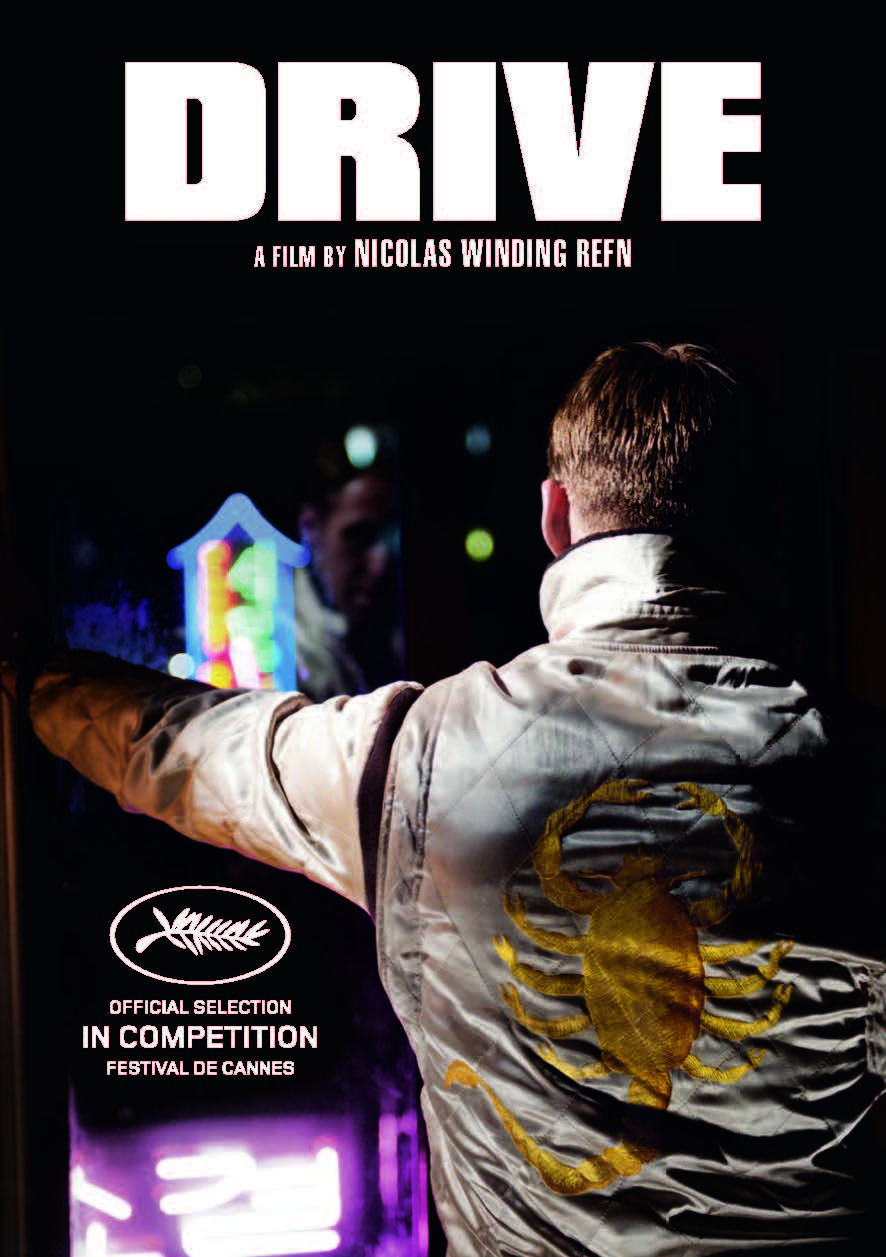


You know the story. Scorpion needs to make it over the river so he tries to hitch a ride on top of a frog. Frog is afraid scorpion will sting him. Scorpion explains that if he did that they would both drown. So frog ferries scorpion along and wouldn't you know it, just before they reach land scorpion stings him in the back, dooming them both. Frog asks why scorpion would pull that shit, to which scorpion responds, "that is my nature." The question of human nature is what Drive is all about: are individuals predisposed to behave by a certain irreversible nature? Are they predisposed to conflicting drives struggling for dominance? Are they able to transcend or change their nature? Can they transform or elevate themselves by embracing their drives? Are people capable of understanding or recognizing what they even are? Can we be a real human being and a real hero? It's a regular Jodorowsky, this one.

There's a great scene that perfectly sums up the question Drive poses. The Driver and Benicio are watching a cartoon together early in the film, and Driver asks the boy if a shark in the cartoon is the bad guy.  Benicio says yes. "How can you tell he’s the bad guy?," Driver asks. "He’s a shark," the boy casually rationalizes. The Driver inquires, "Are all sharks bad?" and the young child nods his head. The scene could easily be (read: IS) referring to a number of characters in the movie, the most obvious being the Driver himself. It's also referencing Benicio's father, whom the audience is predisposed to hate until he actually appears onscreen and turns out to be a great person thrown into awful, inescapable circumstances. And to Driver's mentor (his Alfred, if you will), Shannon, another good guy who makes a bad choice that leads to disastrous consequences. Perhaps even to the antagonist Bernie Rose, a ruthless mobster who seems to genuinely regret the measures he must take to protect himself. Are any of these people intrinsically good or bad? Are any of them conscious of their individual human natures, if they even exist? Are their actions and behavior, their drives, determined by innate, instinctive characteristics? At first glance the Driver seems to serve as a profound 'YES' to these questions, but that's the beauty behind his lack of backstory and dialogue. We have no idea what he's thinking or feeling or how his environment may have shaped him; he's a total mystery to us. He's Rorschach without the caption boxes telling us his thoughts.

Compelling stuff, no?

Believe it or not, this digression I've taken ties in perfectly to the superhero stuff I'm supposed to be talking about. But first we have to take one last detour. Remember at the end of Batman Begins, when Bruce and Rachel are talking at the ruins of Wayne Manor? Rachel feels up Bruce's face (if I'm remembering the scene correctly) and declares "This is your mask. Your real face is the one that criminals now fear. The man I loved, the man who vanished...he never came back at all." Well all that is obviously a load of bullshit; it's not a simple dichotomy between Bruce and Batman. Batman is clearly not his true persona, just as his actual voice isn't a constipated chain smoker's. The Batman identity is just as much a mask as millionaire playboy Bruce is, and although Rachel may think otherwise for some ill-defined reason, that is not the personality she is addressing right now. The real person behind these facades, the man you loved and you think vanished, is the one you're fucking talking face-to-face to you dumb bitch: the highly disciplined, driven, perceptive, introspective, resourceful and self-reliant Bruce Wayne. The man who has devoted his life to a higher ideal and uses "Batman" as a tool to realize it.


 Alright, now to get back on track. We're at the final lap, folks! To finish his transformation, the Driver dons a mask to hide his identity near the end of his origin story, completing his superhero costume. Crucially, the mask is taken from his day job, when the Driver needed to look like one of the actors for a car crash scene. It belongs in the realm of secret identity, not superhero. Drive knows better than Rachel, you see; it recognizes that a man's identity, his true nature, is much more nebulous than any clear-cut duality, especially between hero and secret identity. The entities are not so clearly defined - far from it - nor are they completely separate from one another. Perhaps there are elements of both in one another. Perhaps one morphs into the other. If human nature is an unanswerable question, than any attempts to explain it by ghettoizing its aspects into two definitive, opposite camps will ring as false as Rachel's half-baked analysis.

It's funny how similar the ending of Drive is to that of The Dark Knight; both have the protagonist speeding off into the darkness, with the screen cutting to black. The difference is that the ending to The Dark Knight is ominous, because by the picture's end Batman is not supposed to be a hero, while the ending of Drive is hopeful for the opposite reason. We started out with a man without any drive and saw him self-actualize. We saw him fall in love, transcend and become a real hero.

If Drive is any indication, we may soon be seeing a comparable transformation in the superhero film genre. I was once afraid that in the near future the superhero flick would over-saturate the market and go the way of the Western, that the genre would devour itself as people flocked away from the same formulaic origin stories over and over again. We saw a hint of that this summer: Thor, X-Men: First Class and Captain America all did very, very well at the box office (not so much Green Lantern), but they nevertheless failed to meet studio expectations by a great deal. There was no Iron Man among this crop of new franchises, and the only one to come even somewhat close was the first released. In light of seeing the formula applied with such ingenuity and unconventionality in Drive, I'm now confident that the superhero movie will not just survive, but will thrive in ways we have now only begun to see as it is freed from the constraints that once bound it. Yeah, the superhero movie will be fine.

It's just the superhero comic book movies that are gonna be fucked.

Wednesday, July 27, 2011

At Da Moofies: Captain America: The First Avenger: Killing Nazis is the New Postmodern

COLON COLON COLON COLON COLON


Ahem.

With the final tent-pole in the Marvel Cinematic Universe secured at last, we here at the Junction figure it's about time we posted our thoughts on the summer of superheroes. In the next few articles, prooker and I - and hopefully a guest blogger or two - will be taking on Thor, X-Men: First Class, Green Lantern and Captain America: The First Avenger. Here I'll share my thoughts on the last of the bunch. Spoilers and such.

When I left the theater, my first impression was that Captain America was really cool to look at and really stupid. Now it definitely has some things going for it, namely Chris Evans, whose sincere performance makes Cap easily the most compelling hero we've seen in a while. The kid's got heart. The special effects and retro production design are also exceedingly well done, and Alan Silvestri provides the first truly iconic superhero film score since Spider-Man. The whole operation is charming in its straightforwardness, exuding an anachronistic optimism, earnest simplicity and joy that, at first glance, seems refreshing.

But being refreshing isn't a good thing when it hearkens back to something done better countless times before. Not everything needs to be groundbreaking, but nothing should be derivative, which is exactly what The First Avenger initially appears to offer up. I for one would have rather seen the solemn Captain America of the comic books. Cap via Saving Private Ryan - a WWII movie with a superhero in it instead of a superhero movie in WWII. In my mind, it would have been more interesting to see a period piece that took advantage of the wartime setting, one of the things that sets our hero apart from the other A-listers: (now imagine this narrated by one of those 40s newsreel guys) entrenched in the horrors of world war, in the face of unspeakable hardship, Captain America - the embodiment of everything our nation stands for at its purest ideal - triumphs over the Red Skull's hateful nihilism and learns what it means not just to be a hero, but a leader and a symbol.

Eh? Eh?


The ideas and themes we see in The First Avenger, on the other hand, seem to be FUCK THAT SHIT LOOK AT LASERS BLOWING STUFF UP and HEY YOU GUYS LIKE IRON MAN RIGHT WELL HIS FUCKING DAD IS IN THIS AND HE'S A GODDAMN BALLER! For me, at least, this was a big letdown. The defining moments of Captain America's origin - the super-soldier serum, the deaths of Dr. Erskine and Bucky, his romance with Peggy Carter, his battlefield endeavors, his confrontations with the Red Skull - are treated as bullet points, superficially glossed over and then immediately forgotten. Cap's rationalization of the war - "I don't like bullies, I don't care where they're from" - is endearing but disappointingly childish. The film's moral framework, that the "little guys" are better people because they can appreciate power while the "big guys" can only take it for granted and abuse it (or, uh, something), is beyond wobbly from any standpoint. It's also contradicted in Thor. So there's that.

Any possibility of historical authenticity or of ANY meaningful statement inherent to the material - about war, obedience, loyalty, comradeship, honor, freedom, oppression, discrimination, life in the 40s, the list goes on and on - is thrown out the window for the sake of appeasement. Unlike other WWII movies, Captain America conveniently sidesteps the unsavory side of the times. Which is to say, all of it; to my knowledge it's the only film set in the European theater where ne'er even a swastika is seen. Writers Christopher Markus and Stephen McFeely choose to play it safe with the potentially controversial subject matter, striving to deliver little more than a light, accessible adventure flick: competent weekend entertainment to be mass-consumed, enjoyed and forgotten. I was surprised by how mechanical the entire thing felt, even with Chris Evans doing his best to make everything recognizably human. It's clear that the writers intended Captain America to exist, like Iron Man 2, solely as a set-up for The Avengers. Maybe the subtitle gave it away...

Luckily for us, director Joe Johnston doesn't settle.


Eventually I realized that my main beef with The First Avenger was simply that it wasn't the Captain America movie I wanted to see. What I wanted was a film about Captain America, a film that explored the entirety of his mythos - the depth of his psychology, the magnitude of his friendships, the gravity of his rivalries, and perhaps most importantly his unique status as comicdom's premiere period superhero. Only after I accepted that the movie isn't at all concerned with the Captain America story itself did I realize just how smart it really is. First impressions, after all, are more often than not deceiving.

With Captain America: The First Avenger, Johnston has created the first superhero metafilm; he uses the rich mythology and iconography of Captain America not as the heart of his movie (as nearly all other superhero flicks do) but instead as a broad framework to comment on the adventure film genre itself. A simple, unabashedly old-fashioned adventure story that's actually about adventure stories - their defining characteristics, their development throughout cinema history, their intrinsic meaning to audiences. While it's too bad that Cap's great mythos had to be compromised in the process, in this light it was clearly the best choice for the statement Johnston adapts it to make. After all, what's more American than the good ol' swashbuckling adventure movie?

So let's take a look at what's going on between the lines here. Captain America doesn't try at all to hide its stylistic inspiration: Raiders of the Lost Ark, the archetypal adventure film, itself heavily indebted to the pulpy film serials of the 30s and 40s. Like Spielberg, Johnston avoids grounding his picture as a period piece and instead creates the same feeling of timelessness that pervades Raiders. In addition, many of the tropes that define the Raiders plot have direct analogues in The First Avenger, such as the Ark of the Covenant finding a counterpart in the Cosmic Cube. Or Tesseract. Whatever. What makes all this important is that, despite quite obviously aping the retro style and conventions of Raiders, Johnston's feature retains its own character, what with the whole superhero origin story thing and all. In doing so, Captain America establishes a slick, self-referential genre savviness that only increases as the picture goes on - a sort of mission statement toward its exploration of the adventure film's nature, evolution and importance.


The picture begins with sickly, 90-pound weakling Steve Rogers being rejected yet again for military service. All the poor guy wants to do is join his brothers in arms against the Axis; Rogers is so determined to fight the good fight that by now he's attempted to enlist five times. Utterly defeated, Rogers seeks solace at the movies, where he watches a newsreel - the kind that played alongside Buck Rogers or any of the hundreds of other adventure serials during Hollywood's golden age - showing our boys at the German front. Inspired by what he sees, Rogers tries once again. Except this time, he's accepted! Here Johnston presents the New Deal/WWII-era "Saturday at the Movies" - where the serial and adventure feature reached the height of their popularity - as an empowering, even transformative experience. The genre in this early stage, with its prevailing sense of wonder, hope and optimism and its thematic stock in overcoming impossible odds is a vehicle for positively informing our own lives and inspiring us into positive action.

We soon move ahead to the Red Skull's origin, relayed to Steve by Dr. Erskine. A montage, the first of many, depicts the story as Erskine narrates, but it's not the kind we're used to. Multiple images, both literal and symbolic, are layered over one another, fading in and out in an indistinct, dream-like state. This montage is modeled after the prevailing style during the golden age of Hollywood, an adventure flick staple pioneered by Slavko Vorkapich throughout the 1930s. By employing Vorkapich's method, Johnston firmly anchors this section of Captain America in the serial/adventure aesthetic and its associated values.

The genre would continue more or less unchanged for the next few decades. It did, however, gain new tropes, additions reflected in Captain America as the narrative continues. The first big, catalyzing point in the picture's midsection - the rescue mission and subsequent "forming a team" scenes - are derived from elements popularized in 1960s war adventure films, most notably The Guns of Navarone, The Longest Day, The Great Escape, The Dirty Dozen and Where Eagles Dare. The scenes are certainly unlike anything we've previously seen in The First Avenger, but stylistically they blend in well with what came before.

It won't stay like that for long.


You see, by this same period in the 60s the Vorkapich montage that was once so prevalent had all but vanished in American cinema. The modern montage sequence - the really clichéd kind we're all too familiar with - proliferated during the 70s, the same time when Star Wars ushered in a new Renaissance for the adventure movie genre. Johnston uses this popular method for Captain America's last montage, and just as the first established a specific guiding aesthetic, so too does this one. The sequence portrays Cap, along with Bucky and the Howling Commandos, raiding numerous HYDRA bases as the war progresses toward its end. It's a really jarring, unsuspected moment that can't help but pull you out of the experience.

It is also, accordingly, a signifier of complete stylistic change. It indicates that we have now moved on to a different era in the genre's history, from its pulpy origins in the 30s-40s to its 70s-80s resurgence. It's a difference you can see and feel everywhere in Captain America's last half hour. We finally get some genuine emotional depth via Steve and Peggy's final farewell. The Red Skull's stock villain antics finally become an immediate threat as he prepares to bomb each major American city. His techno-armored HYDRA minions, before depicted one at a time, are now shown en masse, marching through Death Star-like corridors - what once appeared as lone anomalies out of Flash Gordon or King of the Rocket Men now has the character of the Imperial Stormtroopers. In the Star Wars franchise, they were an analogue to the Nazis; here, they ARE the Nazis. Of course in the comics HYDRA was a stand-in for Communism, but, y'know, whatever works. Now back on topic. The film's technology, which before had a retro Sky Captain-style flair, now seems like it was salvaged from Alderaan. There's even a Wilhelm scream and a motorcycle chase that directly pays homage to Return of the Jedi; this last half hour of Captain America explicitly suggests a deep familiarity with the mechanics of the genre - not as a rehash of its formula so much as a modern re-appropriation.

It all adds up to an effective portrayal of the 70s-80s adventure boom's defining elements, and what made those movies so popular. The production side was marked by technological advancement as well as a nostalgic but objective understanding of genre history and iconography, a combination that allowed the finished products to finally achieve a visual scope their stories necessitated. The stories themselves placed greater emphasis on the protagonists and the enormity of their tasks. This generation of movies was even more wide-eyed, but no longer as light-hearted; now something we had reason to care about was palpably at stake. They were still joyously fantastical enough to inspire people, while remaining grounded in truth enough for people to believe in them as more than mere escapement.


That self-referential genre familiarity I keep talking about makes itself apparent in the film's final battle. Long story short, the Red Skull tries to physically handle the Cosmic Cube...and, predictably, is promptly disintegrated. It's kind of a gaping plot hole. Throughout the film the Red Skull has been established as the world's foremost expert on this thing. It has shown him handling the cube with containers and robot grabber claw things, but never with his own hands; he knows damn well that if he touches it he's gonna explode or something. But here, nevertheless, he does. Because that is how adventure movies work. The villain must be destroyed by the very MacGuffin he has set out to harness - it's the Ark of the Covenant and the Holy Grail and R2-D2's Death Star plans. So the Red Skull has to touch that cube and blast into aether simply because he's fated to by virtue of genre. Here it's worth noting that in the film the Cosmic Cube is an object from Norse mythology, which is marked by an overwhelming, pervasive sense of predestination. The Gods and mortals in Norse myths know exactly how it's all going to end, and most of their actions are motivated by a belief in that action's own inevitability. Take note, Johann: life is tough when it's prophesied by Norns, valkyries and the Edda. Bitch.

There's still one thing left to talk about, and it's probably the best thing about Captain America. In between the Red Skull's origin and Howling Commandos FUCK YEAH sequences there is a middle montage, showcasing Cap's time as a government marketing tool. Aside from being an extremely clever and well-executed sequence with an INSANELY catchy Alan Menken tune (all that was missing was this), it's also one of the most important pieces of the movie's overriding statement. The montage features Cap promoting war bonds on a USO national tour, starring in a popular Republic film serial, and having his image mass-marketed in an eponymous comic book. It's already an extremely meta five minutes, as the character did star in a popular Republic serial and the comic books featured are replicas of Captain America Comics #1 (which here in the real world came out before the movie takes place, but again, details). I think it goes even further, though. The sequence seems to be an analysis of the way entertainment industry companies treat their iconic or breakout characters, such as Marvel Studios' attitude toward Captain America: not as a fully realized individual, but as a brand. A multimedia franchise to be marketed and commercially expanded (exploited?) across a variety of different platforms, held together by a broad, vague junction of definitive features and symbols. This montage shows us the franchise in all its outrageous, 20th century glory.

But the times, they are a changin'. And the old media hasn't caught up. After waking up from his almost 70 year slumber and rampaging through SHIELD security in the film's epilogue, Cap stands, utterly bewildered, in the middle of 2011 Times Square. Poor Steve is a man out of time and he has no idea what to do. The nature of the franchise has changed drastically from what he's familiar with, and the Marvel Cinematic Universe is paving the way; now instead of just having his own film (serial or otherwise), Captain America is expected to hobnob with superheroes from others. Once isolated franchises and brands now co-mingle with each other in a dizzying web of shared continuity and box office receipts. While that's great and all, this is an epilogue of the bittersweet variety. It's saying that the old ways are on their way out of Hollywood, among them the old-fashioned adventure flick. Much like Steve's own standing in this new and unfamiliar world, the future of the genre is uncertain, to say the least. It's going to be a long, arduous uphill battle both for Steve and the pictures he represents. We had Jurassic Park in '93 and Pirates of the Caribbean in '03. Those are both amazing movies, no doubt, but they didn't start a zeitgeist. When will the next adventure phenomenon come around?

Don't any one of you fuckers dare think Avatar. Takes more than swinging through space jungles to meet the genre classification. A goddamn story, for starters.

Above all, Captain America: The First Avenger seems to be saying, "hey, these kinds of movies are important to all of us - they're as much a part of our cultural identity as apple pie and childhood obesity - and unless we do something they could be gone forever." Conveniently enough, that something just happens to be seeing Captain America: The First Avenger.

So what are you waiting for?

Monday, March 21, 2011

Rules of Carnage

In my last Spidey villain article - which I'm not too happy with but whatever, read it for the lulzy vid in the intro - I briefly touched on the idea of the Sandman as a horror monster. It started to get me thinking about the other A-list monster foes that plague Spider-Man. Venom and the Lizard are pretty foolproof characters whose thematic appeal is obvious; I don't see any inherent conceptual problems that need to be worked out like with the Sandman, Electro and Mysterio (Part I, Part II). You can still expect a Lizard article eventually since he's my favesies and is gonna be the big bad for the new Spidey flick, but with those two rogues being so obviously sound there's only one real A-list monster villain left. One that could really use a hand these days.

Yup, Carnage, that exemplar of 90s comics excess. He managed to weasel his way into the highest echelons of the Spider-Man villain community by coasting on fan-favoritism and to this day he remains easily the most controversial of web-head's foes. A lot of people, mostly younger kids and folks who were younger kids in the 90s, really love the guy. He's stronger than Venom! He's crazy! He kills people and writes "Carnage Rules" in their blood! He's got fangs and claws and is scary and can morph his arms into swords and stuff!

A lot of other people, mostly the older, more mature readers, really hate the guy. He's derivative! He's creatively bankrupt! He's insipid, has no character, no intrinsic meaning or value! He's a shining example of everything wrong with the mindlessly ultra-violent superhero comics of his golden age!

Me? I remember as a little kid I thought he was so freakin' kool. For the yung'uns who can't remember, this guy was HUGE in the 90s. He was everywhere, probably just as overexposed as Wolverine and Venom were, maybe for a while even more. He was the star of a sweet-ass Sega Genesis game I would always play at my friend's house. I don't know how popular he is today - I get the feeling that the negative opinion of him is the norm now, if only because that's my opinion of him now - but regardless of how poorly-conceived the character may be, Carnage's position is secured. For better or for worse, he's definitely top 10 web-slinger villains material.

Wouldn't it be great, then, if he could actually be made interesting? If he could be re-assembled into a proper foe worthy of Spider-Man while retaining and expanding what little personality is already there?

Ah, but he can be! And it's not as difficult as you might think. Carnage was conceived and pitched as the Joker (or a caricature of the Joker) with a symbiote. To make Carnage a worthwhile enemy, all we have to do is take the symbiote off the Clown Prince of Crime and stick it onto Doctor Hurt.

What, you don't know who Doctor Hurt is? Go out and buy (who am I kidding, pirate) Grant Morrison's recent Batman epic. Some parts are better than others, but it's unquestionably the most innovative interpretation of Batman and his mythos since Frank Miller made him dark again in the mid-80s. And it gave us hands-down the greatest new supervillain of the 21st century. In the saga, Doctor Hurt and his legion of allies attempt to break down the World's Greatest Detective in body, mind and spirit, to unravel his mythology at the seams and annihilate him at the core conceptual level. "Twist and destroy the Batman and his legacy." It was Batman deconstructed to the brink of the abyss as his entire reality crumbled away, then reconstructed as the Dark Knight looked evil's greatest plan straight in the eye, kicked its fucking ass and stood triumphantly validated. Beautiful, inspirational stuff.


Spider-Man's never been properly deconstructed, let alone reconstructed in this way. The closest thing we've had was that Morlun saga by J. Michael Straczynski. It's a good read (JMS hadn't yet jumped the shark at that point) but the profound realizations the story explored basically amounted to "hey, all of these guys are themed after animals" and "eww, a kid with spider powers is actually really gross." It's a damn shame Spidey's never been put through deconstruction, because he's up there with the Caped Crusader as one of the most inspirational comics heroes (definitely not aspirational though, it would suck to be that guy), and because that mode of storytelling is such a natural fit for the genre. Stripping the character and the surrounding mythology, its symbols and milestones, down to pure idea, pure concept. Pure icon. Working out the representational metonymy we all find so compelling to its foundational, universally appealing core. And, since the hero-as-idea is (or at least should be) right, to then reconstruct it: to affirm the fundamental truth behind the concept and build it back up anew.

The physical and psychological agonies inflicted upon Peter is one of the Spider-Man comics' defining features, so it's strange that this has never extended to existential agonies. Obviously these come in spades in deconstruction tales. I mean, I guess there was existential agony in One More Day, but that ended up wrong. Spidey fell, succumbed to the pressure and compromised his values: he made a deal with the Devil in order to play God. The whole affair was very un-Spider-Man. So now we have a hero in need of great redemption, and Carnage, being the most explicitly demonic villain in his rogues gallery, can fill this necessary void. "The hole in things."

Oh oh oh wait, here's a more accessible analogy to tie you down while that Batman torrent finishes downloading: instead of being modeled after slasher flick bad guys, Carnage should take after the Universal monsters. And not just because I've been obsessed with them since I saw Abbott and Costello Meet Frankenstein when I was three years old.

To rid Carnage of his reputation as a derivative, insipid, valueless character, we need to inject some atmosphere into his stories, like the kind we see in all those great old monster flicks. But we have to derive it from something that already exists in the character or else we can't call the end result Carnage, can we? Good thing we've got everything we need. Carnage is very interesting in that he's one of the only comic book characters with an explicit philosophical leaning: absurdism. The school of thought is closely related to existentialism as well as nihilism, and asserts that if there is an inherent meaning or value in life/the universe, there is no way humanity can ever know it. One must learn to accept this human impossibility - the Absurd - and continue to live in spite of it; doing so totally frees the individual from all constraints and allows one to create personal meaning in their own life.


For Cletus Kasady, this constructed meaning came in the form of a calling to mass murder, because...umm....that's what cool villains do, I guess. Remember, we're talking about 90s superhero comics here, so Carnage's absurdist philosophy manifests in such gems as "Life is utterly meaningless! Chaos! The universe has no center! Its creator is a drooling idiot!" and "Order's just a lie, built on fantasies...like law, an' morals! I remember when I first realized that! How without those illusions, I could do anything!" and "Life is totally absurd – and madness is the only sane response." In just three lines I think Cletus has laid out every single cliché of supervillain cod-philosophy. So as you can see he's kind of a neophyte moron, expressing a pathetically bastardized/simplified version of the ideology to justify dumb senseless murder. We're not exactly having a dialogue with Kierkegaard or Camus, here. And, in my opinion, that's the problem.

Spidey has no shortage of dimwitted foes, and most of the intelligent ones are of the left-brained bookworm variety - all mad scientists and corrupt businessman. So why don't we make Carnage someone actually well-acquainted with the tenets of absurdism, someone with an intimate knowledge of philosophy? Give him the characteristics of a Universal monster - all Gothic horror veneer, deadly sophistication belying evil, deranged obsession. A person of culture, perhaps an intellectual or academic. The kind of creepy aristocratic guy who listens to Shostakovich on an old victrola and gets orchestra seats to Mefistofele at the Met. The kind of guy who reclines in his giant, bookshelf-lined study and calculates cryptic diabolical plans amidst the shadows. Less Freddy Kruger, more Dracula or Imhotep or Dr. Frankenstein (or Hannibal Lecter).

There's also another quality to these Universal monster movies that can help us grasp Carnage's endgame. People complain nonstop about how the Twilight films are ruining vampires and werewolves, how the movies are messing with the established mythologies of all these great monster archetypes by essentially making up their own rules. As a fan of all the classic monster movies I can see where these detractors are coming from, but here's the thing they don't realize: those great films took just as many - if not more - liberties with the actual mythology as the Twilight movies do today. Almost everything we think we know about these monsters is wrong, coming not from the actual myths, legends and folklore, but from the films based on them. If you go back to the source material, you'll find a very different picture of these creatures, one that might actually be closer to what we see in Twilight (purely by coincidence, because I'm sure as shit Stephanie Meyers didn't research any of this, and I haven't even seen the movies so I could be way off). I mean Christ, vampires didn't even have an aversion to sunlight until Nosferatu in 1922; even in the novel Dracula only 25 years earlier, the titular character dicks around in broad daylight all the time. And don't even get me started on werewolves, literally over half that shit we think of was made up in either Werewolf of London or The Wolf Man. Weakness to silver? Become a werewolf after being bit by one? Forced transformation specifically under a full moon? None of that exists in the source material.

I guess you could argue that these monster flicks should be considered part of the mythology and its natural evolution over time, but then Twilight - as infuriatingly unconcerned as it may be with producing quality interpretations of these archetypes - should have just as much a right to be a part of it as any other film. And besides, that would be like saying it's okay to change the comics so Peter had organic web-shooters all along, because that's how it was in the first Spider-Man film (Marvel actually did that for a while right after it came out and people flipped a shit). You know how angry we Spidey fans get when people who only know him from the movies think that's how Spider-Man actually is? It's the same deal, guys. So hate Twilight because it's poorly written, directed and acted, not because its vampires sparkle.

To relate this massive digression back to what I'm supposed to be talking about, this same idea of uprooting and corrupting the established mythology should be what Carnage is all about. Because really, what else would cause a superhero more carnage? As much as we like to try with psychology, myth is the only thing that adequately explains any of the stuff we see in comics. The mythology that makes up a hero is more than their personal oaths, creeds and world views - they are universal ideas predicated on a world with inherent significance. Superheroes - at least the iconic ones - are literally defined by the mythos surrounding them, it's the fabric that holds them together. What would it make Batman if Thomas Wayne faked his death to cover up a secret life of debauchery? The entire foundation behind "Batman," the reasons behind this mission Bruce has literally devoted his entire life to, would be utterly compromised. The ideology holding Batman together would fall apart, he would be forced to succumb to the Absurd as his entire world came crashing down on him. Probably end up a mad raving loon in Arkham...or dead in Crime Alley.

Carnage's assault should attempt to infect Spidey's mythology like a devastating virus: he would distort it with misinformation and wickedness into something of his own malevolent design, then peel back the decaying layers to reveal falseness behind any pretensions of importance or value. To rip apart Peter's very soul. "Ah, demoniacal madness!" Every important, hell, every event in his life predetermined as part of some behind-the-scenes plan decades in the making. "Spider-Man" and the reasoning behind it entirely rooted in deceit, "With great power there must also come --- great responsibility!" as a hollow dogma, Peter's decision to become a crime-fighter a meaningless, preordained exercise designed to assure his own destruction (Spider-Man as Peter's archenemy is always juicy, no matter how much it's overused). The radioactive spider was planted, Uncle Ben's murder was a hit, Gwen was a fall guy (HURR DURR), Aunt May is a deviant, Carnage is Richard Parker, etc. All elaborate lies - actually changing the established mythology would defeat the purpose - expertly-orchestrated to destroy the very essence of Spider-Man. Character assassination on a mythic scale, fatally undermining Peter's entire ideology and moral foundation. Carnage should instigate devastating mind games and unending gauntlets that challenge Spidey in ways he simply doesn't know how to deal with, all the while hissing, "Every moment of joy and happiness in your life, all your memories, lies! Your history is MINE!" And Peter, being the paranoid guy he is, would completely buy into the conspiracy theory. Little Puny Parker all alone against the void.

Now isn't all this so much more interesting than some grungy psycho who writes his name in blood? It's definitely a story I'd want to read. Hell, it's a story I'd want to write.

God I wish I wrote comics so bad...

But despite all the gloom and doom, there will be none of that One More Day shit going on here; he'll go through a hell worse than anything he's ever experienced before, but the ol' wall-crawler will come out on top in the end. Because Spider-Man the idea does have intrinsic value. Because Spider-Man is not Absurd. Because Spider-Man can take it, he can endure deconstruction. As I've said again and again, one of the most important things Spider-Man represents is fortitude in the face of seemingly unending hardship. Humanity's capacity to be indefatigable and have steadfast faith in a better future: life sucks now, but it can get so much better as long as we don't let it beat us down, as long as we work towards improving it and keep our hope alive. Carnage's motivation is clear: he has to snuff out this hope as a symbolic and literal victory on his way to engulfing the world in darkness. In the "gentle indifference" of absurdism. He's already won over Spidey's stomping grounds - this is the postmodern NYC, all unyielding cynicism and unhelpful sneering irony! Who does this freak think he is, swinging around giving people a reason to be sincere? Carnage must destroy Spider-Man because, by virtue of his very existence, our hero invalidates everything his foe very consciously represents. This town's not big enough for two big ideas.

Too bad for Carnage, the immovable object is right there in our champion's name - Peter, derived from the Greek word petros meaning stone or rock, and Parker for, well, something parked firmly in place. Spidey tells us we can't let life's apparent indifference crush our spirits, because under that one nasty surface layer - the breakups, awful workloads, financial straits, that shitty Friday night that left you a pathetic sniveling train wreck - life's a beautiful, inspiring, amazing thing. Ebb and flow. We all go through rough patches once in a while, that's why we have family and friends and our own inner life. If you're not at least trying to be a forward-thinking optimist, what's the fucking point of it all? That's certainly what keeps Spidey going; unlike Carnage, he knows that life isn't a black hole - it's a bunch of lights at the ends of tunnels.

So now that we've figured out the man inside the costume, let's finish up by taking a look at the symbiote itself. I guess the big thing here is that it's a more X-TREEM version of Venom. The villainous symbiotes are pretty obvious addictive drug metaphors (keeping in the Marvel framework of social activism in the face of ambivalence) but if Venom is da crack rock, Carnage is fucking PCP. The Venom symbiote will eventually try to assert its rage-filled sovereignty over its host, but it seems above all self-interested, for a while even taking a stab at a true symbiotic relationship. When it first bonds it seems to compromise, contouring to the body shape and skin of its host. It wants to use that body, not use it up.

The Carnage symbiote, on the other hand, still retains its goopy alien texture after bonding - it's much more domineering, controlling and aggressive. It's reckless, couldn't concern itself less with it's own well-being, completely foregone in its passion for destruction and chaotic revelry. It seeks to consume the host much more quickly, and the end result looks like a revenant flayed alive oozing fresh blood everywhere. This juxtaposition of monster and man, of life and death reveals the Carnage symbiote's overtly parasitic nature. It should sap the nutrients from its host, wither him away even as it empowers him with superhuman abilities. It should leave the host reduced to a bald emaciated skeleton, like the people in those hard-to-bear images of Holocaust victims and early AIDS patients (symbolism for the latter is already there in the character: Carnage was created when the Venom symbiote entered an open wound and mixed with Cletus Kasady's blood). And it should of course warp the mind just as badly, leaving the host a mad, babbling lunatic foaming at the mouth with macabre apocalyptic delusions. There would be a great irony at work here: Carnage attempting to break Spider-Man down to his fundamental core while the symbiote did the same to Carnage, stripping away the facade of suave, calculating sophistication to reveal the base, raving insanity and violently demonic obsession that drives him in his purest form.

Cletus Kasady could totally work if he was reshaped into something remotely believable, but I think it would be better to move the symbiote to a different host. Venom did just fine without Eddie Brock, after all. Carnage could be a priest or a demon or an occultist or a cultist or a crime lord or a Burglar or a master of disguise or a schizophrenic or a psychiatrist or a scientist or an old face back from the dead. He can be a Karloff or a Lugosi, or a Meursault. He can be any and all of these things; anything's better than what he is now, than Cletus the straw man psychopath. With the absurdism angle to ground him as a character, Carnage can take the Spidey books on an existential roller coaster to novel, wildly inventive territory. Like Doctor Hurt to Batman (that damn torrent better be finishing up) or the Universal monsters to the horror genre.


Maximum Carnage may be one of my least favorite stories in all superherodom, but I gotta say that cover is spot fuckin' on. The specter of Carnage maniacally leers - ready to pounce - above a superimposed Manhattan, like a poltergeist for the entire city. New York and sky above it scorched to eschatological blacks and reds, singed to be one with the symbiote's skin. It's Beelzebub rising atop his throne of skulls, ready to retake the city of sin in apocalyptic hellfire. And the only thing standing in his way is a single champion, one lone embodiment of everything worth saving. But how can ol' web-head defeat an enemy that can undo those very things our hero embodies?

The battle for New York's soul is at hand! No holds barred!

Carnage rules when the rules are carnage.